
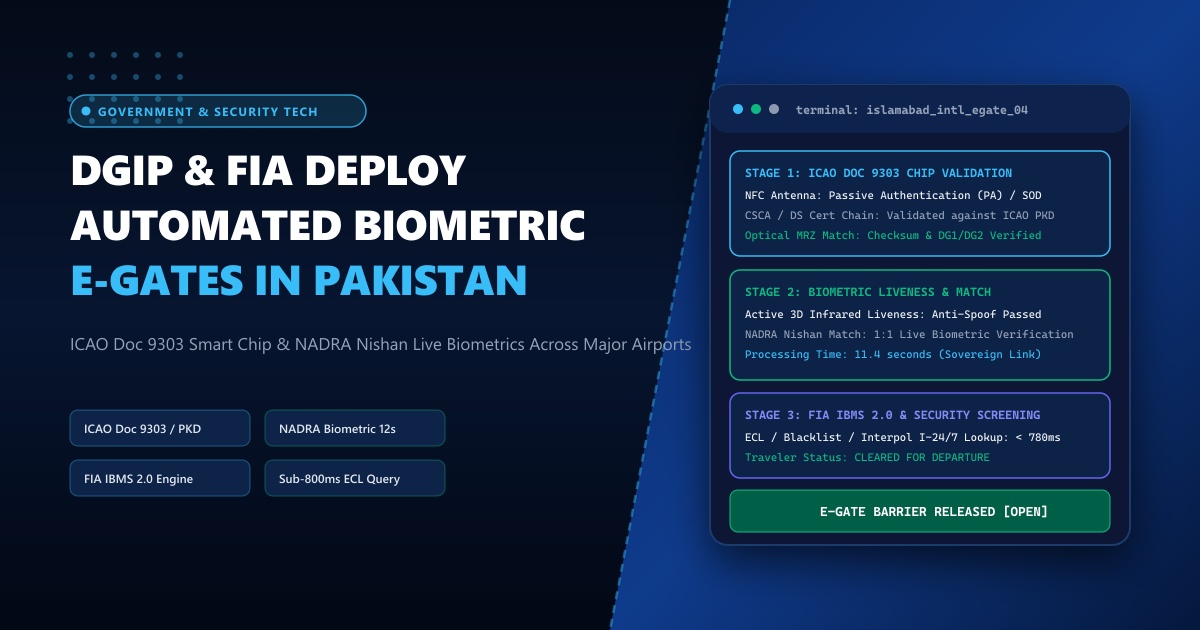
In a landmark milestone for national border security and aviation technology, the Directorate General of Immigration and Passports (DGIP), in joint operational execution with the Federal Investigation Agency (FIA) and the Pakistan Civil Aviation Authority (PCAA), has officially commissioned the National Automated Border Control (ABC) and Biometric E-Gate System 2026.
The operational deployment activates bank-grade automated biometric gates across Pakistan’s primary international gateways: Islamabad International Airport (IIAP), Allama Iqbal International Airport (AIIAP) in Lahore, and Jinnah International Airport (JIAP) in Karachi. Combining contactless near-field cryptographic reading of ICAO Doc 9303 e-Passports, active infrared 3D liveness facial telemetry, and sub-second matching against the National Database and Registration Authority (NADRA) identity grid, the automated gates reduce passenger border clearance times from over 45 minutes to under 12 seconds per traveler.
The Legacy Border Bottleneck: Human Inspection and Queue Latency
For decades, international border clearance across Pakistan’s international terminals relied on manual, paper-intensive processing. While international air traffic steadily expanded—exceeding tens of thousands of daily travelers across primary hubs—border processing at immigration counters operated under substantial friction:
- Manual Inspection and Physical Stamping: Immigration officers manually inspected passport pages, examined laminate watermarks under ultraviolet lamps, stamped physical visa endorsements, and entered traveler details by keyboard.
- Peak Flight Departure Congestion: During overlapping international departures—particularly late-night Gulf Cooperation Council (GCC) banks and transatlantic connections—queue wait times frequently ranged from 45 to 90 minutes.
- Manual Watchlist Queries: Cross-referencing passengers against the Exit Control List (ECL), the Provisional National Identification List (PNIL), and Interpol red notices required manual lookup queries against the legacy Integrated Border Management System (IBMS), creating systemic processing delays.
- Vulnerability to Impostor Substitution: Visual facial comparison between a live traveler and a laminated passport photograph is inherently constrained by human fatigue, making visual inspections vulnerable to sophisticated impostors and lookalike substitution fraud.
flowchart LR
subgraph Legacy_Process["Legacy Manual Border Clearance (45 to 90 Min Queues)"]
direction TB
A1["Passenger Queues at Counter"] --> A2["Physical Passport Handover"]
A2 --> A3["Manual Visual Inspection"]
A3 --> A4["Keyboard Data Entry"]
A4 --> A5["Manual IBMS / ECL Query"]
A5 --> A6["Physical Ink Passport Stamp"]
A6 --> A7["Manual Gate Barrier Release"]
end
subgraph EGate_Process["Automated Biometric E-Gate Clearance (< 12 Seconds)"]
direction TB
B1["Optical MRZ Read & NFC Smart Chip Cryptographic Auth"] --> B2["3D IR Facial Liveness Detection"]
B2 --> B3["NADRA Nishan 1:1 Live Biometric Validation"]
B3 --> B4["FIA IBMS 2.0 Sovereign Database Clearance (< 800ms)"]
B4 --> B5["Automated Pneumatic Glass Barrier Release"]
endThe introduction of the 2026 Automated E-Gate system replaces subjective human inspection with non-repudiable cryptographic validation and multi-spectral biometric verification.
E-Gate Technical Architecture and Hardware Specifications
The newly operationalized e-Gates consist of high-throughput automated physical security barriers manufactured with reinforced modular architectural glass and high-grade stainless steel casings. Each lane integrates four specialized hardware sub-systems operating in synchronized sequence.
flowchart TD
subgraph EGate_Lane["Automated Border Control (ABC) Gate Hardware Pipeline"]
direction TB
H1["Dual-Mode Optical Document Scanner<br/>(Full-Page White, IR 850nm, UV 365nm + MRZ Reader)"]
H2["High-Frequency NFC RFID Antenna Array<br/>(ISO/IEC 14443 Type A/B @ 13.56 MHz, 848 kbps)"]
H3["3D Stereoscopic Optical + Active Infrared (IR) Camera<br/>(ISO/IEC 30107-3 Presentation Attack Detection / PAD)"]
H4["Contactless Multi-Spectral Fingerprint Sensor<br/>(500 DPI Forensic Surface & Subdermal Imaging)"]
H5["Intelligent Interlocking Glass Flap Barrier<br/>(Integrated Tailgating & Luggage Intrusion Sensors)"]
H1 --> H2 --> H3 --> H4 --> H5
end1. Dual-Spectrum Optical Document Scanner
The scanner entry portal accommodates international passports, official travel documents, and Pakistani smart identity credentials:
- Optical Character Recognition (OCR): Reads the two-line or three-line Machine Readable Zone (MRZ) compliant with ICAO Doc 9303 (TD1 and TD3 formats) to extract the document number, holder nationality, date of birth, expiration date, and checksum digits.
- Multi-Illumination Forensic Imaging: Captures document imagery under three distinct light spectrums simultaneously: visible white light (400–700nm), infrared (850nm) to reveal anti-copy patterns, and ultraviolet (365nm) to verify fluorescent security threads, rainbow printing, and chemical watermarks.
2. Contactless NFC Cryptographic Antenna Array
Operating at 13.56 MHz compliant with ISO/IEC 14443 Type A and B standards, the high-throughput RFID antenna array establishes an encrypted communications channel with the traveler’s microchip:
- Baud Rates up to 848 kbps: Rapid payload extraction transfers high-resolution JPEG 2000 facial imagery and biometric minutiae templates from Data Group 1 (DG1) and Data Group 2 (DG2) in under 1.2 seconds.
- Basic Access Control (BAC) & Password Authenticated Connection Establishment (PACE): Utilizes cryptographic keys derived from the MRZ characters to unlock the chip securely, preventing eavesdropping or skimming in public airport spaces.
3. 3D Stereoscopic Facial Recognition and Active IR Liveness
Positioned at eye level with an automated motorized vertical tilt axis accommodating passengers between 120cm and 210cm in height:
- Presentation Attack Detection (PAD): Evaluated under ISO/IEC 30107-3 standards, the sensor combines structured infrared light projection with dual stereoscopic cameras to generate a millimeter-accurate 3D depth mesh of the traveler’s cranial structure.
- Anti-Spoofing Defense: Actively neutralizes presentation attacks, including 2D photographic paper cutouts, curved ultra-high-definition tablets, curved silicone prosthetic masks, and real-time generative video deepfakes.
- Ambient Lighting Invariance: The active 850nm infrared illumination ensures deterministic face acquisition unaffected by terminal glass reflections or shifts between day and night airport lighting.
4. Contactless Multi-Spectral Biometric Fingerprint Sensor
For secondary multi-factor verification when mandated by specific risk profiles:
- Captures high-definition 500 DPI ridge and valley topology both on the skin’s surface and through the subsurface capillary bed, ensuring valid biometric reads even with moist, dry, or worn fingertips.
Sovereign Cryptographic Infrastructure: CSCA, Document Signer, and ICAO PKD
The security of electronic passports does not rely merely on the presence of a microchip; it depends entirely on the unbroken chain of mathematical trust governing the digital certificates stored inside that chip.
flowchart TD
subgraph Cryptographic_Chain["DGIP Sovereign Public Key Infrastructure (PKI)"]
direction TB
CSCA["National Country Signing CA (CSCA)<br/>Offline Sovereign Root HSM (FIPS 140-3 Level 4)"]
DS["Document Signer (DS) Certificate<br/>Issued to DGIP Passport Personalization Facility"]
SOD["Security Object Document (SOD)<br/>Stored on e-Passport Microchip"]
PKD["ICAO Public Key Directory (PKD)<br/>Master List Synchronizer"]
CSCA -->|Signs Digital Certificate| DS
DS -->|Cryptographically Hashes & Signs| SOD
PKD -->|Distributes Foreign & National Public Keys| ABC_Engine["E-Gate Verification Engine (Terminal)"]
SOD -->|Transferred via NFC| ABC_Engine
endCryptographic Verification Pipeline
- Security Object Document (SOD) Validation: The traveler’s e-Passport contains a digitally signed CMS wrapper (
ef.sod) containing SHA-256 cryptographic hashes of all data groups (DG1 to DG16). - Passive Authentication (PA): The e-Gate verification engine reads the SOD and recalculates the SHA-256 hashes of the extracted facial image (DG2) and personal metadata (DG1). If a single pixel of the stored facial photo or a single character of the name has been altered, the calculated hash mismatches the SOD hash, triggering an immediate security lock.
- Document Signer (DS) and Country Signing CA (CSCA) Verification: The Document Signer certificate used to sign the SOD is validated against the national CSCA root certificate managed by DGIP inside an air-gapped, FIPS 140-3 Level 4 certified Hardware Security Module (HSM).
- ICAO Public Key Directory (PKD) Real-Time Synchronization: For foreign travelers holding international e-Passports, the e-Gate validation engine queries an automated local mirror of the ICAO Public Key Directory (PKD). The PKD is updated daily over sovereign cryptographic channels, allowing Pakistan’s border gates to verify the authenticity of passports issued by over 90 foreign nations without transmitting traveler data across borders.
Real-Time Integration: NADRA Nishan-e-Pakistan & FIA IBMS 2.0
Once the authenticity of the physical document and its internal microchip is cryptographically validated, the e-Gate connects directly into Pakistan’s domestic sovereign border intelligence grid:
sequenceDiagram
    autonumber
    actor Traveler
    participant Gate as Biometric E-Gate Lane
    participant IBMS as FIA IBMS 2.0 Gateway
    participant NADRA as NADRA Nishan Service Bus
    participant Watch as ECL / Interpol Database

    Traveler->>Gate: Scans e-Passport & Steps into Portal
    Gate->>Gate: Reads MRZ + NFC Passive Authentication (PA)
    Gate->>Gate: Captures 3D IR Face & Verifies Liveness
    Gate->>NADRA: Sends Live Biometric Minutiae + CNIC / NICOP Identifier
    NADRA-->>Gate: 1:1 Identity Confirmation Match (< 400ms)
    Gate->>IBMS: Submits Traveler Clearance Payload
    IBMS->>Watch: Parallel Query: ECL, PNIL, Interpol I-24/7 (< 380ms)
    Watch-->>IBMS: Zero Flag / Clean Security Record
    IBMS-->>Gate: Clearance Token Generated & Audit Logged
    Gate-->>Traveler: Retracts Glass Barrier (Green Indicator, Clearance Complete)
Sub-800ms Sovereign Database Clearance
To maintain an overall transit time under 12 seconds per passenger, backend database queries must execute with microsecond efficiency:
- FIA Integrated Border Management System (IBMS 2.0): Built on high-availability clustered architectures, IBMS 2.0 cross-references passenger travel history, visa conditions, flight manifests (APIS/PNR), and the Exit Control List (ECL).
- Deterministic Sub-800ms SLA: Multi-tier in-memory index caches guarantee that watch-list queries across millions of records execute in under 380ms, eliminating queue stalls.
- Instant Digital Stamping: Upon positive verification, the system registers an immutable digital departure or arrival record in IBMS 2.0, broadcasting the event to airlines and civil aviation authorities while generating an SMS/Pak-ID push notification to the registered citizen.
Technical Comparison: Legacy Counter vs. Automated Biometric E-Gate
| Evaluation Parameter | Legacy Manual Immigration Counter | Automated Biometric E-Gate (ABC 2026) |
|---|---|---|
| Average Processing Time | 45 to 90 seconds per traveler (excluding queue wait) | 8 to 12 seconds per traveler |
| Peak Queue Wait Duration | 45 to 90 minutes during hub bank flights | Less than 3 to 5 minutes |
| Document Authentication | Manual visual review + handheld UV lamp | ICAO Doc 9303 Optical MRZ + NFC Passive Authentication |
| Facial Verification | Subjective officer visual inspection | 3D IR Structured Light + ISO/IEC 30107-3 Liveness PAD |
| Biometric Match Source | None (or ad-hoc manual single-finger glass scan) | Live 1:1 match against NADRA Nishan 240M+ citizen ledger |
| Spoofing Resistance | Vulnerable to lookalike impostors & silicone prosthetics | Hardware 3D depth mapping neutralizes masks & deepfakes |
| Security Watchlist Query | Manual keyboard input into legacy terminal | Automated sub-800ms parallel query to ECL, PNIL & Interpol |
| Passport Physical Stamping | Physical wet-ink stamp consumes blank passport pages | 100% Paperless cryptographic digital entry/exit stamp |
| Operational Availability | Constrained by officer shift rotations & fatigue | 24/7 continuous operation with automated diagnostics |
| Audit Trail & Integrity | Paper counter registers & manual station logs | Digitally signed, RFC 3161 timestamped immutable audit logs |
The Infrastructure Imperative: Sovereign Low-Latency Bare-Metal Infrastructure
Deploying national automated border infrastructure demands computing platforms with unyielding reliability, deterministic real-time responsiveness, and strict data sovereignty.
Biometric data—encompassing 3D facial point clouds, multi-spectral fingerprint minutiae, and citizen identity registries—is categorized as Tier-1 Sovereign Critical Data under the Pakistan Cloud-First Policy 2.0. By federal mandate, this data is strictly prohibited from being processed, transferred, or routed through foreign multi-tenant public clouds.
flowchart LR
    subgraph Airport_Edge["Airport Edge Infrastructure (JIAP / AIIAP / IIAP)"]
        direction TB
        E1["E-Gate Controllers"] --> E2["Edge Cryptographic Hardware Security Modules"]
        E2 --> E3["Local Transit Buffer"]
    end

    subgraph Sovereign_Backbone["Dual-Redundant 10G Sovereign Dark Fiber Ring"]
        E3 <==>|"Low-Latency mTLS 1.3 Tunnel (< 3ms RTT)"| DC1
    end

    subgraph DataCenter["Domestic Tier-3 / Tier-4 Datacenter (Islamabad / Lahore / Karachi)"]
        direction TB
        DC1["Dual-Homed Dedicated Bare-Metal Servers"]
        DC2["IBMS 2.0 High-Availability Database Clustered Nodes"]
        DC3["NADRA Nishan Sovereign Cryptographic Gateway"]
        DC1 --- DC2 --- DC3
    end
Why Sovereign Dedicated Servers are Mission-Critical
- Sub-5ms Deterministic Network Latency: Real-time passenger processing limits the entire network trip budget between airport gate controllers and the national identity database to less than 15 milliseconds. High-performance Dedicated Servers connected over domestic fiber rings guarantee low jitter and prevent queue lockouts during peak flight arrival waves.
- Elimination of Hypervisor Noisy-Neighbor Contention: In multi-tenant cloud environments, virtualized workloads experience CPU throttling and I/O wait latency when neighboring instances execute compute-intensive batch jobs. High-throughput cryptographic operations (SHA-256 hash recalculation and RSA-4096 signature verification) require dedicated bare-metal execution pipelines.
- Hardware Security Module (HSM) Direct PCI-Passthrough: National Country Signing CA (CSCA) root keys and Document Signer keys must reside in dedicated, tamper-responsive HSM hardware directly interfaced with bare-metal host buses without hypervisor abstraction layers.
- Domestic Data Sovereignty Compliance: Hosting border control engines on Dedicated Servers in Pakistan guarantees full jurisdictional compliance with federal data protection laws, keeping citizen biometric records on sovereign soil.
Phase-Wise Rollout Roadmap: 2026 to 2027
The National Automated Border Control program follows a structured three-phase expansion:
flowchart TD
P1["Phase 1 (Operational - Q4 2026)<br/>Departure & Arrival E-Gates Live at Islamabad (IIAP), Lahore (AIIAP), and Karachi (JIAP)"]
P2["Phase 2 (Q1-Q2 2027)<br/>Expansion to Peshawar (Bacha Khan), Multan, and Faisalabad International Airports"]
P3["Phase 3 (Q3-Q4 2027)<br/>Land Border Automations at Torkham, Wagha, and Chaman Border Terminals"]
P1 --> P2 --> P3- Phase 1 (Active / Commissioned): Operationalization of 24 e-Gate lanes across Islamabad International, Allama Iqbal International (Lahore), and Jinnah International (Karachi), supporting Pakistani passport holders, overseas NICOP cards, and authorized digital business visa travelers.
- Phase 2 (Q1–Q2 2027): Deployment across regional international terminals, including Bacha Khan International (Peshawar), Multan International, and Faisalabad International, scaling total national e-Gate lanes to 64.
- Phase 3 (Q3–Q4 2027): Implementation of ruggedized automated vehicular and pedestrian border control e-Gates across Pakistan’s primary terrestrial border transit corridors, including Torkham, Wagha, and Chaman.
Related Technical Architecture & Security Guides
- MoITT & NITB Operationalize National Data Exchange Layer (NDEL) – In-depth review of Pakistan’s zero-trust sovereign API interconnect linking federal registries.
- NADRA Launches Nishan Pakistan Biometric e-KYC API Framework – Technical integration guide for instant identity authentication and face matching.
- Ministry of IT Unveils Cloud-First Policy 2.0: Sovereign Data Residency Mandate – Detailed analysis of sovereign data classification tiers and bare-metal hosting requirements.
- PTA Activates 100G PkIX Internet Exchange Mesh Across Lahore and Karachi – Domestic peering fabrics delivering deterministic low latency for sovereign services.
- Layer 7 DDoS Protection & Edge Defense for Enterprise Platforms in Pakistan – Safeguarding critical government and enterprise API gateways against volumetric cyber attacks.
Deploy Sovereign, Low-Latency Compute for Enterprise Security & Identity APIs
Comply with Pakistan's National Cloud-First Policy 2.0 and strict sovereign data protection directives. Nextgen Hosting delivers ultra-low-latency bare-metal servers, private cryptographic cloud enclaves, and sub-5ms domestic fiber interconnects housed within certified Tier-3 and Tier-4 carrier-neutral datacenters across Islamabad, Lahore, and Karachi.
Related News & Regulatory Updates
- Pakistan Launches National Cyber Security Incident Response Center (NCIRC)
- SBP Raast Cross-Border Remittance & Freelancer Settlement Rail
- National Cloud Sovereignty Act: Domestic Cloud Mandates Explained
- High-Performance Dedicated Bare-Metal Servers in Pakistan
- Enterprise Dedicated Compute and Scalable Infrastructure