
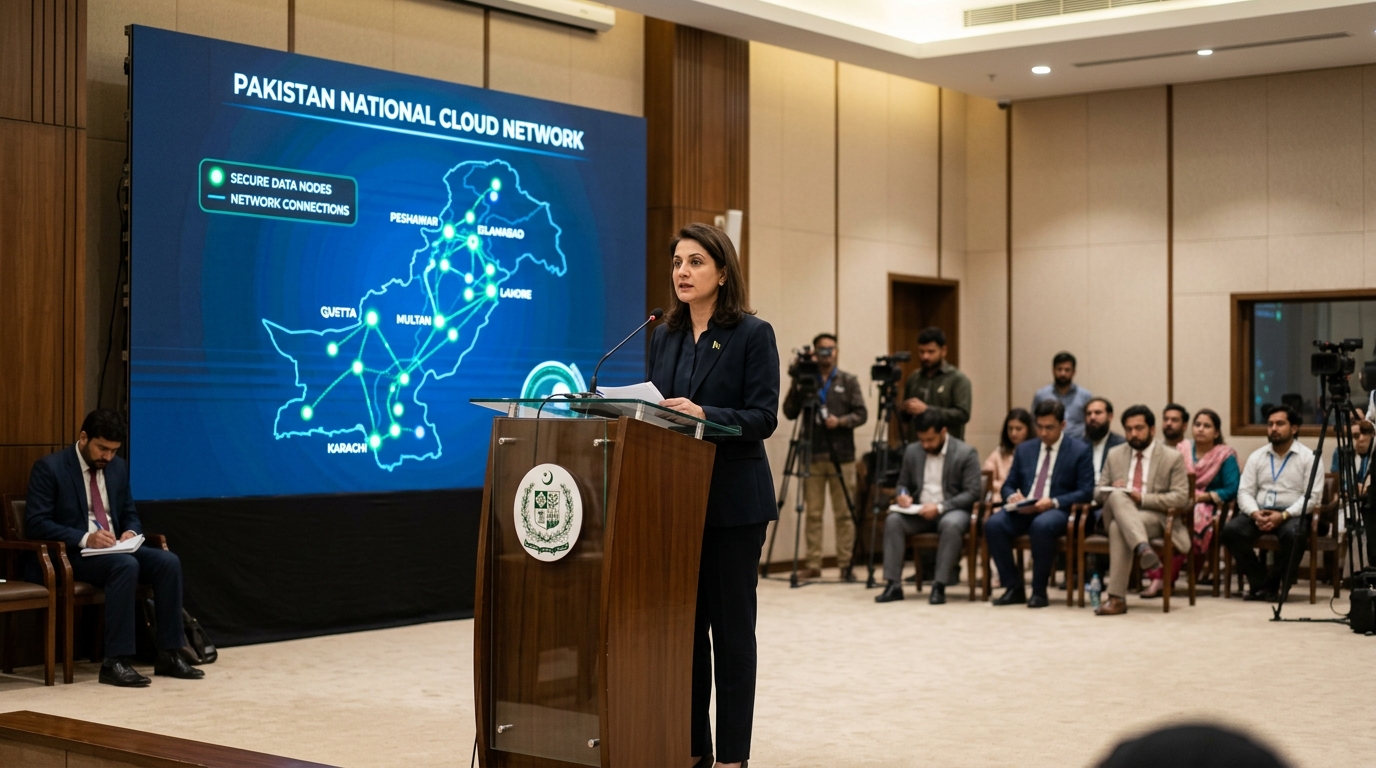
In a landmark regulatory milestone that fundamentally reshapes Pakistan’s enterprise technology landscape, the Ministry of Information Technology and Telecommunication (MoITT) has officially notified and operationalized Pakistan’s Cloud-First Policy 2.0. The comprehensive statutory directive establishes a mandatory sovereign data residency framework across all federal ministries, provincial line departments, autonomous public bodies, state-owned enterprises (SOEs), and regulated financial switches.
Under the new directive, government agencies and critical financial infrastructure operators are legally prohibited from hosting sensitive citizen records, core fiscal ledgers, and national telemetry on foreign public cloud regions. Concurrently, the policy establishes the National Cloud Accreditation Board (NCAB) to certify domestic cloud service providers (CSPs) and tier-standardized datacenters, while projecting an immediate national savings of over $350 million annually in foreign exchange previously expended on offshore hyperscaler subscriptions.
The Strategic Imperative: Digital Sovereignty Meets Macroeconomic Prudence
The transition from the exploratory 2022 framework to the enforceable Cloud-First Policy 2.0 reflects two urgent national priorities: technological sovereignty and macroeconomic stability.
Over the past decade, public sector entities, higher education commissions, and state-backed utilities routinely provisioned cloud workloads on foreign hyperscalers like Amazon Web Services (AWS), Microsoft Azure, and Google Cloud Platform (GCP). This practice introduced acute vulnerabilities:
- Jurisdictional and Legal Exposure: Foreign-hosted public sector workloads remain subject to extra-territorial data requests under legislation such as the United States CLOUD Act and European surveillance frameworks, depriving Pakistani courts and regulatory bodies of exclusive legal custody over national data assets.
- Foreign Exchange Depletion: Annual software-as-a-service (SaaS) and infrastructure-as-a-service (IaaS) subscriptions drained an estimated $350 million to $400 million in foreign currency reserves each fiscal year through dollar-denominated compute cycles, licensing fees, and bandwidth egress charges.
- Network Latency and Transit Inefficiencies: Routing domestic traffic through overseas regions (such as AWS
eu-central-1in Frankfurt orap-southeast-1in Singapore) introduced round-trip latencies of 110ms to 180ms for interactions that originated and terminated within Pakistan, degrading the responsiveness of citizen-facing public portals.
Cloud-First Policy 2.0 closes these regulatory and architectural gaps by mandating localized compute procurement and establishing an institutional mechanism for sovereign digital governance.
The Tri-Tier Sovereign Data Classification Framework
At the core of the newly notified policy is a strict, three-tiered taxonomy governing how institutional data must be categorized, encrypted, and physically domiciled.
flowchart TD
    DATA[Institutional Public & Financial Sector Data] --> CLASSIFY{MoITT Data Classification Engine}

    CLASSIFY -->|Public / Unrestricted| C1[Class 1: Public Data]
    CLASSIFY -->|Confidential / Citizen PII| C2[Class 2: Confidential Data]
    CLASSIFY -->|Secret / Critical Infrastructure| C3[Class 3: Secret & Critical National Data]

    subgraph Hosting_Requirements["Mandatory Hosting Architecture"]
        C1 --> H1[Accredited Commercial Clouds / Local or Hybrid]
        C2 --> H2[Certified Sovereign Domestic Cloud or Local Private Infrastructure]
        C3 --> H3[Physical Datacenters on Pakistani Soil / Air-Gapped Sovereign Compute]
    end

    subgraph Jurisdictional_Boundary["Territorial Boundary Verification"]
        H2 --> PK_BORDER[Strictly Within Pakistani Territory]
        H3 --> PK_BORDER
        PK_BORDER --> LOCAL_IXP[Direct Peering via PkIX & Domestic Fiber]
    end
Class 1: Public Data
- Scope: Published statistical reports, open academic research, public press releases, educational curricula, and non-sensitive informational portals.
- Hosting Mandate: Can reside on accredited domestic or international commercial cloud providers, provided data is encrypted in transit using TLS 1.3 and static assets are cached via recognized content delivery networks.
Class 2: Confidential Data
- Scope: Personally Identifiable Information (PII) of Pakistani citizens, internal ministry administrative communications, land revenue and property registration archives, provincial excise and taxation records, and corporate financial statements submitted to regulatory authorities.
- Hosting Mandate: Strict Domestic Residency. Must be physically hosted within accredited datacenters located inside the geographic boundaries of Pakistan. Offshore replication or mirror backups in foreign availability zones are explicitly forbidden under Section 8.4 of the policy.
Class 3: Secret and Critical National Data
- Scope: National identity and biometric records managed by the National Database and Registration Authority (NADRA), intelligence and defense networks, the State Bank of Pakistan’s core interbank settlement engines (Raast and PRISM), the 1LINK financial switch, the National Transmission & Despatch Company (NTDC) power SCADA telemetry, and telecom core signaling databases.
- Hosting Mandate: Absolute Sovereign Isolation. Must operate within dedicated, air-gapped, or cryptographically segregated bare-metal environments located in Tier-3 or Tier-4 government or certified commercial datacenters on Pakistani territory. Access keys must reside on hardware security modules (HSMs) manufactured and managed under direct sovereign jurisdiction.
The National Cloud Accreditation Board (NCAB): Certification and Enforcement
To operationalize compliance and avoid supplier monopolies, Cloud-First Policy 2.0 establishes the National Cloud Accreditation Board (NCAB). Operating under the joint stewardship of the National Information Technology Board (NITB) and the Pakistan Telecommunication Authority (PTA), with technical advisory from PKCERT and the National Cyber Incident Response Center (NCIRC), the NCAB serves as the sole licensing and compliance authority for domestic cloud providers.
| NCAB Level | Target Infrastructure | Core Technical Requirements | Eligible Workload Tiers |
|---|---|---|---|
| Level 1 | Standard Web Hosting & SaaS | ISO 27001 certification, local IP assignment, basic DDoS protection | Class 1 (Public Data Only) |
| Level 2 | Enterprise IaaS & Virtualization | Tier-3 facility design, SOC 2 Type II, 99.982% uptime SLA, local BGP peering via PkIX | Class 1 & Non-Critical Class 2 |
| Level 3 | Sovereign Cloud & High-Security Hosting | Hardware-level resource isolation, localized HSM key storage, TEMPEST-certified cages, dual-redundant power/cooling | Class 2 (Confidential PII & Financial Records) |
| Level 4 | Mission-Critical Sovereign Bare-Metal | Air-gapped physical enclaves, dedicated dark-fiber interconnects, sovereign background-checked operations staff, zero foreign hypervisor telemetry | Class 3 (National Defense, NADRA, Raast, SCADA) |
The NCAB has been granted statutory audit authority, conducting unannounced biannual physical inspections and continuous automated cryptographic verification of certified facilities. Service providers failing compliance reviews face immediate revocation of their accreditation and disqualification from public sector procurement tenders under Public Procurement Regulatory Authority (PPRA) rules.
Economic Dividends: Conserving $350M+ in Foreign Exchange Reserves
A primary catalyst driving Cloud-First Policy 2.0 is the fiscal strain imposed by offshore hyperscaler dependency. Historically, federal and provincial budgets allocated millions of dollars annually to international credit-card billing mechanisms or overseas telegraphic transfers to satisfy hyperscaler invoices.
Under the new mandate:
- Procurement Domiciliation: All compute, storage, and networking resources procured by public sector entities, universities, and state-backed enterprises must be billed and invoiced in Pakistani Rupees (PKR) through locally incorporated entities.
- Foreign Exchange Protection: The Ministry of Finance estimates that transitioning public sector and financial institution workloads to domestic cloud infrastructure will retain approximately $350 million to $420 million inside Pakistan’s domestic banking system annually.
- Domestic Datacenter Boom: The policy guarantees an anchor customer base for local infrastructure investments. This predictable demand is accelerating the development of multi-megawatt, green-powered datacenter parks across the Islamabad-Rawalpindi corridor, Lahore, and Karachi.
Architectural Migration: The Shift to Domestic Bare-Metal and Sovereign Compute
For enterprise technology leaders, chief information security officers (CISOs), and public sector digital transformation heads, compliance with Cloud-First Policy 2.0 necessitates a fundamental review of infrastructure architecture.
While public clouds offer rapid elasticity, their multi-tenant virtualization layers introduce compliance hurdles under the strict physical isolation mandates of Class 2 and Class 3 classifications. As a result, regulated institutions and state enterprises are increasingly standardizing on dedicated bare-metal infrastructure.
flowchart LR
    subgraph Legacy_Offshore_Model["Legacy Offshore Model (Non-Compliant)"]
        CLIENT_OLD[Domestic Citizen Request] -->|Cross-Border Latency 140ms| WAN_INT[International Transit Cables]
        WAN_INT --> FOREIGN_CLOUD[Offshore Public Cloud / Multi-Tenant]
        FOREIGN_CLOUD -->|Foreign FX Invoicing / USD Egress| FX_DRAIN[Foreign Exchange Outflow]
    end

    subgraph Sovereign_Policy_2_Model["Cloud-First Policy 2.0 Model (Compliant)"]
        CLIENT_NEW[Domestic Citizen Request] -->|Domestic Latency Sub-10ms| PKIX_MESH[PkIX Domestic Exchange Points]
        PKIX_MESH --> BARE_METAL[Domestic Sovereign Bare-Metal / Private Cloud]
        BARE_METAL --> HSM_LOCAL[Local Hardware Security Modules / In-Country Keys]
        BARE_METAL --> PKR_BILLING[100% In-Country PKR Invoicing]
    end
Organizations modernizing their data architecture are deploying Dedicated Servers to achieve deterministic compute power, dedicated hardware isolation, and zero hypervisor-level side-channel vulnerabilities. For institutions handling high-concurrency transaction processing, deploying Dedicated Servers in Pakistan ensures that sensitive citizen databases, interbank settlement records, and health information remain strictly within local jurisdiction while operating with ultra-low latency.
Comparative Architectural Analysis
| Dimension | Offshore Hyperscaler (Shared Tiers) | Sovereign Domestic Bare-Metal & Private Cloud |
|---|---|---|
| Data Sovereignty Compliance | Vulnerable to foreign legal subpoenas (e.g., US CLOUD Act) | 100% Compliant with MoITT Cloud-First Policy 2.0 |
| Network Latency | 110ms – 180ms round-trip (transit via Gulf/Europe) | Sub-10ms round-trip across major Pakistani cities via PkIX |
| Billing and Currency Risk | USD-denominated pricing subject to currency fluctuations | Predictable, fixed PKR invoicing with zero currency exposure |
| Resource Contention | Shared hypervisor kernel, susceptible to “noisy neighbors” | 100% Dedicated CPU cores, ECC memory, and NVMe throughput |
| Physical Security Verification | Remote attestation only; no physical inspection rights | Inspectable on-demand; verifiable hardware supply chain |
Technical Migration Playbook for Enterprise IT Teams
To assist organizations in achieving full compliance before the mandatory 180-day grace period expires, the MoITT Technical Advisory Committee has published a five-stage implementation methodology:
Stage 1: Data Discovery and Classification Mapping
Conduct an exhaustive audit of all digital assets across departmental systems. Tag data stores according to Class 1, Class 2, and Class 3 criteria. Identify any hidden cross-border telemetry pipelines, error reporting services, or analytics endpoints that route citizen metadata offshore.
Stage 2: Database and State Migration
Decouple persistent state layers (PostgreSQL, MariaDB, Oracle, MongoDB) from application runtimes. Provision domestic bare-metal database clusters configured with synchronous replication across geographically separated Tier-3 facilities within Pakistan (e.g., primary cluster in Islamabad, disaster recovery cluster in Karachi).
Stage 3: Cryptographic Key Relocalization
Migrate cryptographic root keys, certificates, and token generators from foreign key vaults to domestic, NCAB-certified hardware security modules (HSMs). Ensure that encryption keys are generated, rotated, and destroyed exclusively on Pakistani territory.
Stage 4: Network Re-Architecture and Domestic Peering
Reconfigure public DNS and BGP routing policies to announce departmental Autonomous System Numbers (ASNs) directly at the Pakistan Internet Exchange (PkIX) peering nodes in Karachi, Lahore, and Islamabad. This guarantees that user requests traverse domestic fiber-optic backbones without leaving the national routing perimeter.
Stage 5: Formal NCAB Compliance Certification
Submit infrastructure deployment blueprints and third-party penetration testing reports to the NCAB portal. Obtain formal accreditation documentation prior to the upcoming public procurement cut-off.
Related Technical Architecture Guides
- PTA & MoITT Launch National Cybersecurity Rating & SOC Accreditation Scheme for Cloud Service Providers – Full breakdown of domestic certification tiers and compliance benchmarks.
- National Cyber Defense Range and Real-Time Threat Intelligence Exchange Launched in Islamabad – Technical analysis of the STIX/TAXII automated threat-sharing grid.
- Fintech Cybersecurity & SBP Cloud Framework Compliance for Pakistani Platforms – Step-by-step regulatory checklist for financial infrastructure.
- Layer 7 DDoS Protection for Pakistan Websites: Mitigating Volumetric & HTTP Floods – Enterprise mitigation patterns and architecture.
Achieve 100% Cloud-First Policy 2.0 Compliance with Sovereign Bare-Metal Infrastructure
Meet mandatory Pakistani data residency directives with zero foreign exchange risk. Nextgen Hosting delivers enterprise-grade, NCAB-ready bare-metal compute, sovereign private clouds, and low-latency domestic transit hosted in certified Tier-3 datacenters across Islamabad, Lahore, and Karachi.
Related News & Regulatory Updates
- Pakistan Launches National Cyber Security Incident Response Center (NCIRC)
- PTA Activates 100G PkIX Internet Exchange Mesh Across Lahore and Karachi
- SBP & SECP Issue Mandatory Cybersecurity Audit Directives for Banks and Fintechs
- Digital Pakistan Stack and Open API Gateway Framework
- Enterprise Bare-Metal Dedicated Servers in Pakistan
