
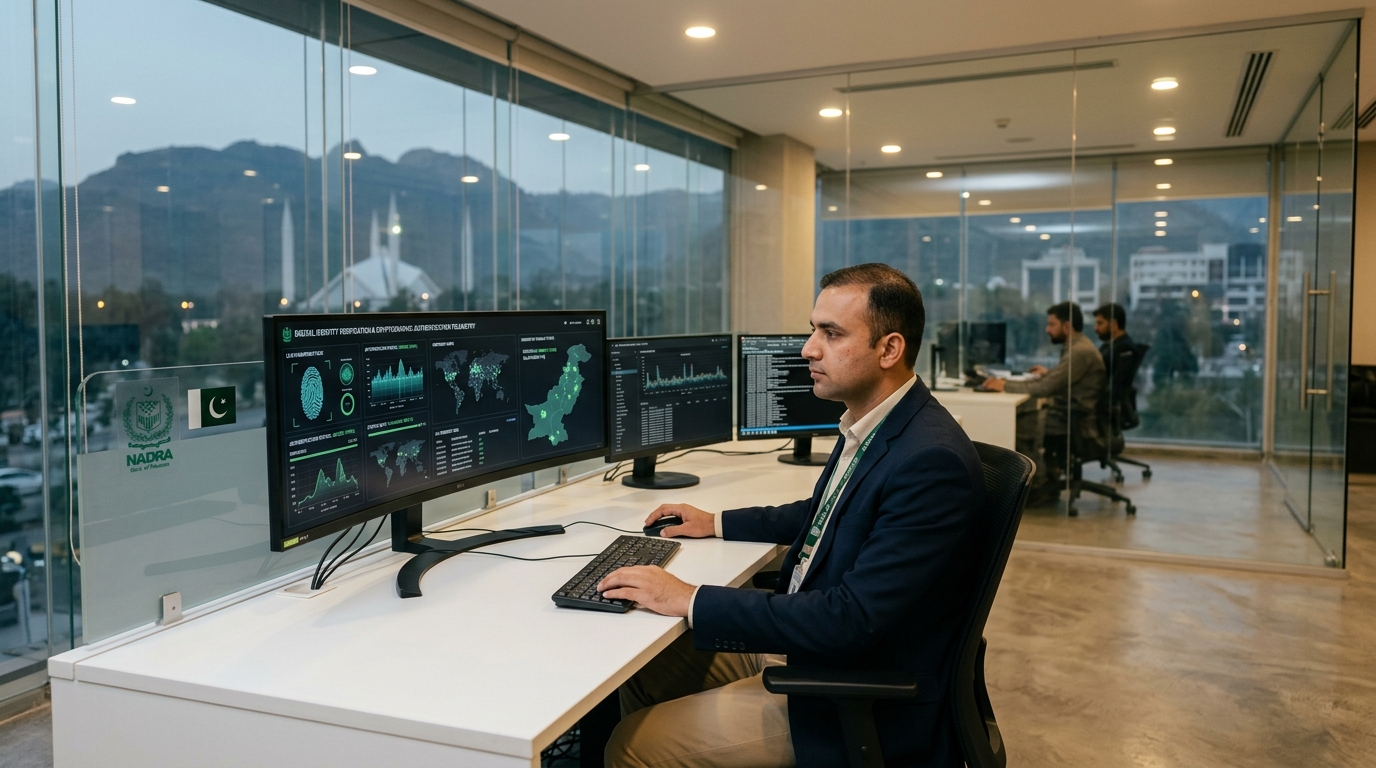
The National Database and Registration Authority (NADRA) has officially operationalized “Nishan Pakistan”, a next-generation Identity-as-a-Service (IDaaS) and contactless biometric verification API gateway. Designed to dismantle the legacy dependency on costly hardware fingerprint scanners, the sovereign platform enables commercial banks, microfinance institutions, Digital Retail Banks (DRBs), and fintech platforms to perform real-time, tamper-resistant electronic Know Your Customer (e-KYC) directly through consumer smartphone cameras.
Operating out of NADRA’s secure tier-rated data center infrastructure in Islamabad, Nishan Pakistan establishes a unified national identity verification rail. Regulated entities can now execute multi-modal biometric matches—including contactless 3D fingerprint ridge reconstruction and micro-expression facial liveness detection—against the national civil registry within sub-second latencies, transforming customer onboarding and digital credit underwriting across the country.
The Paradigm Shift: From Proprietary Hardware to Contactless Sovereign IDaaS
For over two decades, Pakistan’s formal financial and telecommunications sectors relied heavily on physical optical or capacitive fingerprint sensors. While effective for branch-based counter verifications, dedicated hardware readers imposed severe operational friction:
- Hardware Capital Expenditure: Financial institutions and telecom franchises maintained fleets of tens of thousands of specialized biometric dongles, subject to high import tariffs, optical degradation, and proprietary driver incompatibilities.
- Physical Friction and Drop-offs: Remote digital onboarding remained an oxymoron; users could download a banking app but were required to visit a physical agent, biometric kiosk, or branch teller to complete level-2 biometric verification.
- Sensor Spoofing Vulnerabilities: Legacy 2D optical scanners struggled to detect sophisticated silicone molds, gelatin prosthetics, and latent print reactivation.
Nishan Pakistan completely flips this paradigm. By exposing hardened RESTful API endpoints and a cryptographic mobile SDK, the gateway turns any commodity smartphone equipped with a standard high-definition camera and LED flash into an automated biometric acquisition station.
flowchart TD
    subgraph Mobile_Client["Consumer Mobile Application (DRB / Fintech App)"]
        A[Customer Initiates Account Opening / Loan] --> B[Embedded Nishan Mobile SDK]
        B --> C[Contactless Camera Capture: 4-Finger Slap / Face Mesh]
        C --> D[Client-Side Passive Liveness & Anti-Spoof ML Evaluation]
    end

    subgraph Edge_Middleware["Licensed Institution Domestic Backend"]
        D -->|Encrypted ISO Payload| E[Fintech / Core Banking API Gateway]
        E -->|Mutual TLS 1.3 + HSM Token| F[Domestic Verification Broker]
    end

    subgraph NADRA_Sovereign_Cloud["NADRA Nishan Pakistan Sovereign Cloud (Islamabad)"]
        F -->|Sub-10ms Local Fiber Link| G[Nishan National API Gateway Node]
        G --> H[HSM Cryptographic Verification & JWS Decryption]
        H --> I[Deep Learning 3D Ridge Reconstruction Engine]
        I --> J[Central Citizen Civil Biometric Core: 1:1 Match]
        J --> K[Signed Verification Attestation JWT Generated]
    end

    K -->|Authenticated Result JSON| E
    E -->|Real-Time Account Provisioning| A
Through computer vision and convolutional neural networks executed locally on the client device before secure payload serialization, the platform captures high-resolution ridge patterns from four fingers simultaneously, automatically compensating for ambient lighting, skin pigmentation variations, hand tremor, and focal depth.
Technical Architecture: Cryptography, mTLS, and Liveness Detection
The architectural framework of Nishan Pakistan is engineered to adhere to zero-trust security standards, ensuring that citizen identity parameters remain immutable, confidential, and mathematically auditable throughout transmission.
1. Mutual TLS (mTLS v1.3) and Transport Security
Direct communication with the Nishan API gateway requires dedicated, mutual cryptographic handshake protocols. Regulated client institutions must present an X.509 client certificate issued by Pakistan’s National Public Key Infrastructure (PKI) or an accredited commercial Certification Authority (CA) authorized by the Electronic Certification Accreditation Council (ECAC).
- Cipher Suite Enforcement: All traffic strictly mandates TLS 1.3 with forward-secrecy cipher suites (
TLS_AES_256_GCM_SHA384andTLS_CHACHA20_POLY1305_SHA256). - IP Pinning & Dedicated Whitelisting: API access is restricted to verified, domestic static IP ranges routed over isolated leased lines, cross-connects, or the Pakistan Internet Exchange (PkIX).
- Replay Protection: Every API transaction demands a unique, cryptographically random nonce and an ephemeral timestamp with a maximum 30-second validity window.
2. Hardware Security Module (HSM) Signed Tokens
Every verification request transmitted by a licensed banking institution must be encapsulated within a signed JSON Web Signature (JWS) structured payload:
{
  "header": {
    "alg": "PS512",
    "typ": "JWT",
    "x5t#S256": "9b1d8f7e2c4a5b6e7f8a9b0c1d2e3f4a5b6e7f8a9b0c1d2e3f4a5b6e7f8a9b0c",
    "kid": "drb-hsm-prod-node-01"
  },
  "payload": {
    "iss": "HUGOBANK-PK-DRB-098",
    "aud": "NADRA-NISHAN-GATEWAY-ISB",
    "iat": 1792404000,
    "exp": 1792404030,
    "jti": "d6a3f120-7c22-4981-b5e0-318a47890f84",
    "citizen_cnic": "35201-XXXXXXXX-X",
    "biometric_modality": "CONTACTLESS_FOUR_FINGER_SLAP",
    "liveness_confidence_score": 0.9984,
    "iso_minutiae_payload": "BASE64_ENCRYPTED_ENCLAVE_DATA",
    "client_telemetry": {
      "app_version": "v4.12.0",
      "device_attestation": "GOOGLE_PLAY_INTEGRITY_MEETS_STRONG",
      "gps_geofence": { "lat": 31.5204, "lon": 74.3587 }
    }
  }
}
The payload is signed inside a FIPS 140-2 Level 3 compliant Hardware Security Module (HSM) residing on the institution’s production server infrastructure. This architecture ensures non-repudiation: neither the financial institution nor an interceptor can alter verification parameters or replay captured minutiae records.
3. Contactless 3D Ridge Reconstruction & Liveness Detection
Contactless camera capture introduces challenges including perspective distortion, varying focal lengths, and variable skin elasticity. Nishan Pakistan addresses these through dual-tier liveness and biometric reconstruction pipelines:
| Dimension | Legacy Hardware Scanners (Optical 500 DPI) | Nishan Pakistan Contactless AI Engine |
|---|---|---|
| Capture Modality | Physical platen press (single finger) | Multi-angle camera stream (4 fingers simultaneous) |
| Liveness Verification | Static capacitive check (easily spoofed) | Active micro-movement + passive subsurface scattering analysis |
| Ridge Correction | Fixed planar geometry | 3D mesh projection mapping with perspective normalization |
| Resolution Equivalent | 500 DPI standard | Interpolated 650+ DPI equivalent calibrated minutiae map |
| Spoofing Resistance | Low to moderate (vulnerable to latex/silicone) | High (deep learning anti-spoof certified to ISO 30107-3 Level 2) |
| Transaction Processing Time | 3.5 – 6.0 seconds per finger | Sub-800 milliseconds for composite 4-finger array |
Integration with Digital Retail Banks (DRBs) and Fintechs
The operationalization of Nishan Pakistan serves as the catalyst for Pakistan’s newly licensed Digital Retail Banks (DRBs) and established Electronic Money Institutions (EMIs).
sequenceDiagram
    autonumber
    participant App as Customer Mobile App
    participant BankServer as Bank Core Middleware (Domestic Server)
    participant Nishan as NADRA Nishan Gateway (Islamabad)
    participant Core as Central Civil Registry Core

    App->>App: 1. SDK Captures Contactless Slap (4 Fingers)
    App->>App: 2. Local Liveness & Anti-Spoof Pass (Neural Model)
    App->>BankServer: 3. Post Encrypted Minutiae Buffer via HTTPS
    Note over BankServer: Signs Payload using Local HSM Key
    BankServer->>Nishan: 4. REST POST with mTLS (Target SLA < 30ms)
    Nishan->>Nishan: 5. Authenticate Bank Certificate & HSM Signature
    Nishan->>Core: 6. 1:1 In-Memory Biometric Registry Lookup
    Core-->>Nishan: 7. Positive Match Confirmed (Threshold > 99.4%)
    Nishan-->>BankServer: 8. Return Cryptographically Signed e-KYC Attestation
    BankServer->>BankServer: 9. Execute AML / Sanctions Screener & Create IBAN
    BankServer-->>App: 10. Account Activated: Instant Virtual Card Issued
Unlocking Paperless Digital Banking
Licensed digital retail banks—including HugoBank, KT Bank, and Mashreq Pakistan—alongside top fintechs such as Easypaisa, JazzCash, NayaPay, and SadaPay, are leveraging the gateway to compress customer acquisition funnels:
- Instant Digital Onboarding (Tier-1 and Tier-2 Wallets): Customers no longer face friction when raising daily wallet transaction limits from PKR 50,000 to PKR 500,000+. Account upgrades that previously necessitated branch visits or physical retail agent interaction are now executed in under 60 seconds from the living room.
- Instant Micro-Lending and SME Credit: Collateral-free working capital loans and nano-financing products require legally enforceable biometric authorization before disbursement. Digital retail banks can bind loan agreements with an immutable NADRA-backed e-signature and biometric timestamp, mitigating identity fraud in unbanked rural corridors.
- Branchless Agent Empowerment: Freelance merchants and kiryana store owners can act as micro-banking agents using standard Android smartphones, eliminating hardware maintenance costs.
Regulatory Mandates: SBP, PTA, and Sovereign Data Residency
The rollout of Nishan Pakistan is supported by coordinated regulatory directives from the State Bank of Pakistan (SBP) and the Pakistan Telecommunication Authority (PTA).
SBP Directives on Digital Onboarding Framework
Under SBP’s revised regulatory framework for branchless banking and digital retail banking, customer identity verification during remote account creation must utilize certified biometric gateways. The central bank has directed that:
- All Tier-2 digital account tier upgrades must utilize multi-modal biometric authentication (contactless fingerprint and/or facial verification with active liveness).
- Financial institutions must maintain an immutable, tamper-evident audit log of all e-KYC query attestations for a minimum statutory period of ten years.
- Zero citizen biometric images or raw video frames may be permanently stored on client devices or intermediate corporate databases; only transient ISO minutiae templates and NADRA-signed verification hashes may be logged.
PTA SIM Issuance and Re-Verification
Simultaneously, the Pakistan Telecommunication Authority has established technical timelines for telecom operators to transition SIM sales, eSIM remote provisioning, and corporate mobile service re-verifications to the Nishan gateway, eliminating rogue biometric hardware terminals historically linked to unauthorized grey SIM activations.
Class-3 Sovereign Data Residency Compliance
Under Pakistan’s Cloud First Policy 2.0 and the draft Personal Data Protection Bill, national biometric identifiers and civil registration parameters are classified as Class-3 Critical National Infrastructure (CNI) Data.
This classification establishes strict statutory mandates:
- Biometric verification payloads cannot cross international terrestrial or submarine borders.
- Intermediate routing through offshore proxies, global Content Delivery Networks (CDNs), or public cloud regions in Europe, North America, or East Asia constitutes an immediate violation of sovereign data protection laws.
- The entire transaction life cycle—from the user’s mobile ISP hop to the banking verification middleware and upstream to NADRA’s gateway—must remain entirely within the sovereign network perimeter of Pakistan.
The Latency Imperative: Why Overseas Clouds Cause Drop-Offs
When architecting high-volume biometric verification pipelines, network latency is not merely an engineering metric; it directly determines business conversion rates and fraud mitigation efficacy.
During a contactless biometric acquisition session, a mobile client captures a rapid sequence of high-resolution video frames to compute micro-movements, blood flow perfusion (photoplethysmography), and ridge clarity. The resulting cryptographically sealed ISO minutiae buffer must be transmitted, validated, and acknowledged before client session timers lapse.
+---------------------------------------------------------------------------------------+
| BIOMETRIC SESSION LATENCY BUDGET BREAKDOWN (MAX TOLERABLE WINDOW: 2,500ms)           |
+---------------------------------------------------------------------------------------+
| Local Smartphone SDK Image Capture & Neural Liveness Pre-filter:      350ms - 500ms   |
| 4G LTE / 5G Mobile Edge Network Transmission to Bank Server:         40ms - 120ms   |
| Bank Internal Middleware Processing & HSM Payload Signing:             20ms - 50ms    |
| Bank Middleware to NADRA Islamabad Nishan Node (Domestic Route):       8ms - 25ms    |
| NADRA Central In-Memory Biometric 1:1 Engine Verification:             200ms - 350ms  |
| Return Gateway Transmission & Core Ledger Provisioning:               30ms - 80ms    |
+---------------------------------------------------------------------------------------+
| TOTAL ROUND-TRIP TIME (DOMESTIC ARCHITECTURE):                        648ms - 1,125ms |
| STATUS: SUCCESSFUL VERIFICATION (ZERO TIMEOUTS, SUB-SECOND RESPONSE)                  |
+---------------------------------------------------------------------------------------+

+---------------------------------------------------------------------------------------+
| FAILED ARCHITECTURE: OFFSHORE PUBLIC CLOUD ROUTING (e.g., Frankfurt / Singapore)      |
+---------------------------------------------------------------------------------------+
| Mobile Uplink to Overseas Cloud Region (Cross-Border Subsea Transit): 280ms - 450ms   |
| Overseas Cloud Processing & Reverse Route to Islamabad:               310ms - 520ms   |
| Flaky Subsea Cable Latency Spikes & Jitter / Packet Retransmission:   1,200ms - 3,500ms|
| Total Accumulative Latency Exceeding Client Heartbeat SLA (>5,000ms): TIMEOUT ERROR  |
+---------------------------------------------------------------------------------------+
| RESULT: SESSION ABORTED | CAMERA RESCAN FORCED | USER DROPS OFF (42% FAILURE RATE)     |
+---------------------------------------------------------------------------------------+
When financial institutions route e-KYC verification middleware through offshore cloud regions (such as AWS eu-central-1 in Frankfurt, Azure SE Asia in Singapore, or GCP us-east-1), every authentication call incurs heavy transatlantic or Indian Ocean submarine cable transit penalties. Latency surges past 300ms–600ms per round trip, frequently exceeding the strict 5,000ms total session timeout threshold enforced by NADRA and mobile SDKs.
The consequences are severe:
- Catastrophic Drop-Off Rates: Industry telemetry reveals that biometric onboarding flows exceeding 3 seconds suffer user abandonment rates as high as 42%, devastating customer acquisition efficiency.
- Flaky Submarine Cable Vulnerability: Frequent outages or cable shunts along the SMW4, SMW5, or AAE-1 submarine cable systems degrade offshore connections, leaving domestic digital banks unable to onboard customers for days.
- Regulatory Penalties: Hosting middleware processing sensitive Class-3 biometric tokens outside national borders exposes executives to severe regulatory sanctions from the SBP and PTA.
Infrastructure Imperative: Deploying on Domestic Bare Metal
To satisfy stringent sub-second end-to-end SLAs and comply with sovereign data localization directives, Pakistan’s leading fintech payment gateways, core banking backends, and verification middleware must run on dedicated, domestic infrastructure.
graph LR
    subgraph National_End_Users["Pakistani Citizens Nationwide"]
        U1[Karachi 4G/5G Users]
        U2[Lahore 4G/5G Users]
        U3[Islamabad / Rawalpindi Users]
    end

    subgraph Domestic_Data_Center["Certified Domestic Tier-3 Infrastructure (Karachi / Islamabad)"]
        FW[Carrier-Neutral BGP Routing & Hardware Anti-DDoS]
        BM[Bare-Metal Dedicated Server Cluster]
        HSM[On-Premise Hardware Security Module]
        DB[(Local Primary PostgreSQL & Ledger Nodes)]
    end

    subgraph NADRA_Core["NADRA Islamabad Infrastructure"]
        GW[Nishan Pakistan Production API Gateway]
    end

    U1 & U2 & U3 -->|Domestic Fiber Backhaul < 25ms| FW
    FW --> BM
    BM <--> HSM
    BM <--> DB
    BM -->|Dedicated Dark Fiber Cross-Connect < 10ms RTT| GW
Relying on generic public cloud shared instances introduces virtualization overhead, “noisy neighbor” I/O throttling, and unpredictable CPU scheduling that degrade cryptographic token signing performance during morning transaction peaks.
By provisioning enterprise-grade Dedicated Servers optimized with modern multi-core processors, NVMe storage arrays, and Hardware Security Module (HSM) acceleration cards, fintech engineering teams eliminate virtualization bottlenecks and achieve predictable, microsecond-level execution.
Furthermore, deploying mission-critical middleware directly on Dedicated Servers in Pakistan situated within certified Tier-3 facilities in Karachi, Lahore, and Islamabad grants engineering teams direct low-latency peering across the Pakistan Internet Exchange (PkIX) and telecom dark fiber backbones. This architecture guarantees:
- Sub-10ms Domestic Round-Trip Time: Verification requests originate within the national borders and reach NADRA’s gateway nodes in Islamabad within single-digit milliseconds.
- Deterministic Cryptographic Throughput: Bare-metal hardware guarantees dedicated cryptographic cycles for high-volume JWS signing and verification operations.
- 100% Sovereign Data Residency: Complete compliance with SBP, PTA, and CNI regulatory frameworks, insulating institutional operations from foreign jurisdiction claims and subsea cable failures.
- Zero Foreign Currency Volatility: Infrastructure costs are fully localized and billed in PKR, eliminating margin compression caused by currency fluctuations.
Technical Implementation Guide: Building a Resilient Nishan Gateway Client
For systems engineers and enterprise backend architects deploying verification middleware, the following implementation guidelines outline a production-grade integration pattern.
1. Connection Pool and Keep-Alive Tuning
Establishing an mTLS handshake over TLS 1.3 requires multiple round trips. Backend services must reuse long-lived TCP connections through HTTP/2 or HTTP/1.1 persistent connection pooling to avoid repeating the TLS handshake on every biometric query:
import httpx
import ssl

def create_nishan_gateway_client(client_cert_path: str, client_key_path: str, ca_bundle_path: str) -> httpx.Client:
    """
    Configures a production-grade, hardened mTLS client for NADRA Nishan Pakistan.
    Enforces persistent connection pooling, strict TLS 1.3, and domestic DNS resolution.
    """
    ssl_context = ssl.create_default_context(ssl.Purpose.SERVER_AUTH, cafile=ca_bundle_path)
    ssl_context.load_cert_chain(certfile=client_cert_path, keyfile=client_key_path)
    ssl_context.minimum_version = ssl.TLSVersion.TLSv1_3
    ssl_context.maximum_version = ssl.TLSVersion.TLSv1_3

    # Enforce secure forward-secrecy ciphers
    ssl_context.set_ciphers("ECDHE-ECDSA-AES256-GCM-SHA384:ECDHE-RSA-AES256-GCM-SHA384")

    limits = httpx.Limits(
        max_keepalive_connections=50,
        max_connections=200,
        keepalive_expiry=30.0
    )

    timeouts = httpx.Timeout(
        connect=2.0,      # Strict 2s connect budget (domestic fiber)
        read=3.5,         # 3.5s read budget for biometric search
        write=2.0,
        pool=1.0
    )

    return httpx.Client(
        base_url="https://gateway.nishan.nadra.gov.pk/api/v2",
        verify=ssl_context,
        limits=limits,
        timeout=timeouts,
        http2=True
    )
2. Circuit Breakers and Fallback Queueing
While NADRA’s core biometric engine guarantees high availability, enterprise core banking systems must implement circuit breaker patterns (e.g., Resilience4j or Envoy sidecars) to gracefully handle upstream rate limiting or transient gateway jitter:
- Automatic Fallback to Offline Agent Queue: If consecutive gateway timeouts exceed 3%, customer onboarding requests should automatically queue for asynchronous retry without forcing the user to re-capture biometric data.
- Deterministic Payload Caching: Intermediate minutiae buffers should remain in encrypted Redis in-memory caches configured with aggressive eviction policies (TTL < 120 seconds).
The Road Ahead for Pakistan’s Digital Identity Stack
The rollout of Nishan Pakistan represents a milestone in Pakistan’s journey toward a sovereign digital economy. By transforming biometric verification from an expensive, hardware-bound operation into a seamless API call accessible to any smartphone camera, NADRA has established the identity verification pillar of the Digital Pakistan Stack.
When combined with the Raast Instant Payment System for sub-second settlement and the emerging Open Banking Framework, Nishan Pakistan provides the rails for a truly frictionless financial system. Millions of unbanked citizens, remote freelancers, and micro-entrepreneurs can now access formal credit, insurance, and banking services in seconds—powered by modern digital identity and resilient domestic hosting infrastructure.
Related Technical Architecture Guides
- Ministry of IT Unveils Cloud-First Policy 2.0: Sovereign Data Residency Mandate for Public & Financial Clouds – In-depth breakdown of Class-1 to Class-3 sovereign data compliance requirements.
- Digital Pakistan Stack and Open API Gateway Framework – Architectural blueprint for unified open banking, Raast, and digital governance.
- Fintech Cybersecurity & SBP Cloud Framework Compliance for Pakistani Platforms – Hardening transaction processing switches against modern threat vectors.
- Deploying High-Availability PostgreSQL and Redis Clusters on Bare Metal – Production guides for zero-downtime, low-latency database architectures.
Power Your Banking Middleware with Sub-10ms Domestic Bare Metal
Eliminate e-KYC timeouts and comply with SBP sovereign data residency mandates. Nextgen Hosting delivers enterprise bare-metal dedicated servers, hardware security module (HSM) hosting, and low-latency domestic transit in certified Tier-3 facilities in Karachi, Lahore, and Islamabad—billed transparently in PKR.