
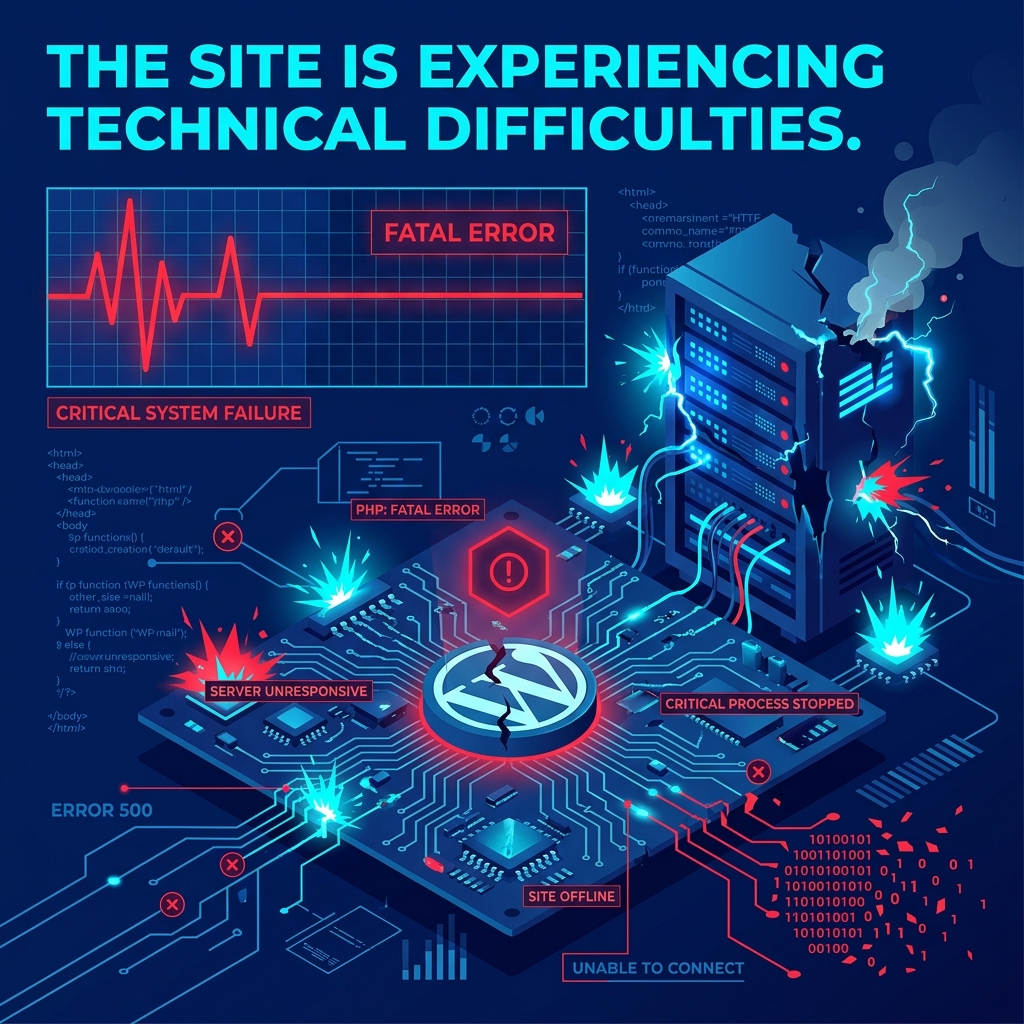
Prior to the release of WordPress 5.2, if a plugin update went wrong or you pasted a broken snippet of PHP code into your theme, your website would instantly crash and display an entirely blank white page—infamously known as the White Screen of Death (WSoD).
To make troubleshooting easier for non-developers, WordPress introduced a fatal error protection feature. Now, instead of a terrifying blank screen, WordPress catches the fatal PHP error and gracefully displays a message: “The site is experiencing technical difficulties.” (In newer versions, this message might say “There has been a critical error on your website.”)
Regardless of the exact wording, the meaning is identical: A PHP script on your server has suffered a Fatal Error and completely crashed. Here is the technical workflow to diagnose and resolve it.
1. Utilize WordPress Recovery Mode
The most helpful aspect of this fatal error protection is that WordPress automatically attempts to identify the specific plugin or theme causing the crash. It then sends an automated email to the site’s primary Administrator address.
This email contains a unique, time-sensitive link that activates Recovery Mode.
- Click the link in the email.
- Log into your WordPress dashboard.
- Once in Recovery Mode, WordPress temporarily “pauses” the specific plugin or theme that caused the crash, allowing the rest of the dashboard to load normally.
- You can then navigate to your Plugins page, locate the paused plugin (it will have a red warning next to it), and safely deactivate or delete it.
2. Enable WP_DEBUG to Find the Root Cause
If your server’s mail system is not configured correctly, you will never receive the Recovery Mode email. In this scenario, you must manually dig into the server logs to find out which file crashed.
To do this, you need to enable WordPress’s built-in debugging tool:
- Connect to your server via FTP or use your hosting cPanel’s File Manager.
- Locate the
wp-config.phpfile in the root directory. - Find the line that says
define( 'WP_DEBUG', false );and change it totrue. - Immediately below that line, add two more lines so it looks like this:
define( 'WP_DEBUG', true );
define( 'WP_DEBUG_LOG', true );
define( 'WP_DEBUG_DISPLAY', false );
Save the file. Now, refresh your broken website once.
Navigate to the /wp-content/ folder in your File Manager. You will see a newly generated text file named debug.log. Open it, and look at the very last line. It will give you the exact file path and line number of the fatal crash (e.g., Fatal error: Uncaught Error in /wp-content/plugins/bad-plugin/index.php on line 42). This is very similar to how you would track down a core Pluggable.php Error.
3. Manually Deactivate the Offending Plugin or Theme
Now that debug.log has told you exactly which plugin (or theme) caused the site to experience technical difficulties, you must surgically disable it.
- Using your File Manager, navigate to
/wp-content/plugins/(or/wp-content/themes/if the error was in a theme). - Find the folder belonging to the broken plugin.
- Rename the folder (e.g., change
woocommercetowoocommerce-broken).
By renaming the folder, WordPress can no longer find the plugin’s core files. It automatically deactivates the plugin in the database, immediately lifting the fatal error and bringing your website back online.
Prevent Disasters with Snapshot Backups
Fatal errors almost always occur immediately after clicking “Update” on a plugin or theme. The new code simply might not be compatible with your server’s current PHP version, instantly triggering the “technical difficulties” screen.
The safest way to manage WordPress is to ensure you can instantly roll back any catastrophic updates. Nextgen’s WordPress Hosting in Pakistan includes automated, daily JetBackup snapshots. If a bad update completely destroys your site, you don’t need to panic or read debug logs. You simply log into your client portal and restore your entire file system and database to the exact state it was in yesterday, minimizing downtime to mere seconds.
Scale your script execution times without artificial caps using Nextgen shared hosting packages.
