
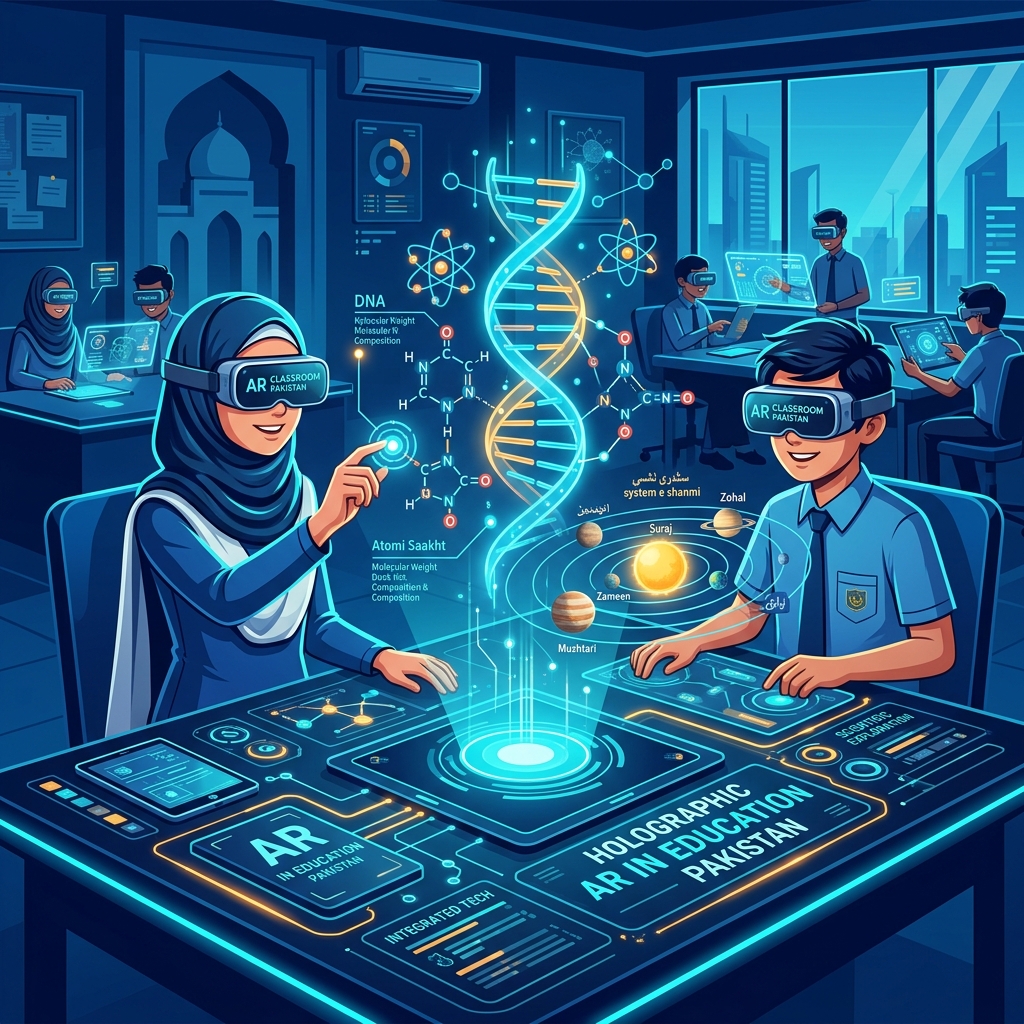
In a massive leap forward for digital literacy and educational reform, the Government of Pakistan has officially mandated the integration of Augmented Reality (AR) into the national STEM (Science, Technology, Engineering, and Mathematics) curriculum for high schools starting in the 2026 academic year.
This landmark initiative, heavily influenced by the recent success of the National Web3 & Metaverse Sandbox, aims to transition the country’s education system away from rote memorization and toward interactive, experiential learning.
Replacing Textbooks with 3D Holograms
The traditional model of reading static, 2D diagrams from textbooks is fundamentally changing. Under the new AR curriculum, students will utilize smart tablets and heavily subsidized, locally assembled AR headsets to project complex 3D holographic models directly onto their classroom desks.
For instance, during a biology lecture on the human cardiovascular system, students will not just look at a drawing of a heart. They will interact with a floating, beating 3D model, allowing them to physically walk around it, dissect its chambers digitally, and observe blood flow in real-time. Similarly, volatile chemistry experiments that are too dangerous or expensive to conduct in physical school labs can now be simulated perfectly in a zero-risk augmented environment.
The proprietary educational software powering these AR modules was proudly developed by indigenous tech startups currently housed in the newly inaugurated Islamabad IT Park.
The Crucial Role of Edge Infrastructure
Rendering high-definition 3D models for thirty students simultaneously inside a single classroom is incredibly resource-intensive. If the AR headsets have to fetch rendering data from overseas cloud servers, the resulting latency (lag) would cause motion sickness and severely disrupt the learning experience.
To solve this, the Ministry of IT is deploying localized “Edge Computing” nodes directly inside the schools, powered by high-speed 5G networks.
This requirement for zero-latency infrastructure is a common challenge for modern tech startups. For EdTech developers building the next generation of AR, VR, or AI learning platforms, hosting your backend close to your users is critical. Nextgen’s enterprise-grade Dedicated Servers in Pakistan provide the exact localized, high-bandwidth environment needed to process heavy 3D rendering and real-time multiplayer data without the lag associated with international servers.
Phase 1 Rollout and Beyond
The initial rollout phase targets 500 “Model High Schools” across major urban centers, including Karachi, Lahore, and Islamabad. The government has also allocated a dedicated tech fund to train over 2,000 public school teachers on how to effectively integrate AR technology into their daily lesson plans.
By making complex scientific concepts tangible and interactive, the AR curriculum is projected to massively boost student engagement and retention rates. As hardware costs continue to drop, the ultimate goal is to expand this digital infrastructure to rural schools by 2028, ensuring that the next generation of Pakistani students is fully equipped to compete in a global, technology-driven economy.
Deploy interactive educational portals through professional Custom Web Development.
