
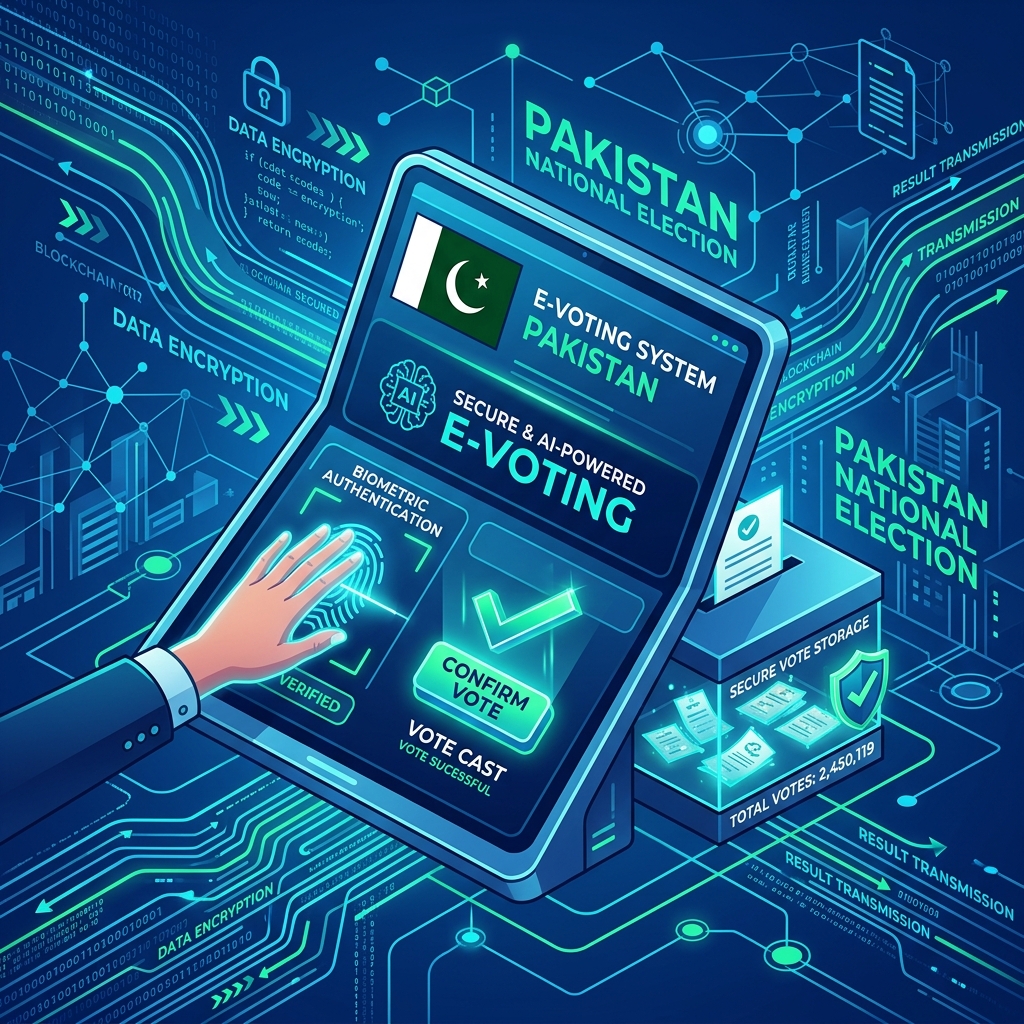
For decades, the electoral process in Pakistan has been dogged by logistical hurdles, delayed results, and recurring allegations of vote tampering. In a definitive move to modernize the democratic process, the Election Commission of Pakistan (ECP), in collaboration with the Ministry of IT and NADRA, has officially unveiled the prototype for a state-of-the-art AI-Powered E-Voting System.
This next-generation hardware and software ecosystem is designed to eliminate manual ballot stuffing, provide instantaneous vote tallying, and secure the entire lifecycle of a vote using advanced cryptography.
The Tri-Layer Security Architecture
The e-voting prototype relies on three distinct technological pillars to ensure absolute transparency and security.
1. Real-Time Biometric & Facial Verification
The physical voting machine replaces the traditional paper ballot. When a voter approaches the terminal, they must authenticate themselves using dual-factor biometrics: a live fingerprint scan and real-time facial recognition.
This hardware interfaces directly with the newly launched Digital Identity Wallet (Pak-ID) database. If the AI detects a mismatch, or if a person attempts to cast a second vote, the terminal instantly locks and alerts the presiding officer, reducing the possibility of impersonation to zero.
2. Immutable Blockchain Ledgers
The most critical component of the system is how the vote is stored. Instead of saving votes on a local hard drive or a central, vulnerable database, every single vote is hashed, encrypted, and recorded on a distributed ledger hosted at the National Blockchain Data Center.
Because a blockchain is functionally immutable (unchangeable), once a vote is mathematically verified and added to the block, it cannot be altered, deleted, or manipulated by any official, hacker, or political entity.
3. AI-Driven Threat Detection
At the network level, a bespoke Artificial Intelligence model acts as the system’s overwatch. The AI constantly monitors network traffic from all polling stations nationwide. If it detects anomalies—such as a localized DDoS attack attempting to take a polling station offline, or unusual patterns in voting speeds—it instantly reroutes traffic and deploys automated countermeasures to isolate the threat.
Facilitating the Overseas Diaspora
A major driving force behind the development of this robust system is the facilitation of Overseas Pakistanis. A dedicated I-Voting (Internet Voting) portal is being developed concurrently. Using advanced zero-knowledge proofs and secure mobile apps, expats will be able to undergo live biometric verification and cast their encrypted votes from their smartphones anywhere in the world.
Enterprise Infrastructure for National Security
A system handling the live biometrics and electoral choices of over 100 million registered voters requires hosting infrastructure of the highest possible caliber. Downtime or data breaches are simply not an option.
For mission-critical applications demanding maximum security and raw computational power, Nextgen’s Dedicated Servers in Pakistan are the gold standard. Housed in Tier-III data centers with physical isolation (bare-metal hardware), hardware-level firewalls, and enterprise DDoS mitigation, these servers provide the impenetrable fortress required to run national blockchain ledgers and secure sensitive electoral data from foreign state-sponsored attacks.
The government plans to conduct rigorous penetration testing on the prototype throughout 2026, aiming for limited pilot deployments in local by-elections before a full nationwide rollout.
