
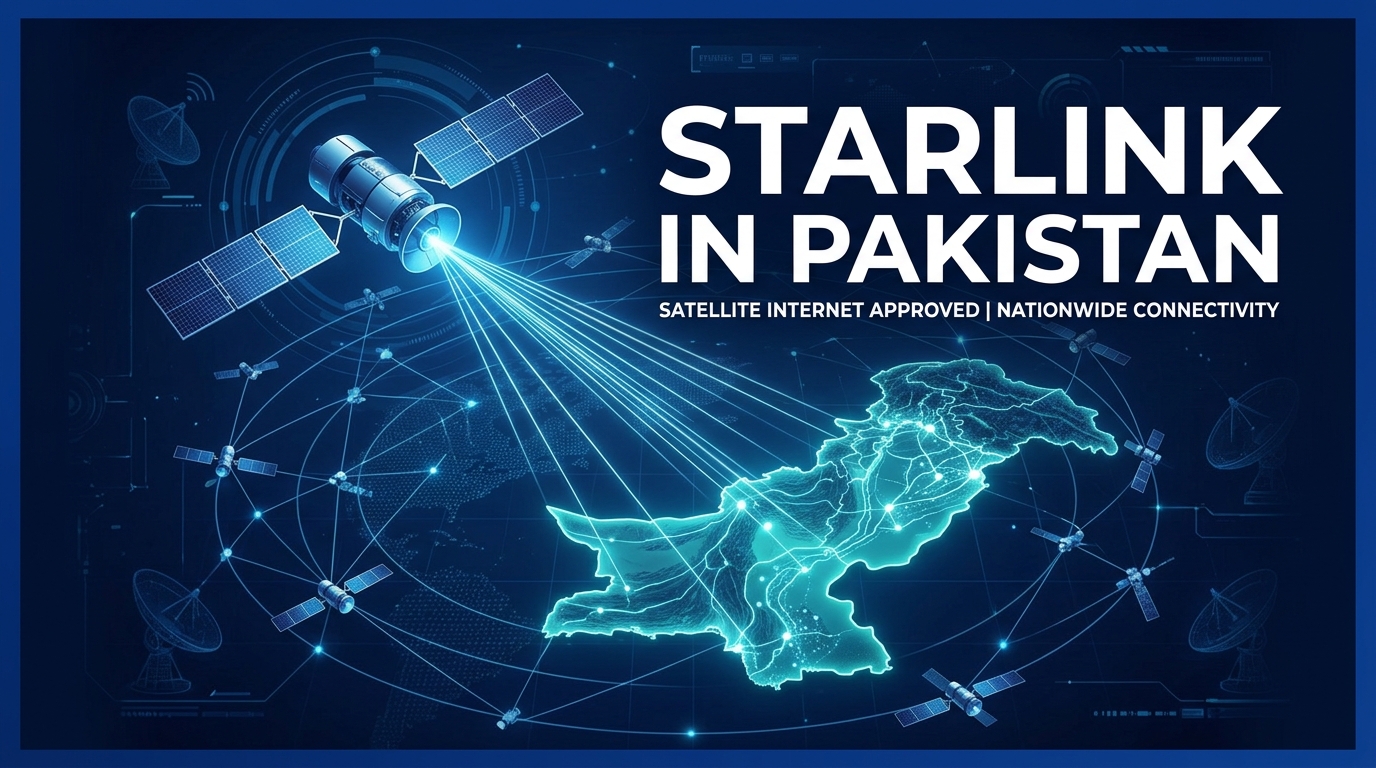
In a landmark announcement for Pakistan’s digital connectivity agenda, Jazz and Telenor Pakistan have separately signed infrastructure partnership agreements with SpaceX’s Starlink to utilize its Low Earth Orbit (LEO) satellite constellation as backhaul connectivity for mobile towers deployed in rural and mountainous regions of Pakistan.
The agreements represent a paradigm shift in how Pakistan’s telecoms will extend coverage to the approximately 40 million citizens who currently live outside the reach of terrestrial fiber or mobile networks — particularly in Balochistan, Gilgit-Baltistan, and the tribal areas of Khyber Pakhtunkhwa.
The Technical Challenge: Rural Tower Backhaul
Deploying a 4G or 5G mobile tower in a remote village requires two things: power and backhaul. Power has increasingly been solved by solar panels and battery storage. Backhaul — the connection that links the tower to the core network — has remained the unsolvable bottleneck.
Traditional backhaul options in remote Pakistan:
- Microwave links: Require line-of-sight and multiple hops across mountains. Extremely expensive and unreliable in heavy weather.
- VSAT geostationary satellites: High latency (~600ms round-trip) due to 36,000km orbit. Unusable for real-time applications.
Starlink’s LEO constellation, operating at 550km altitude, achieves latencies of 25-50ms — comparable to terrestrial fiber — making it genuinely viable as a mobile backhaul solution for the first time in history.
How the Partnership Works
Under the agreements, Jazz and Telenor will deploy Starlink Business terminals at remote tower sites where fiber or microwave backhaul is economically or logistically impossible. Each Starlink terminal provides up to 500 Mbps of throughput — more than sufficient to backhaul a standard rural 4G cell serving hundreds of simultaneous users.
This directly builds on the trajectory set by the PTA Starlink Satellite Internet rollout and the spectrum infrastructure being prepared under the PTA 5G Auction Framework Q4 2026.
Coverage Impact: 40 Million New Subscribers
The combined rural footprint of Jazz and Telenor, once extended via Starlink backhaul, is projected to bring connectivity to areas including:
- Balochistan plateau (currently ~18% 4G coverage)
- Gilgit-Baltistan valleys (many with zero terrestrial connectivity)
- Southern KPK and FATA merger districts
Analysts estimate this could add 8-12 million new mobile data subscribers in the first two years, with significant implications for Pakistan’s IT export revenues as remote freelancers gain stable internet access for the first time.
Economic Implications for the Cloud and Hosting Sector
This expansion represents a massive growth in Pakistan’s digital economy user base. As newly connected rural entrepreneurs and freelancers come online, demand for domestic web hosting, VPS servers, and cloud infrastructure will grow in tandem.
Businesses currently serving Pakistan’s urban digital market should anticipate significant growth from tier-2 and tier-3 city users within 18-24 months. Ensuring your online presence is fast, reliable, and hosted on infrastructure optimized for Pakistan’s network topology will be a key competitive differentiator as this new user base comes online.
