
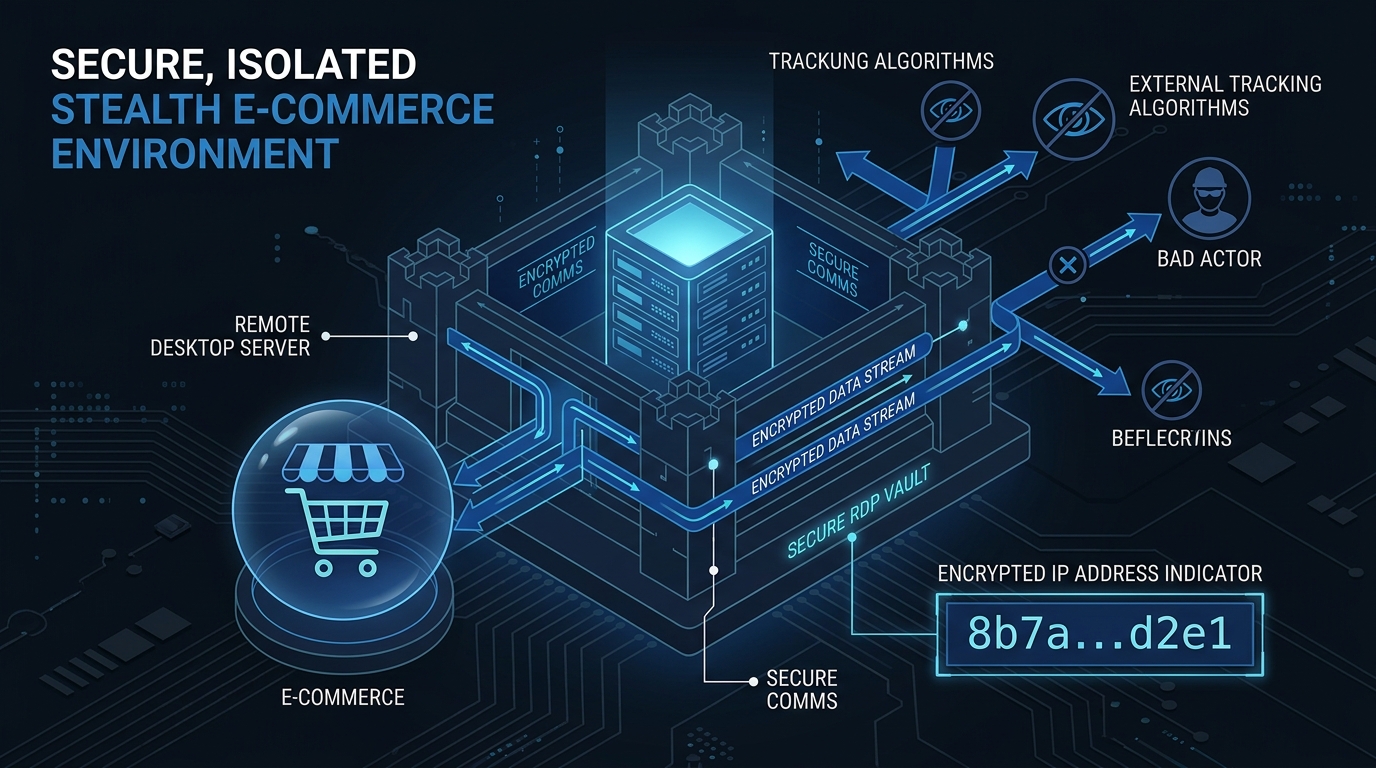
Operating a successful e-commerce business on platforms like Amazon or eBay comes with a constant, underlying risk: algorithmic suspensions. A single mistaken policy violation, a competitor’s false intellectual property claim, or an unexpected verification error can instantly freeze your entire business and hold your funds hostage for months.
To mitigate this existential risk, professional sellers utilize “stealth accounts”—legitimate, legally distinct seller accounts operated in complete technical isolation from one another. To achieve this level of isolation, the industry standard is utilizing dedicated Remote Desktop Protocol (RDP) servers.
The Flaws of Browsers and VPNs
Many amateur sellers attempt to run multiple accounts using residential VPNs or anti-detect browsers like Multilogin. While these tools obfuscate your IP and user-agent, they often leak secondary telemetry data:
- WebRTC Leaks: Exposing your true local IP address behind the VPN.
- Hardware Fingerprinting: Amazon’s advanced scripts can detect your exact CPU architecture, GPU hash, and RAM configuration.
- Canvas Fingerprinting: Identifying how your local browser renders HTML5 canvas graphics.
When Amazon’s risk algorithms detect that Account A and Account B share the exact same hardware fingerprint, they “link” the accounts. If one gets suspended, the other is immediately taken down as a related account.
The Dedicated RDP Solution
A dedicated Pakistan RDP or international VPS provides an absolute, hardware-level isolation barrier. When you connect to an RDP, you are logging into an entirely separate physical (or virtualized) machine sitting in a data center.
1. Isolated Hardware Footprint
The CPU, RAM, and GPU detected by Amazon’s tracking scripts belong to the RDP server, not your local laptop. Because every RDP is a distinct virtual instance, running five different stealth accounts simply requires purchasing five separate RDP servers. There is zero hardware cross-contamination.
2. Static Residential and Datacenter IPs
Unlike standard VPNs that cycle through shared IP addresses (often blacklisted by Amazon for high fraud rates), a dedicated RDP provides a static, clean IP address that never changes. This prevents the “suspicious login location” triggers that often plague VPN users.
3. Remote Workflow Continuity
If your local internet connection drops or your computer crashes while uploading a large product inventory file, the RDP server remains unaffected. Your operations continue running 24/7 in the cloud.
Best Practices for RDP Stealth
If you are managing Amazon Seller Central via RDP, follow strict compartmentalization rules:
- One RDP = One Account: Never log into two different Amazon accounts from the same RDP server.
- Avoid Local File Transfers: Do not copy/paste product images or CSV files from your local PC directly into the RDP clipboard. Instead, use cloud storage (like Google Drive) accessed directly from within the RDP browser to ensure no hidden local file paths are transmitted.
- Maintain Session Hygiene: Just as you Avoid Upwork and Fiverr IP Bans by keeping freelancer profiles isolated, ensure your payment methods (credit cards, Payoneer accounts) are also strictly compartmentalized to the specific RDP environment.
Conclusion
Building a stealth infrastructure is an insurance policy for your e-commerce revenue. By migrating your seller operations to secure, isolated VPS Hosting running RDP, you guarantee that a suspension on one account will never cascade and destroy your entire digital enterprise.
