
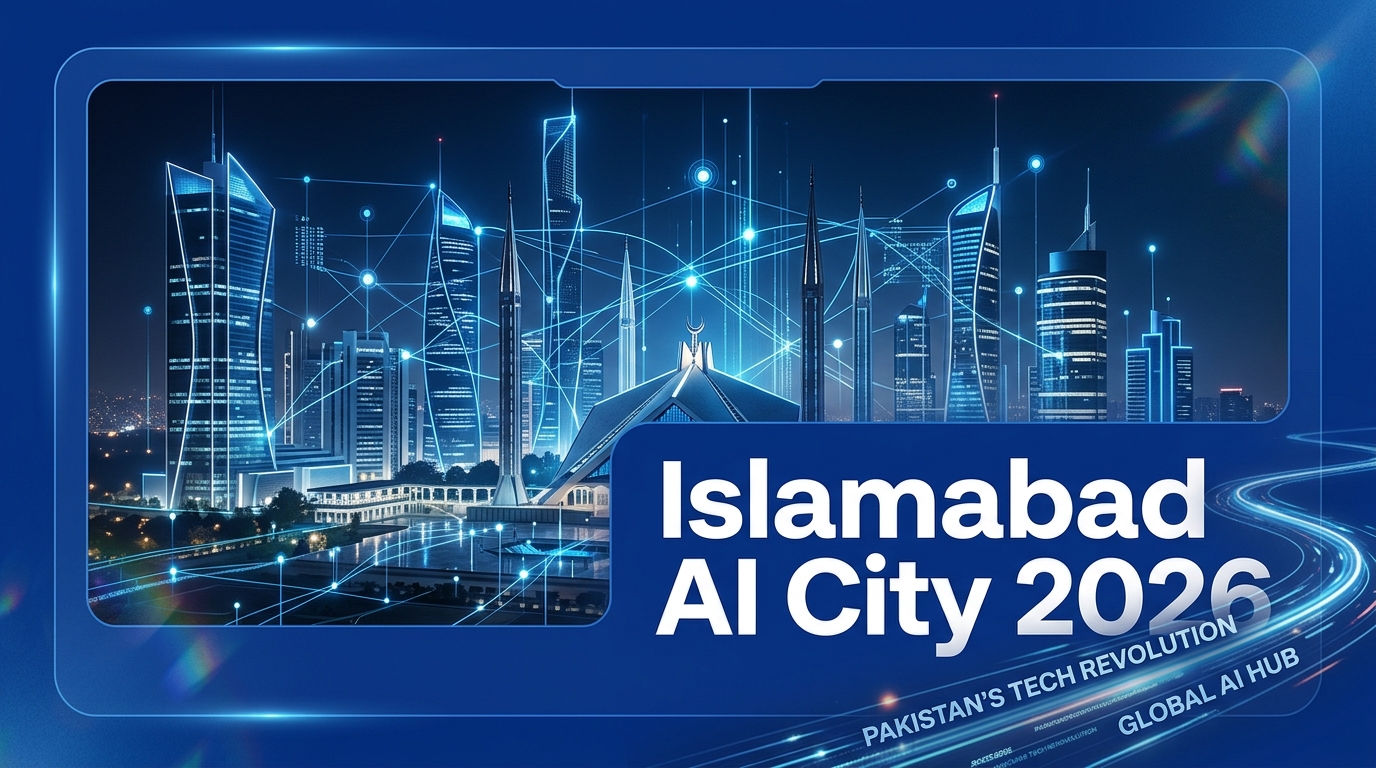
In a landmark move to position Pakistan as a leading tech hub in South Asia, the Ministry of Information Technology and Telecommunication (MoITT) along with the Special Technology Zones Authority (STZA) has officially announced the launch of the Islamabad AI City project.
Modeled loosely on highly successful global tech hubs like Dubai Internet City and Silicon Valley, the Islamabad AI City is a massive, multi-billion rupee infrastructure project designed specifically to attract global artificial intelligence firms, foster local tech startups, and aggressively push Pakistan’s IT exports beyond the critical $5 billion mark by 2028.
What is the Islamabad AI City?
The Islamabad AI City will be a state-of-the-art, purpose-built technology park spanning over 200 acres in the capital territory. It is engineered from the ground up to provide the specialized infrastructure required for deep tech, machine learning (ML), and artificial intelligence (AI) development.
Key highlights of the project include:
1. 10-Year Tax Holiday for Tech Firms
To aggressively incentivize foreign direct investment (FDI) and lure in global tech giants, the government has announced a comprehensive 10-year tax holiday for all registered AI, Web3, and cloud computing firms operating within the AI City limits. This includes exemptions on corporate tax, customs duties on imported networking equipment, and dividend taxes.
2. Tier-4 AI Data Centers
Training Large Language Models (LLMs) requires massive computational power. The AI City will house several government-subsidized Tier-4 data centers. These facilities will offer local startups access to high-performance GPU clusters at subsidized rates, eliminating the need to rely entirely on expensive foreign cloud providers like AWS or Google Cloud. For enterprises requiring absolute control, deploying Dedicated Servers within these high-speed local nodes will dramatically reduce latency.
3. One-Window FDI Operation
Historically, bureaucratic red tape has been a major hurdle for foreign companies entering the Pakistani market. The AI City will feature an autonomous, one-window regulatory body to streamline business registration, visa processing for foreign experts, and intellectual property (IP) protection.
The Impact on Freelancers and Startups
Pakistan already boasts one of the largest freelance workforces in the world, ranking highly on platforms like Upwork and Fiverr. However, the transition from individual freelancing to building scalable tech startups has been slow due to a lack of infrastructure.
The Islamabad AI City includes a massive startup incubator and co-working space designed to house over 500 emerging companies. By placing local talent in the same geographic ecosystem as international tech firms, the government hopes to spark a massive transfer of skills and technology.
Furthermore, the integration of seamless internet gateways and advanced Virtual Private Servers (VPS) will allow these startups to build, test, and deploy AI-driven web applications faster than ever before.
Looking Forward: A $5 Billion Export Target
Currently, Pakistan’s IT exports hover around the $3 billion mark. While impressive, industry experts believe the country is punching far below its weight given its massive, young, English-speaking population.
The Islamabad AI City is the cornerstone of the “Digital Pakistan 2030” vision. By providing world-class infrastructure and unmatchable financial incentives, the government aims to add an additional $2 billion to the IT export ledger within the next 24 months.
As the physical infrastructure breaks ground this quarter, all eyes are on the capital to see if this ambitious vision will finally unlock Pakistan’s true potential in the global digital economy.
