
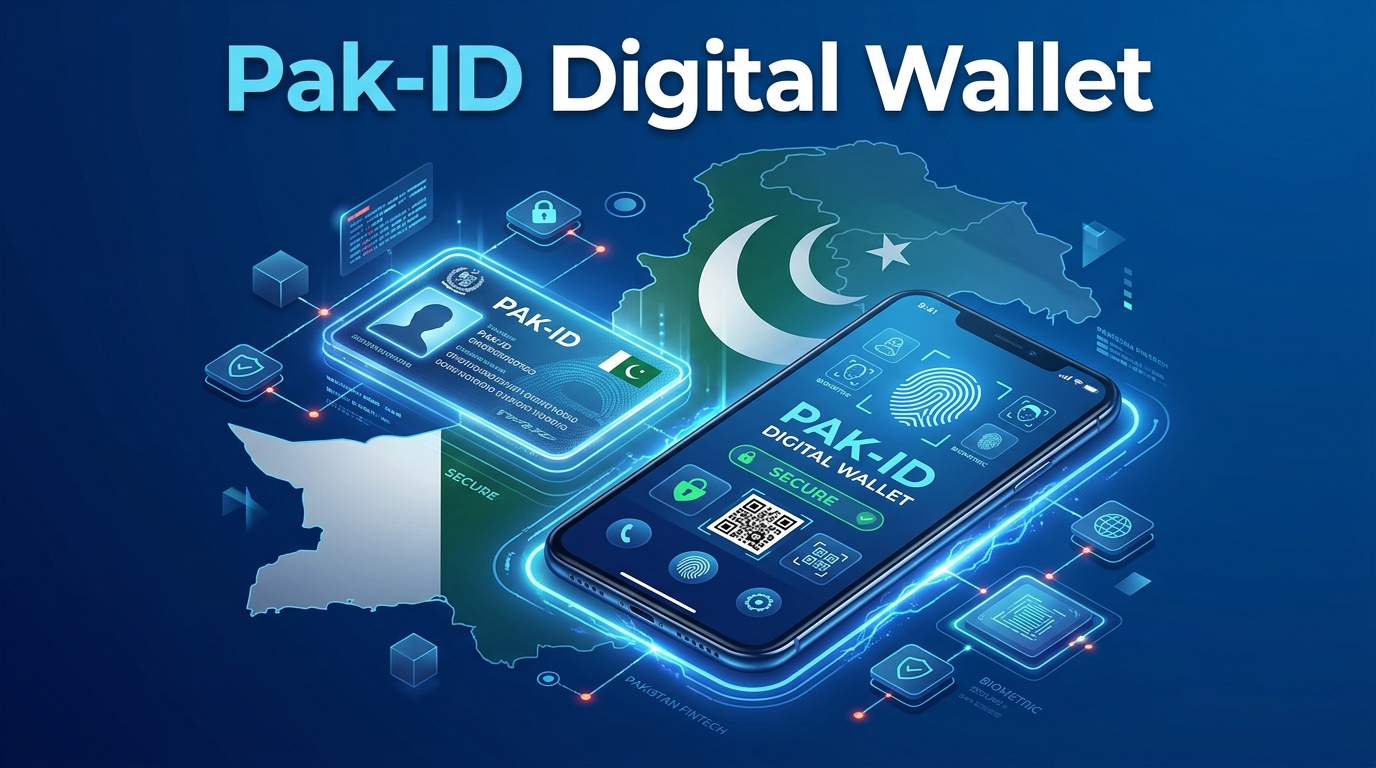
In a watershed moment for Pakistan’s digital transformation agenda, the National Database and Registration Authority (NADRA) has officially launched the Pak-ID Digital Identity Wallet — a smartphone application that allows Pakistani citizens to carry a verified, cryptographically secure digital identity and use it to access government and private sector services without physical documentation.
The launch marks the full operationalization of the framework first announced in the Pakistan Digital Identity Wallet Initiative of 2026, and positions Pakistan among a small group of developing nations with a functioning, population-scale digital ID infrastructure.
What is the Pak-ID Wallet?
The Pak-ID Wallet is a mobile application (available on Android and iOS) that stores a citizen’s verified identity credentials — including their CNIC number, biometric verification status, and government-issued digital certificates — in an encrypted, tamper-proof format on their device.
Unlike a simple photocopy of a CNIC, the Pak-ID Wallet uses Public Key Infrastructure (PKI) to generate verifiable credentials. When a citizen presents their Pak-ID at a service counter or an online portal, the system performs a real-time cryptographic verification against NADRA’s central database — confirming the identity is genuine without transmitting the underlying sensitive data.
Services Now Accessible via Pak-ID
At launch, the Pak-ID Wallet enables seamless, paperless access to over 50 government services, including:
- FBR Tax Filing: Pre-filled tax returns using income data from the Pak-ID ecosystem
- Driving License Renewal: Full online renewal without a physical visit to MTMIS
- Property Registration: Digital verification for property deed registrations at Sub-Registrar offices
- Bank Account Opening: KYC (Know Your Customer) verification for opening accounts at participating banks — completely digitally
- SIM Card Registration: Telcos can now verify new subscribers via Pak-ID, eliminating the physical biometric verification requirement
- Passport Applications: Pre-filled applications with verified NADRA data, reducing processing time
Infrastructure Implications for the Private Sector
The Pak-ID ecosystem creates a powerful new API layer for the private sector. Businesses registered with NADRA can integrate the Pak-ID Verification API into their own platforms, enabling instant, verified customer onboarding.
For fintech companies and digital banks — particularly those already operating under the SBP Open Banking Framework — this is transformative. Customer onboarding that previously required 3-5 days of manual document verification can now be completed in under 60 seconds.
Companies building on this infrastructure will require robust, secure backend servers to handle the API calls and store citizen data in compliance with Pakistan’s data residency regulations. This makes dedicated Pakistan-based cloud servers not just a preference, but a regulatory requirement.
Privacy and Security Architecture
NADRA has stated that the Pak-ID Wallet uses a “data minimization” approach — service providers only receive the specific verified attribute they request (e.g., “Is this person over 18?” or “Is this CNIC number valid?”) rather than the full underlying data record.
The cryptographic keys are stored in the device’s secure enclave (equivalent to Apple’s Secure Enclave or Android’s StrongBox), meaning even if the phone is physically stolen, the credentials cannot be extracted without the citizen’s biometric authentication.
