
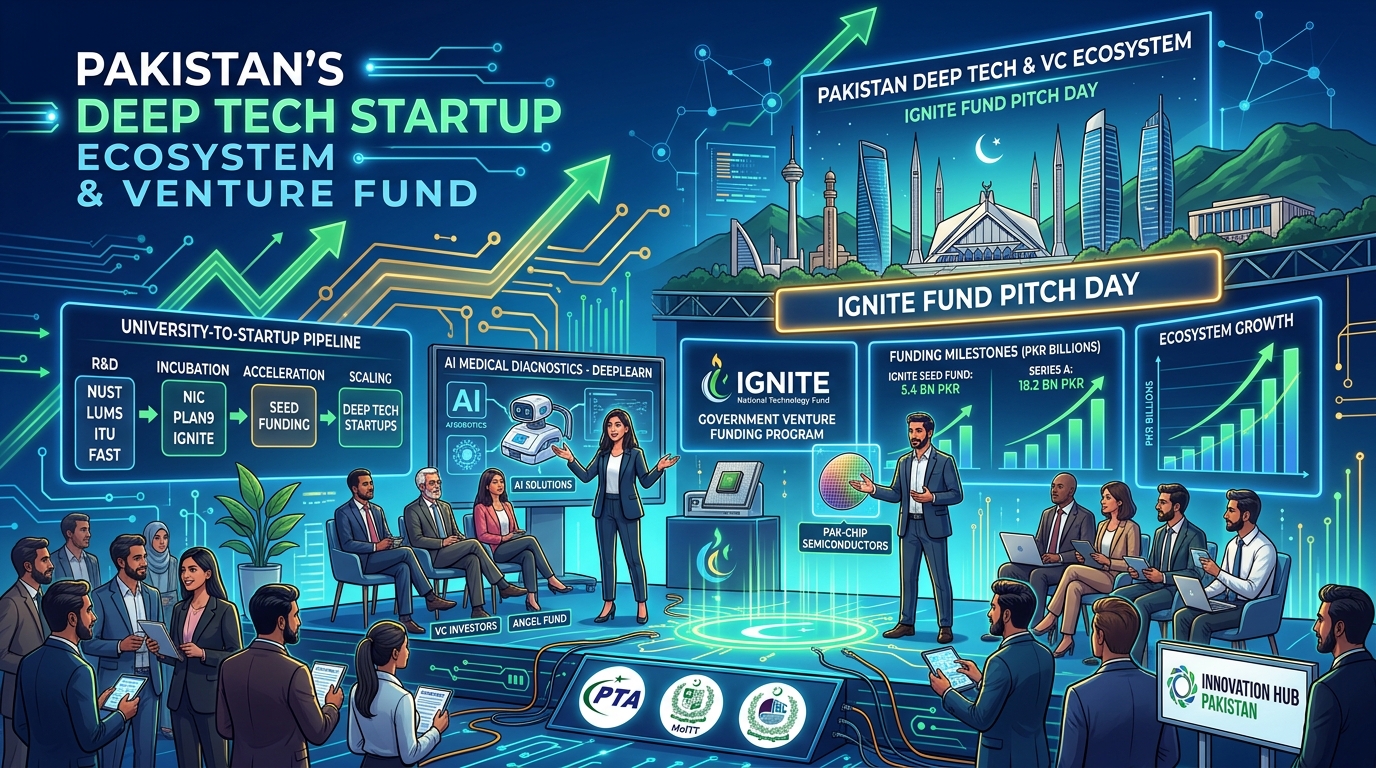
In the most significant government investment in Pakistan’s technology startup ecosystem to date, Ignite National Technology Fund — operating under the Ministry of IT and Telecom — has announced the launch of a PKR 5 billion Deep Tech Commercialization Program designed to transform research outputs from Pakistan’s leading engineering institutions into globally competitive, venture-backed companies.
The announcement, made at a ceremony attended by the Federal Minister for IT and senior representatives from NUST, LUMS, IBA, FAST-NUCES, and ITU, positions Pakistan as a serious contender in the global deep tech race — joining India, Bangladesh, and Vietnam in building government-backed pipelines from university laboratories to startup scale-up.
Program Structure and Funding Tiers
The PKR 5 billion corpus is structured across three distinct funding tiers, designed to support startups from laboratory prototype through Series A readiness:
Tier 1: Research Commercialization Grants (PKR 500M pool)
- Target: University research teams at prototype stage
- Grant size: PKR 5–25 million per team (non-dilutive)
- Eligibility: Must have demonstrable IP from a Pakistani university lab
- Focus sectors: AI/ML models, semiconductor IP cores, quantum algorithms, biotech
Tier 2: Ignite Seed Fund (PKR 2B pool)
- Target: Post-grant startups with validated prototype and initial market traction
- Investment size: PKR 25–150 million (equity-based, 10–20% stake)
- Co-investment: Matched 1:1 by private angel syndicates registered with SECP
- Board seat: Ignite takes one observer seat; no operational control
Tier 3: Scale-Up Bridge (PKR 2.5B pool)
- Target: Revenue-generating deep tech companies preparing for Series A
- Investment size: PKR 150–500 million
- Condition: Must be on track for $1M ARR within 18 months
- International linkage: Co-investment rights offered to Singapore’s SGInnovate and UAE’s Hub71
Priority Sectors and Strategic Rationale
Ignite’s deep tech program explicitly targets five strategic sectors where Pakistan has demonstrated academic strength but minimal commercialization:
1. Artificial Intelligence & Machine Learning
Pakistan produces over 3,000 AI/ML graduates annually from NUST, LUMS, and FAST-NUCES alone. Despite this talent depth, fewer than 50 Pakistan-origin AI startups have raised Series A funding globally. The program targets 200 AI startup formations by 2028, with a focus on Urdu/regional language NLP models, medical imaging diagnostics, and precision agriculture AI. This builds directly on Pakistan’s sovereign AI LLM development initiative announced earlier this year.
2. Semiconductor Design (Fabless)
Following Pakistan’s semiconductor design hub launch in Lahore, the Ignite program will fund 15–20 fabless chip design startups targeting RISC-V processor cores, IoT sensor ASICs, and 5G modem chiplets. Pakistan’s electrical engineering graduates are already employed by Qualcomm, Intel, and MediaTek globally — the program aims to retain this talent domestically.
3. Quantum Computing Applications
Building on the Pakistan National Quantum Computing Initiative, Ignite will fund algorithm-layer startups focusing on quantum optimization for logistics, financial risk modeling, and drug discovery — areas where Pakistan’s pharmaceutical and textile sectors represent immediate commercial applications.
4. AgriTech with AI Integration
Pakistan’s agriculture sector employs 37% of the workforce but suffers from yield inefficiencies costing the economy $8–12 billion annually. Deep tech startups applying computer vision, IoT soil sensing, and predictive weather AI to crop management are a priority vertical.
5. HealthTech & Biotech
Diagnostic AI for tuberculosis, dengue, and hepatitis C — diseases disproportionately affecting Pakistan’s population — represents a high-impact commercialization opportunity. Startups in this vertical qualify for additional support from the National Institute of Health (NIH) Pakistan.
Infrastructure Requirements: Why Sovereign Hosting Matters
A critical condition across all Tier 2 and Tier 3 funded startups is data sovereignty compliance under the SBP and SECP digital data residency frameworks. All user data, model training datasets, and inference infrastructure must be hosted on Pakistan-domiciled servers.
This requirement is driving immediate demand for enterprise-grade Pakistan VPS and cloud infrastructure among funded startups, as international cloud providers without Pakistani PoPs are non-compliant by default under the Ignite program’s data governance conditions.
University Pipeline Partners
Ignite has formalized commercialization pipeline agreements with eight Pakistani universities:
| University | Deep Tech Focus | Tech Transfer Office |
|---|---|---|
| NUST | Aerospace AI, Defense Tech, Robotics | NUST TTO (established 2024) |
| LUMS | Fintech AI, Management Science AI | LUMS Innovation Office |
| FAST-NUCES | Computer Vision, NLP, Blockchain | FAST Entrepreneurship Center |
| IBA Karachi | Financial AI, AgriTech | IBA AMAN CED |
| UET Lahore | Civil Engineering AI, Smart Cities | UET Innovation Hub |
| ITU Lahore | AI Policy, E-Governance Tech | ITU Tech Park |
| NED Karachi | Manufacturing AI, Industrial IoT | NED Research & Development Cell |
| COMSATS | Cybersecurity, Quantum | COMSATS TTO |
International Co-Investment and Exit Pathways
Ignite has secured Memoranda of Understanding with five international deep tech investors willing to co-invest in Tier 3 portfolio companies:
- Singapore’s SGInnovate — quantum computing and deep tech
- UAE’s Hub71 (Abu Dhabi) — AI and fintech
- UK’s Innovate UK — health tech and biotech
- Saudi Arabia’s Aramco Ventures — energy tech and industrial AI
- Malaysia’s MDEC — digital economy and AI
Exit pathways include strategic acquisition by multinational technology companies (Qualcomm, Huawei, Google, Microsoft have all established Pakistan R&D presences), dual listings on PSX and international exchanges, and SECP-regulated secondary sale mechanisms.
What This Means for Pakistan’s Startup Ecosystem
The PKR 5 billion Ignite Deep Tech program represents a maturation moment for Pakistan’s startup ecosystem — moving beyond consumer internet and e-commerce clone businesses into genuinely novel technology companies with defensible IP and international addressable markets.
If even 10% of funded startups reach Series A, Pakistan could see 15–20 new deep tech companies valued above $10 million by 2028 — a doubling of the country’s current venture-backed technology company count. Combined with the PVCA’s reported $50M seed funding surge in Q3 2026, Pakistan’s startup funding landscape is entering its most dynamic period in history.
