
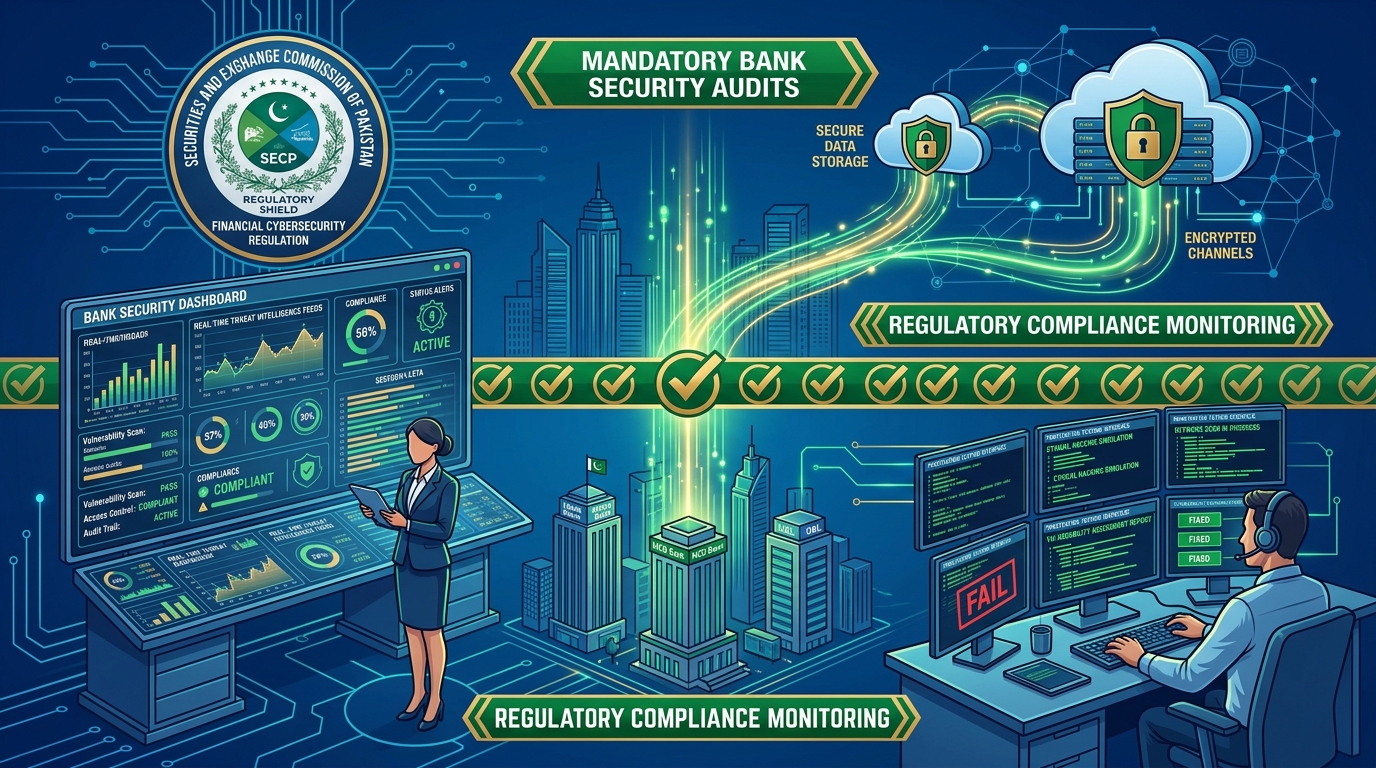
In a landmark regulatory move that signals Pakistan’s rapidly maturing financial cybersecurity posture, the State Bank of Pakistan (SBP) and the Securities and Exchange Commission of Pakistan (SECP) have jointly issued Circular No. BPRD/CSD/2026/09, mandating comprehensive cybersecurity audits for all licensed commercial banks, digital banks, payment service providers, and SECP-regulated fintech companies.
The directive, effective Q4 2026, represents the most sweeping financial sector cybersecurity enforcement action in Pakistan’s history — directly responding to a 340% surge in cyber incidents targeting Pakistani financial infrastructure recorded in the first half of 2026.
Scope of the Mandatory Audit Framework
The joint SBP-SECP circular covers all entities operating under the following license categories:
- Commercial and Islamic Banks (all 33 licensed institutions)
- Electronic Money Institutions (EMIs) including JazzCash, EasyPaisa, NayaPay, and Sadapay
- Payment System Operators (PSOs) including 1LINK and RAAST operators
- SECP-regulated crowdfunding and digital asset platforms
- Fintech startups operating under the SBP Regulatory Sandbox
Each regulated entity must complete four mandatory audit components by December 31, 2026.
The Four Mandatory Audit Components
1. Annual Penetration Testing (Mandatory)
All covered entities must commission an independent penetration test conducted by a CREST-certified or PASHA-accredited cybersecurity firm. The test must cover:
- External network attack surface (internet-exposed APIs, web portals)
- Internal network segmentation and lateral movement risks
- Mobile banking application security (OWASP Mobile Top 10)
- SWIFT/messaging infrastructure hardening
The FBR’s earlier mandate requiring penetration testing for fintech startups set a precedent for this broader SBP expansion to the full banking sector.
2. Data Residency Verification Audit
Building on the SBP’s landmark data residency directive for digital banks, the new circular extends residency verification to all covered entities. Auditors must confirm:
- 100% of customer PII stored on Pakistan-domiciled servers or SBP-approved sovereign cloud infrastructure.
- Real-time transaction data processed exclusively within Pakistani jurisdiction.
- Disaster recovery systems with secondary copies also hosted locally.
This requirement is accelerating enterprise migration to Pakistan VPS and local cloud infrastructure, as international cloud providers operating without Pakistani PoPs are now non-compliant by default.
3. Incident Response Certification
Entities must maintain a certified Cyber Incident Response Plan (CIRP) and demonstrate:
- A documented response playbook covering ransomware, DDoS, and insider threats.
- A 24-hour mandatory breach notification SLA to the SBP’s newly established National Cybersecurity Incident Response Centre (NCIRC).
- Quarterly tabletop exercises with results submitted to regulators.
4. Third-Party Vendor Risk Assessment
The circular extends audit requirements to third-party technology vendors, requiring banks to:
- Maintain a complete inventory of all software and cloud vendors with access to customer data.
- Conduct annual security assessments of critical vendors.
- Terminate relationships with vendors failing minimum security standards within 90 days.
Industry Response: Compliance Timelines and Costs
Major banks including HBL, UBL, MCB, and Meezan Bank have already acknowledged the circular and begun procurement for audit services. Industry estimates place compliance costs at PKR 15–45 million per institution depending on size and existing security maturity.
For emerging fintech startups operating under regulatory sandbox licenses, SECP has announced a subsidized compliance support program providing access to government-rate penetration testing through PASHA-affiliated firms.
Why Local Data Residency Is Now a Competitive Advantage
The data residency audit requirement is creating an immediate competitive moat for locally hosted financial infrastructure. Banks and fintechs using offshore cloud providers (AWS Mumbai, Azure Singapore) without Pakistani data center redundancy now face audit risk.
Infrastructure providers offering fully sovereign, Pakistan-based server capacity are rapidly gaining enterprise fintech clients seeking to eliminate regulatory exposure while maintaining the performance standards expected by digital banking customers.
What This Means for Pakistan’s Cybersecurity Ecosystem
This regulatory evolution has three major downstream effects:
- Rapid growth of domestic cybersecurity firms — expect 3–5x revenue growth for PASHA-accredited security auditors in 2026–2027.
- Accelerated sovereign cloud adoption — financial sector demand for locally hosted infrastructure will drive significant capacity expansion.
- Talent demand surge — certified ethical hackers (CEH, OSCP) and cloud security architects will command premium salaries from banks competing for compliance talent.
Pakistan’s financial sector is undergoing a genuine security transformation — moving from reactive breach response to proactive, regulation-driven security culture. For the country’s broader digital economy ambitions, this mandatory audit framework may prove to be one of the most consequential regulatory decisions of the decade.
