
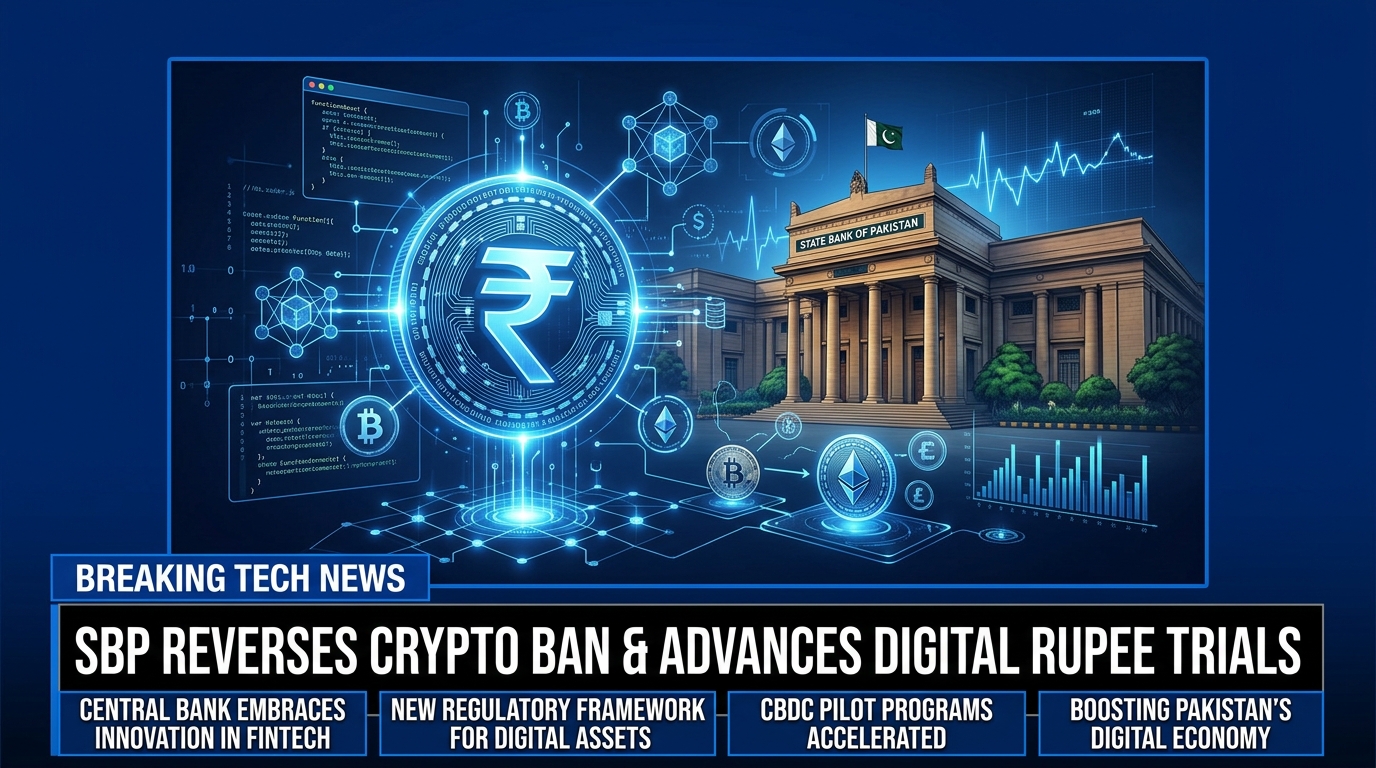
In what is being hailed as a monumental turning point for the nation’s digital economy, the State Bank of Pakistan (SBP) has officially enacted major policy reversals regarding digital assets in 2026, while simultaneously advancing its own Central Bank Digital Currency (CBDC) project.
Following years of regulatory uncertainty, the landscape of Pakistani fintech is undergoing rapid modernization to align with global financial standards.
The Reversal of the Crypto Banking Ban
Perhaps the biggest news to hit the tech sector in August 2026 is the SBP’s formal rollback of the 2018 restrictions that prohibited banks from facilitating cryptocurrency transactions.
Spurred by the passage of the Virtual Assets Act 2026, the establishment of the Pakistan Virtual Assets Regulatory Authority (PVARA) has provided a clear legal framework. Under the new SBP Circular 10/2026, commercial banks are now permitted to open segregated accounts for PVARA-licensed virtual asset service providers (VASPs) and crypto exchanges. This allows Pakistani citizens to legally and securely purchase digital assets through regulated local channels, effectively killing the massive unregulated P2P grey market.
The Advance of the Digital Rupee
Alongside regulating private cryptocurrencies, the State Bank is accelerating its own digital ambitions. The “Digital Rupee” (the SBP’s retail CBDC) has officially entered its second phase of closed-loop sandbox trials.
What to Expect from the CBDC
The primary goal of the Digital Rupee is to promote financial inclusion, drastically reduce domestic transaction costs, and combat the black economy. The SBP is testing a hybrid architecture that allows for instant clearing while maintaining rigorous AML/CFT (Anti-Money Laundering) compliance. Official sources indicate that a limited public pilot involving select commercial banks—such as the newly approved digital-first HugoBank—is targeted for late 2026.
Infrastructure Demands for the New Fintech Era
The legalization of crypto exchanges and the impending rollout of a CBDC present massive opportunities for local software houses and Web3 startups. However, dealing with financial data and blockchain ledger synchronization introduces extremely high infrastructure requirements.
Why Fintech Requires Local Hosting
Hosting decentralized finance (DeFi) apps, crypto wallet interfaces, and exchange matching engines requires zero-latency execution and ironclad data security. Relying on offshore cloud environments poses significant compliance risks under the new PVARA regulations.
To meet these strict regulatory demands, Pakistani fintech startups are deploying their infrastructure locally. By utilizing Nextgen Hosting’s Dedicated Servers and KVM VPS environments, financial platforms can guarantee:
- Data Sovereignty: Keeping all transaction logs and user KYC data strictly within Pakistan’s borders, ensuring full compliance with SBP and PVARA audits.
- High-Frequency Execution: Local hosting provides the sub-millisecond ping required for high-frequency crypto trading algorithms and real-time wallet balance updates.
- Unhindered Uptime: Financial institutions cannot afford international routing disruptions. A local server bypasses the National Firewall entirely, ensuring 100% uptime for local users.
Conclusion
The SBP’s progressive stance in 2026 marks the beginning of a new chapter for Pakistan’s tech industry. As the regulatory hurdles vanish, the race to build the next generation of financial infrastructure has begun. For startups looking to capitalize on this boom, securing enterprise-grade local server infrastructure is the critical first step.
