
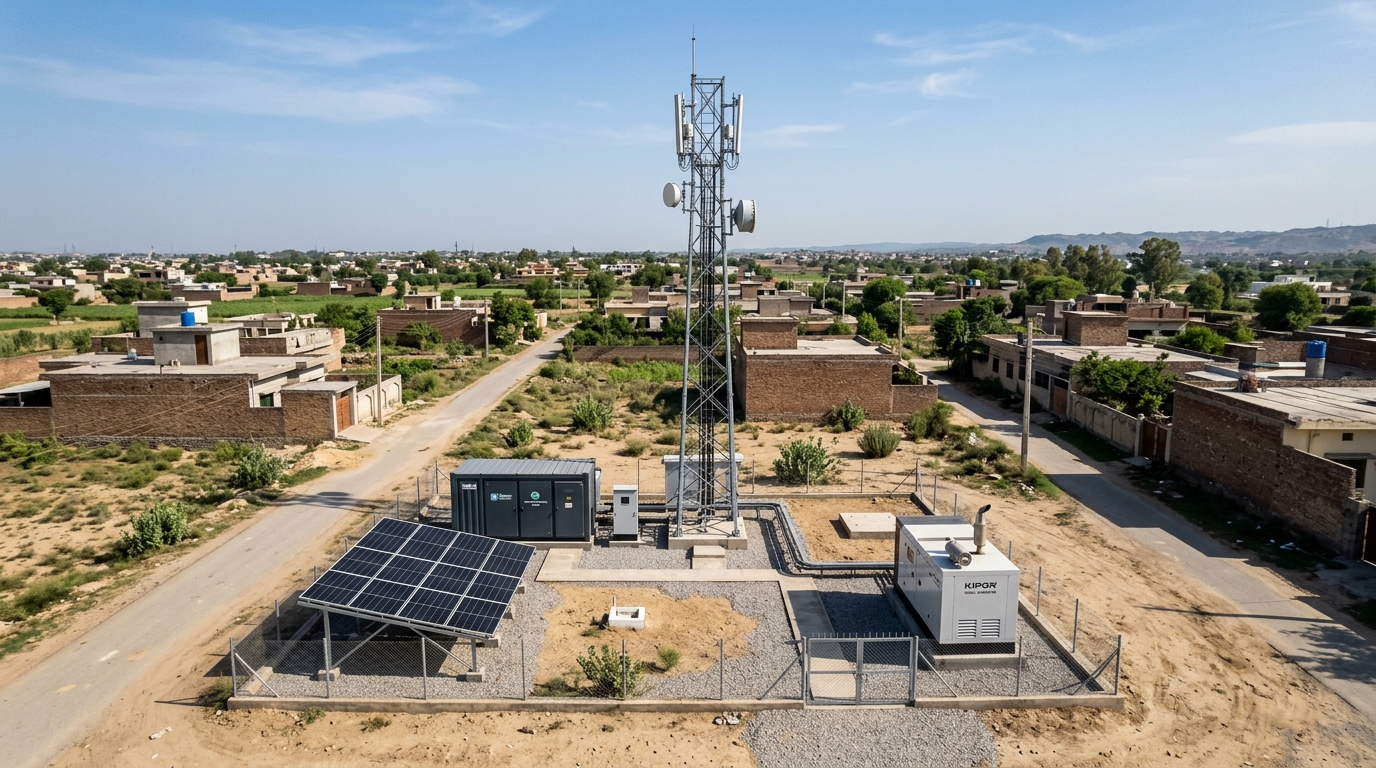
In response to mounting public complaints regarding dropped calls, degraded data speeds, and intermittent signal blackouts during grid outages, the Pakistan Telecommunication Authority (PTA) has launched an aggressive, nationwide physical inspection blitz targeting backup power infrastructure across Pakistan’s telecommunications cell sites.
Directed personally by PTA Chairman Major General (Retd.) Hafeez Ur Rehman, specialized technical inspection squads from all nine PTA zonal directorates—Karachi, Lahore, Rawalpindi, Peshawar, Quetta, Multan, Faisalabad, Abbottabad, and Muzaffarabad—have deployed to conduct rigorous, on-site audits of auxiliary power systems at urban rooftops, suburban ground-based towers, and remote rural base transceiver stations (BTS).
The regulatory offensive targets critical power continuity hardware: valve-regulated lead-acid (VRLA) and Lithium Iron Phosphate (LiFePO4) battery banks, automated diesel generator (DG) sets, automatic transfer switches (ATS), and solar photovoltaic (PV) hybrid installations operated by Mobile Network Operators (MNOs—Jazz, Zong, Telenor, and Ufone/PTCL) as well as independent Tower Companies (TowerCos such as Engro Enfrashare, edotco Pakistan, and TAWAL).
The Catalyst: Power Grid Fragility and Cellular Network Dropouts
Over the past two years, the compounding pressures of rising grid electricity tariffs, localized power distribution company (DISCO) feeder tripping, and scheduled load-shedding have severely stressed Pakistan’s cellular access layer. Under optimal operational standards, a base station is engineered to transition instantaneously from utility power to direct current (DC) battery backup, bridging the gap until automated diesel generators fire up or secondary solar arrays supply the load.
In practice, however, thousands of suburban and rural cell towers have suffered from:
- Severely Degraded Battery Capacities: Traditional lead-acid battery strings subjected to multiple daily deep discharge cycles degrade prematurely, failing within 20 to 45 minutes of a power cut rather than providing the mandatory 4 to 8 hours of autonomous reserve.
- Generators Missing or Dry: Soaring high-speed diesel (HSD) prices and fuel pilferage risks have led subcontractors to operate generators on minimal fuel reserves, leading to generator start failures when utility power drops.
- Theft of Battery Packs: Cellular tower sites—particularly in isolated corridors of Khyber Pakhtunkhwa, rural Sindh, and Balochistan—have been plagued by organized thefts of high-density lithium-ion battery modules, leaving towers instantly dead the moment the grid trips.
- Thermal Throttling of Baseband Equipment: Extreme summer temperatures exceeding 45°C overwhelm under-maintained air conditioning and heat exchangers within BTS shelters, prompting automated thermal shutdowns of power amplifiers and RF transceivers.
When a cell tower shuts down unexpectedly, neighboring towers experience sudden signal overload as mobile devices automatically ramp up broadcast power to establish handshake connections with distant sites. This triggers cascading handoff failures, packet loss spikes exceeding 25%, and widespread voice call drops across adjacent neighborhoods.
PTA Zonal Inspection Scope and Audit Mandate
The PTA inspection squads are examining physical infrastructure parameters that directly dictate field survivability:
| Inspection Dimension | Regulatory Standard & Field Check | Common Point of Failure |
|---|---|---|
| Battery Autonomy & State of Health (SoH) | Minimum 4 to 6 hours continuous discharge capacity under full active RF load | Internal resistance degradation, cell imbalance, thermal dry-out in VRLA units |
| Diesel Generator (DG) Readiness | Operational fuel tank filled to at least 70% capacity; functional auto-start controller | Dry fuel tanks, faulty starting solenoids, clogged fuel filters, expired lube oil |
| Automatic Transfer Switch (ATS) | Seamless transfer from grid to auxiliary power within 15 to 45 seconds | Mechanical contactor jamming, phase reversal faults, burned relay coils |
| Solar Hybrid Microgrids | Clean PV panel arrays with functioning MPPT solar charge controllers | Heavy dust accumulation reducing yields by >40%, disconnected DC strings |
| Remote Monitoring Units (RMS) | Real-time telemetry transmitting fuel, battery voltage, and door alarms to NOC | Severely delayed or disconnected IoT sensors, lack of SIM data connectivity |
To ensure that field data reflects genuine consumer reality rather than operator-curated metrics, the PTA has instituted a civic partnership mechanism. Regional zonal teams are directly liaising with local elected representatives, trade union bodies, and community nominees to pinpoint micro-geographies where mobile reception systematically vanishes whenever local electricity feeders are de-energized.
TowerCos, Fuel Costs, and the Push for Lithium & Solar Modernization
Pakistan’s telecommunications topology has evolved rapidly from operator-owned infrastructure to a shared passive model. Today, more than 50,000 tower assets are increasingly managed by independent TowerCos, which rent vertical tower space and DC power to multiple tenant operators simultaneously.
While infrastructure sharing reduces capital expenditure, it significantly intensifies the power load per site. A multi-tenant macro tower hosting three operators’ 2G, 3G, 4G LTE, and trial 5G massive MIMO active antenna units (AAUs) can draw anywhere from 3.5 kW to 8 kW of continuous power.
With national grid tariffs exceeding PKR 60 to 75 per kilowatt-hour for commercial connections and commercial diesel generating power at over PKR 120 per kWh, power accounts for more than 45% to 55% of total site operating expenses (OPEX) in Pakistan.
To resolve this sustainably, the PTA is using these audits to accelerate two structural transitions:
1. Mandatory Migration to Lithium Iron Phosphate (LiFePO4)
Unlike traditional lead-acid batteries, modern LiFePO4 cells support deep 80–90% Depth of Discharge (DoD), sustain over 3,500 to 5,000 charge cycles, and operate reliably at ambient temperatures up to 50°C without requiring energy-intensive shelter air conditioning. LiFePO4 modules also feature integrated battery management systems (BMS) with GPS anti-theft tracking, deterring stolen battery syndicates.
2. Standardized Solar-Hybrid Micro-Generators
Operators and TowerCos are being pressured to expand rooftop and ground-mounted solar PV configurations. Under the PTA’s clean energy push, sites with adequate sun exposure must deploy solar generation capable of covering daytime baseline loads, reserving battery and diesel reserves exclusively for evening hours and monsoon grid emergencies.
Stringent Quality of Service (QoS) Penalties Ahead
The nationwide inspection comes under the statutory authority of the Pakistan Telecommunication (Re-organization) Act, 1996 and the updated Telecom Quality of Service Regulations.
Under PTA’s compliance metrics, licensed mobile operators are legally bound to uphold:
- Network Service Availability: ≥ 99.0% continuous uptime across each licensed district.
- Call Drop Rate (CDR): ≤ 1.5% across all operational cells.
- Call Setup Success Rate (CSSR): ≥ 98.0%.
- Minimum Mobile Data Download Throughput: Consistently enforced thresholds across 4G LTE coverage footprints.
Zonal directors have been instructed to issue formal Show Cause Notices (SCNs) and impose statutory financial penalties on licensees whose sites fail physical backup power verification. Where repeat outages are documented, operators risk administrative fines of up to hundreds of millions of rupees, alongside mandated infrastructure remediation deadlines.
Why Mission-Critical Digital Services Cannot Rely on Fragile Edge Grids
The PTA’s high-profile tower audits spotlight a harsh reality for businesses operating in Pakistan: distributed public infrastructure is highly vulnerable to energy shocks.
While telecom operators battle to keep distributed suburban cell sites powered during rolling blackouts, financial institutions, enterprise software houses, logistics platforms, and SaaS startups cannot afford even a single millisecond of downtime. When edge towers fluctuate, consumer endpoints may reconnect slowly, but mission-critical database backends, ERP applications, and e-commerce APIs must remain unshakeably stable.
+-----------------------------------------------------------------------------------+
|                           INFRASTRUCTURE AVAILABILITY MATRIX                       |
+------------------------------------+----------------------------------------------+
| Distributed Cell Site (Edge Layer) | Tier-3 Enterprise Data Center (Core Hosting) |
+------------------------------------+----------------------------------------------+
| Single-point utility grid feeder   | Dual-redundant 11kV independent grid feeds   |
| Battery autonomy: 1-4 hours        | Multi-megawatt N+1 UPS battery flywheels     |
| Small local diesel gen (unattended)| Dual N+1 emergency generators with bulk fuel |
| Vulnerable to ambient heat/theft   | 24/7 armed security & precision HVAC cooling |
| Target SLA: 98% - 99%              | Guaranteed SLA: 99.99% - 99.999%             |
+------------------------------------+----------------------------------------------+
Enterprises that run core transaction engines or mission-critical customer portals cannot leave their backend hosting vulnerable to local power cuts or unmanaged shared server environments. For organizations demanding guaranteed uninterrupted connectivity, low-latency Pakistan routing, and complete hardware isolation, investing in high-performance Dedicated Servers in Pakistan deployed in carrier-grade, Tier-3 colocation facilities ensures continuous operation regardless of municipal grid load-shedding.
Similarly, for Pakistani software export firms and tech startups serving global enterprise clients across North America, Europe, and the Middle East, enterprise Dedicated Servers situated in global hyperscale availability zones provide the fault tolerance, hardware isolation, and zero-downtime reliability required to meet stringent international service-level agreements.
What Telecom Consumers Can Expect in Q4 2026
As PTA teams conclude their field surveys in late 2026, mobile subscribers across Pakistan can expect several tangible shifts:
- Resolution of Persistent “Dark Spots”: Chronic dead zones in secondary cities such as Gujranwala, Sukkur, Mardan, and Sahiwal will see direct remediation as operators are forced to replace depleted battery banks and repair automatic generators.
- Prioritization of Critical Hubs: Hub sites that relay microwave and fiber backhaul for surrounding secondary towers are receiving upgraded dual-battery systems to prevent wide-area chain-reaction blackouts.
- Transparent Outage Reporting: PTA is working toward an automated outage logging portal where localized cellular disruptions are mapped in real-time, providing regulatory oversight over mobile operators’ Mean Time to Restore (MTTR).
As Pakistan accelerates its national digital agenda—with expanding digital banking, instant payment rails through Raast, and the forthcoming commercial rollout of 5G—resilient physical power at the tower level is no longer merely a telecom operational issue; it is a vital pillar of the country’s national economic infrastructure.
Immune to Grid Outages: Enterprise Bare-Metal in Tier-3 Facilities
While cell towers face power and battery constraints, Nextgen Hosting's enterprise servers operate in certified Tier-3 facilities with dual N+1 diesel generators, automatic transfer switches (ATS), and uninterruptible battery banks for guaranteed 99.99% uptime.
Related Articles & Regulatory Insights
- PTA 5G Spectrum Auction Framework & Commercial Rollout Details
- PTA Subsea Cable Resilience: 200Tbps Redundancy for Gwadar and Karachi
- SBP & SECP Mandate Comprehensive Cybersecurity Audits for Financial Institutions
- PTA Satellite Broadband Licensing & Non-Geostationary Gateway Mandates
- High-Performance Pakistan VPS & Sovereign Cloud Hosting Solutions
