
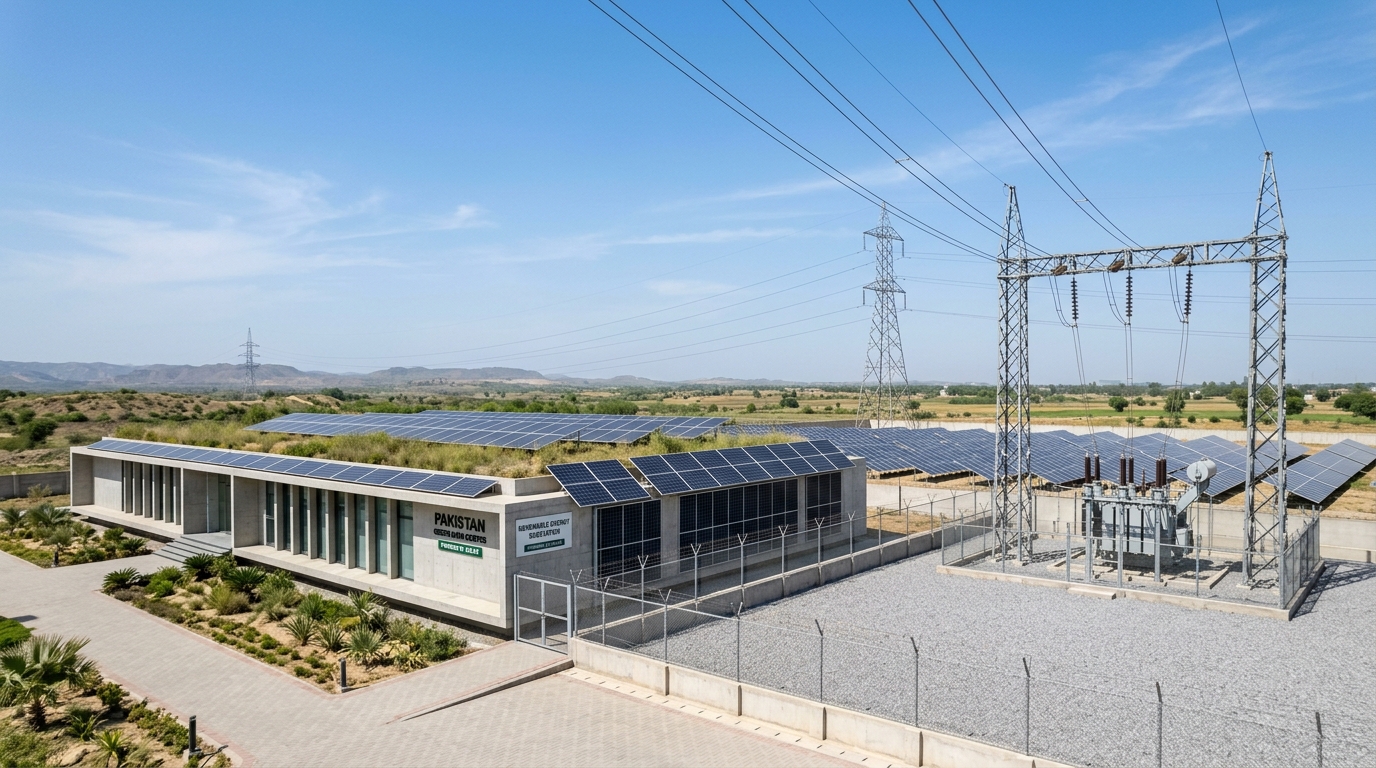
In a structural breakthrough for Pakistan’s digital economy and infrastructure competitiveness, the National Electric Power Regulatory Authority (NEPRA), in joint coordination with the Ministry of Information Technology and Telecommunication (MoITT) and the Ministry of Energy (Power Division), has officially notified the bilateral green energy wheeling framework under the Competitive Trading Bilateral Contract Market (CTBCM).
The regulatory determination enables certified Tier-3 and Tier-4 commercial datacenters, high-performance computing (HPC) facilities, and sovereign AI clusters to bypass punitive power distribution company (DISCO) retail surcharges. Datacenter operators can now execute long-term, direct Business-to-Business (B2B) Power Purchase Agreements (PPAs) with independent renewable power producers (IPPs), transmitting clean energy across the national grid via standardized Use-of-System Charges (UoSC).
By decoupling digital infrastructure from volatile retail electricity tariffs—which previously climbed to PKR 65–75 per kilowatt-hour (kWh) inclusive of fuel price adjustments, cross-subsidies, and capacity payments—the new CTBCM wheeling regime slashes the effective cost of delivered electricity for high-density compute facilities to sub-PKR 25/kWh ($0.089/kWh). The policy eliminates the single largest operating-cost impediment that historically thwarted regional hyperscalers and domestic cloud providers from deploying multi-megawatt facilities on Pakistani soil.
The Energy Cost Crisis: How DISCO Tariffs Strangled Digital Infrastructure
Electricity consumption represents between 55% and 70% of total operational expenditure (OpEx) for enterprise datacenters and high-density GPU clusters. Prior to the operationalization of the CTBCM wheeling framework, commercial datacenters in Pakistan were categorized under conventional DISCO commercial and industrial tariffs (A-2 and B-3 categories).
This classification subjected mission-critical compute infrastructure to structural grid distortions:
flowchart TD
    subgraph Legacy_DISCO_Tariff["Legacy DISCO Commercial Tariff Structure (PKR 65 - 75/kWh)"]
        A1["Base Energy Charge: PKR 28 - 32/kWh"]
        A2["Capacity Purchase Price (CPP): PKR 18 - 22/kWh"]
        A3["Fuel Charges Adjustment (FCA) & Quarterly Adjustments (QTA): PKR 6 - 10/kWh"]
        A4["Cross-Subsidies & Debt Servicing Surcharges: PKR 8 - 12/kWh"]
        A5["Sales Tax & Electricity Duty: 17% - 19%"]
    end

    subgraph CTBCM_Wheeling_Tariff["CTBCM Green Wheeling Cost Structure (Sub-PKR 25/kWh)"]
        B1["Renewable Levelized PPA (Solar/Wind/Hydro): PKR 11 - 14/kWh"]
        B2["Transmission Use of System Charge (TUOS): PKR 2.80 - 3.20/kWh"]
        B3["Standardized Wheeling Line Losses: PKR 1.20 - 1.60/kWh"]
        B4["System Operator Balancing & Ancillary Reserve: PKR 2.00 - 2.50/kWh"]
        B5["Net Effective Power Cost: PKR 17.00 - 21.30/kWh"]
    end
Under the legacy framework, datacenter operators bore the systemic burden of sovereign sovereign debt retirement, circular debt levies, and cross-subsidization of under-recovering agricultural and domestic consumer feeders. A standard 10-megawatt (MW) Tier-3 datacenter operating at an 85% utilization rate faced an annual power bill exceeding PKR 5.2 billion ($18.6 million), rendering domestic facilities non-competitive against regional hubs in Dubai, Bahrain, and Muscat, where industrial power costs range from $0.065 to $0.085/kWh.
The CTBCM determination permanently insulates digital infrastructure from these legacy market inefficiencies by transitioning certified datacenters from “passive captive consumers” to Bulk Power Consumers (BPCs) with open-access grid eligibility.
Technical Wheeling Mechanics: Grid Interconnects, TUOS, and Real-Time Balancing
The operationalization of the bilateral market relies on a multi-layered regulatory and transmission architecture administered by the Central Power Purchasing Agency (CPPA-G) acting as the Market Operator (MO), and the National Transmission & Despatch Company (NTDC) acting as the System Operator (SO).
flowchart LR
    subgraph Generation_Zone["Renewable Generation Corridors"]
        SOLAR["Cholistan & Sukkur Solar PV Parks (50MW - 200MW)"]
        WIND["Jhimpir & Gharo Wind Corridor (Turbine Arrays)"]
        HYDRO["KP & AJK Run-of-the-River Hydroelectric Stations"]
    end

    subgraph Transmission_Grid["National Grid Backbone (NTDC High-Voltage Mesh)"]
        STEP_UP["500kV / 220kV Step-Up Substation Interconnect"]
        WHEEL["Bilateral Open Access Wheeling via NTDC Mesh"]
        LOSS["Loss Accounting & SCADA Metering (0.8% - 1.8%)"]
    end

    subgraph Consumption_Point["Carrier-Neutral Datacenter Facilities"]
        STEP_DOWN["132kV / 11kV Dedicated Dedicated Substation"]
        BESS["Battery Energy Storage System (BESS) 4-Hour Buffer"]
        DC["Tier-3 / Tier-4 Datacenter / GPU Compute Floor"]
    end

    SOLAR --> STEP_UP
    WIND --> STEP_UP
    HYDRO --> STEP_UP
    STEP_UP --> WHEEL
    WHEEL --> LOSS
    LOSS --> STEP_DOWN
    STEP_DOWN --> BESS
    BESS --> DC
Transmission Use-of-System Charges (TUOS / UoSC)
Under NEPRA’s notified determination, the national average Transmission Use-of-System Charge (TUOS) has been set at PKR 2.85 per kWh for wheeling over the 500kV and 220kV primary grid, with an additional PKR 0.45 per kWh applicable where wheeling utilizes provincial 132kV transmission lines. Datacenters directly connected to 132kV or 220kV substations are exempt from low-voltage distribution wheeling surcharges, eliminating middle-tier DISCO administrative friction.
Loss Accounting and Settlement
Wheeling power across national transmission corridors incurs natural physical impedance losses. NEPRA has mandated a standardized transmission loss factor ranging between 1.2% and 2.4%, depending on geographical injection and off-take nodes:
- Southern Wind Corridor (Jhimpir/Gharo) to Karachi Tech Hubs: Standardized loss deduction capped at 1.4%.
- Southern Solar Corridors (Cholistan/Guddu) to Central Punjab (Lahore/Sheikhupura): Standardized loss deduction set at 2.1%.
- Northern Run-of-the-River Hydro (Swat/AJK) to Islamabad-Rawalpindi Corridor: Standardized loss deduction capped at 1.8%.
Real-time settlements are recorded via bidirectional, Four-Quadrant High-Accuracy Electronic Smart Meters compliant with IEC 62053-22 Class 0.2S standards, synchronized via GPS clock to NTDC’s National Power Control Center (NPCC) in Islamabad.
Hybrid Baseload Strategy & Battery Storage (BESS)
Because AI model training clusters and enterprise cloud servers demand continuous 24/7/365 baseload reliability, intermittent renewable generation is coupled with multi-resource bilateral contracts and on-site Battery Energy Storage Systems (BESS):
- Daytime Hours (07:00 – 17:00): 100% compute load powered by wheeled utility-scale solar generation from Southern Punjab and Sindh.
- Evening Wind Peaks (17:00 – 23:00): Baseload shifts to wheeled high-velocity coastal wind corridors from Jhimpir.
- Overnight Hours (23:00 – 07:00): Balanced via firm run-of-the-river hydroelectric power wheeled from northern basins, augmented by 4-hour lithium iron phosphate (LiFePO4) BESS banks deployed on-site to handle instantaneous voltage fluctuations and frequency stability.
Green AI Compute: Power Usage Effectiveness (PUE) and GPU Power Densities
The global emergence of generative AI and large language models (LLMs) has fundamentally transformed datacenter rack power requirements. While traditional enterprise workloads require 5kW to 10kW per rack, modern high-density AI clusters—such as NVIDIA HGX H100, H200, and Blackwell B200 systems—require 40kW to 100kW per cabinet.
flowchart TD
    subgraph Compute_Power_Distribution["Rack-Level Power Dynamics (NVIDIA B200 / H100 Pods)"]
        MAINS["132kV Substation Clean Feed (Wheeled Renewable)"]
        UPS["High-Frequency Transformerless UPS (97.5% Efficiency)"]
        CDU["Cooling Distribution Unit (Liquid Direct-to-Chip)"]
        RACK["80kW High-Density GPU Cabinet"]

        MAINS --> UPS
        UPS --> RACK
        UPS --> CDU
        CDU -->|Chilled Coolant Loop| RACK
    end

    subgraph Efficiency_Metrics["Thermal & Efficiency Target Benchmarks"]
        PUE["Target PUE Benchmark: Sub-1.25"]
        WUE["Water Usage Effectiveness (WUE): Zero-Evaporative Cooling"]
        CARBON["Carbon Intensity: Sub-45 gCO2e/kWh (Zero Scope 2)"]
    end

    RACK --> PUE
    CDU --> WUE
    MAINS --> CARBON
Under NEPRA’s CTBCM directives, datacenters qualifying for priority wheeling allocation must satisfy strict environmental and efficiency thresholds:
- PUE Ceiling of 1.25: Datacenter facilities must demonstrate an annualized Power Usage Effectiveness (PUE) below 1.25, verified via third-party energy audits. This mandates the adoption of advanced thermal management, including rear-door heat exchangers, hot-aisle containment, and direct-to-chip liquid cooling loops.
- Renewable Energy Certificates (I-RECs): Power wheeled through the bilateral market comes bundled with verifiable International Renewable Energy Certificates (I-RECs). This allows domestic datacenter operators and multinational tenants to report Zero Scope 2 emissions, a mandatory procurement requirement for Apple, Microsoft, Google, and Amazon under global RE100 commitments.
- Foreign Direct Investment (FDI) Catalysis: Regional infrastructure funds that previously bypassed Pakistan due to thermal coal and furnace-oil grid footprints can now deploy capital into green-certified, carrier-neutral facilities with predictable dollar-hedged returns.
Sovereign Cloud, Data Governance, and Economic Sovereignty
The operationalization of green energy wheeling addresses a critical vulnerability in Pakistan’s digital architecture: cross-border compute flight.
Over the past decade, regulatory ambiguity and expensive local power compelled Pakistani fintechs, commercial banks, e-commerce giants, and software exporters to host their primary production databases in overseas public cloud regions in Singapore, Frankfurt, and Bahrain. This practice generated severe structural liabilities:
- Foreign Exchange Outflow: SBP estimates that cross-border cloud hosting services consume over $400 million annually in foreign exchange reserves.
- Regulatory Vulnerability: Under the State Bank of Pakistan’s (SBP) Cloud Security Framework and the Securities and Exchange Commission of Pakistan’s (SECP) Cloud Computing Guidelines, customer personal financial data hosted overseas remains vulnerable to foreign sovereign access and extra-territorial subpoena laws.
- Network Latency: Routing financial transactions through offshore availability zones adds 120ms to 180ms in round-trip latency, degrading high-frequency transaction engines and domestic payments infrastructure.
By pairing CTBCM green wheeling tariffs with sovereign data localization directives, the state has eliminated the cost justification for offshore compute hosting. Local hosting now offers a structural 35% to 45% cost advantage over overseas public cloud platforms, while maintaining latency under 10ms across domestic fiber routes.
The Infrastructure Imperative: Dedicated Bare-Metal vs. Multi-Tenant Clouds
While renewable power wheeling dramatically reduces bulk energy costs, the physical compute architecture chosen by enterprises dictates performance, reliability, and security.
For AI engineering teams training localized Urdu LLMs, financial institutions executing real-time fraud scoring, and high-concurrency SaaS applications, shared multi-tenant public cloud virtual machines (VMs) introduce critical performance bottlenecks:
- Hypervisor Overhead & “Noisy Neighbor” Contention: High-throughput matrix calculations and vector database searches experience micro-burst CPU throttling and shared cache eviction on multi-tenant infrastructure.
- Network Egress Fees: Public cloud providers levy steep egress penalties for moving large model weights, image datasets, and database mirrors.
- Forex Volatility: Offshore cloud instances billed in US dollars expose Pakistani engineering budgets to sharp currency devaluations.
flowchart LR
    subgraph Multi_Tenant_Cloud["Offshore Multi-Tenant Cloud (High Latency & USD Risk)"]
        M1["Shared Virtualized CPU / Shared Memory Bus"]
        M2["Variable I/O Contention & Jitter"]
        M3["120ms - 160ms Transit Latency via International Subsea Cables"]
        M4["Dollar-Denominated Monthly Invoices"]
    end

    subgraph Green_Domestic_Bare_Metal["Green-Wheeled Domestic Bare-Metal (Deterministic)"]
        D1["100% Dedicated Physical Silicon (Zero Hypervisor Steal)"]
        D2["Deterministic PCIe Gen 5 NVMe I/O Throughput"]
        D3["Sub-10ms Domestic Latency via PkIX Exchange Nodes"]
        D4["Fixed Rupee-Denominated Commercial Billing"]
    end
To maximize the benefits of low-cost green energy, enterprise engineering teams are bypassing public virtualization layers in favor of dedicated bare-metal infrastructure. Deploying enterprise Dedicated Servers provides engineering organizations with unconstrained physical hardware control, dedicated memory buses, and line-rate network interfaces essential for heavy transactional workloads.
Furthermore, for organizations processing strictly regulated citizen records, corporate ledgers, and real-time core banking switches, provisioning Dedicated Servers in Pakistan within local, green-wheeled Tier-3 facilities delivers the optimal convergence of legal sovereignty, sub-10ms latency across major metropolitan centers, and complete immunity from international transit cable disruptions.
Comprehensive Comparative Overview
| Architectural Dimension | Legacy DISCO Grid Datacenter | Offshore Hyperscaler (Shared VM) | CTBCM Green-Wheeled Domestic Facility |
|---|---|---|---|
| Delivered Power Tariff | PKR 65 – 75 / kWh ($0.23 – $0.27) | Embedded in compute rates ($0.35+ equiv.) | Sub-PKR 25 / kWh ($0.089 / kWh) |
| Grid Energy Mix | Fossil heavy (RLNG, coal, furnace oil) | Regional grid dependent | 100% Certified Green (Solar, Wind, Hydro) |
| Scope 2 Carbon Offset | Zero (High carbon intensity) | Depends on cloud availability zone | Bundled I-RECs (Zero Scope 2) |
| PUE Performance Target | Typically 1.60 – 1.85 (Inefficient) | 1.15 – 1.25 | Sub-1.25 (Direct Liquid / Containment) |
| Network Transit Latency | 5ms – 25ms (Domestic) | 120ms – 180ms (Offshore Gulf/EU) | Sub-10ms nationwide via PkIX peering |
| Currency Risk | PKR billed, but subject to rapid tariff hikes | High US Dollar exposure & Forex risk | Fixed long-term PKR bilateral PPAs |
| Regulatory Compliance | SBP/SECP Data Residency Compliant | Non-compliant for Class 2/3 sovereign data | 100% Sovereign Data Residency Compliant |
Technical Implementation Roadmap for Datacenter Developers
For infrastructure providers and enterprise operators planning to transition to the CTBCM wheeling regime, the joint NEPRA-MoITT advisory panel outlines a five-phase qualification pathway:
1. Bulk Power Consumer (BPC) Certification
The facility must demonstrate a connected load capacity of not less than 1 MW. An application is lodged with NEPRA’s licensing division for BPC accreditation under Section 21 of the NEPRA Act, establishing independent eligibility for open-access bilateral procurement.
2. Bilateral PPA Contracting
The operator negotiates and executes a long-term bilateral Power Purchase Agreement with certified renewable power producers. Key contractual covenants include minimum energy guarantees, peak generation forecasting protocols, and curtailment compensation formulas.
3. Grid Interconnect Study (System Impact Study)
NTDC and the relevant regional transmission utility conduct a comprehensive System Impact Study (SIS) and Load Flow Analysis to verify that the injection node (e.g., Jhimpir or Cholistan) and withdrawal node (e.g., Karachi Korangi or Lahore Sundar Industrial Estate) possess adequate thermal capacity without causing line congestion.
4. Smart Metering & SCADA Integration
Installation of dual-redundant Class 0.2S bidirectional smart meters connected to the Market Operator’s Central Settlement System (CSS) and NTDC’s supervisory control and data acquisition (SCADA) network. Real-time telemetry must report active power (MW), reactive power (MVAr), and harmonic distortion levels every 15 minutes.
5. Standard Operating Procedure for Baseload Stabilization
Establishment of a standardized balancing contract with the System Operator to manage intraday variance between forecasted renewable generation and actual datacenter consumption, backed by automated dispatch of on-site BESS or spinning reserve allocations.
Related Infrastructure & Regulatory Coverage
- STZA Allocates $120M Sovereign AI & HPC Datacenter Tech Zone in Islamabad – Full technical analysis of Pakistan’s hyperscale computing corridors.
- MoITT & Ignite Launch National AI GPU Supercomputing Cluster at Lahore – Infrastructure blueprint for state-backed LLM compute.
- Ministry of IT Unveils Cloud-First Policy 2.0: Sovereign Data Residency Mandates – Regulatory requirements for public sector and financial institutions.
- IESCO & LESCO Complete Advanced Smart Metering AMI Rollout on Sovereign Cloud – IoT telemetry integration across national power utilities.
Deploy High-Density Dedicated Infrastructure Powered by Pakistan's Next-Gen Clean Grid
Eliminate foreign exchange volatility, slash compute power overheads, and guarantee deterministic performance for enterprise AI and mission-critical cloud applications. Nextgen Hosting delivers sovereign bare-metal servers, ultra-low latency domestic interconnects, and carrier-neutral reliability hosted within certified Tier-3 facilities across Pakistan.
Related News & Regulatory Updates
- PTA Activates 100G PkIX Internet Exchange Mesh Across Lahore and Karachi
- PTA Mandates Domestic DDoS Scrubbing Grid Across Karachi and Lahore
- SBP Mandates Local Data Residency for Digital Banks and Fintech Switches
- PTA & CCP Issue Open-Access Fiber Regulations for Nationwide FTTH Networks
- High-Performance Dedicated Bare-Metal Servers in Pakistan