
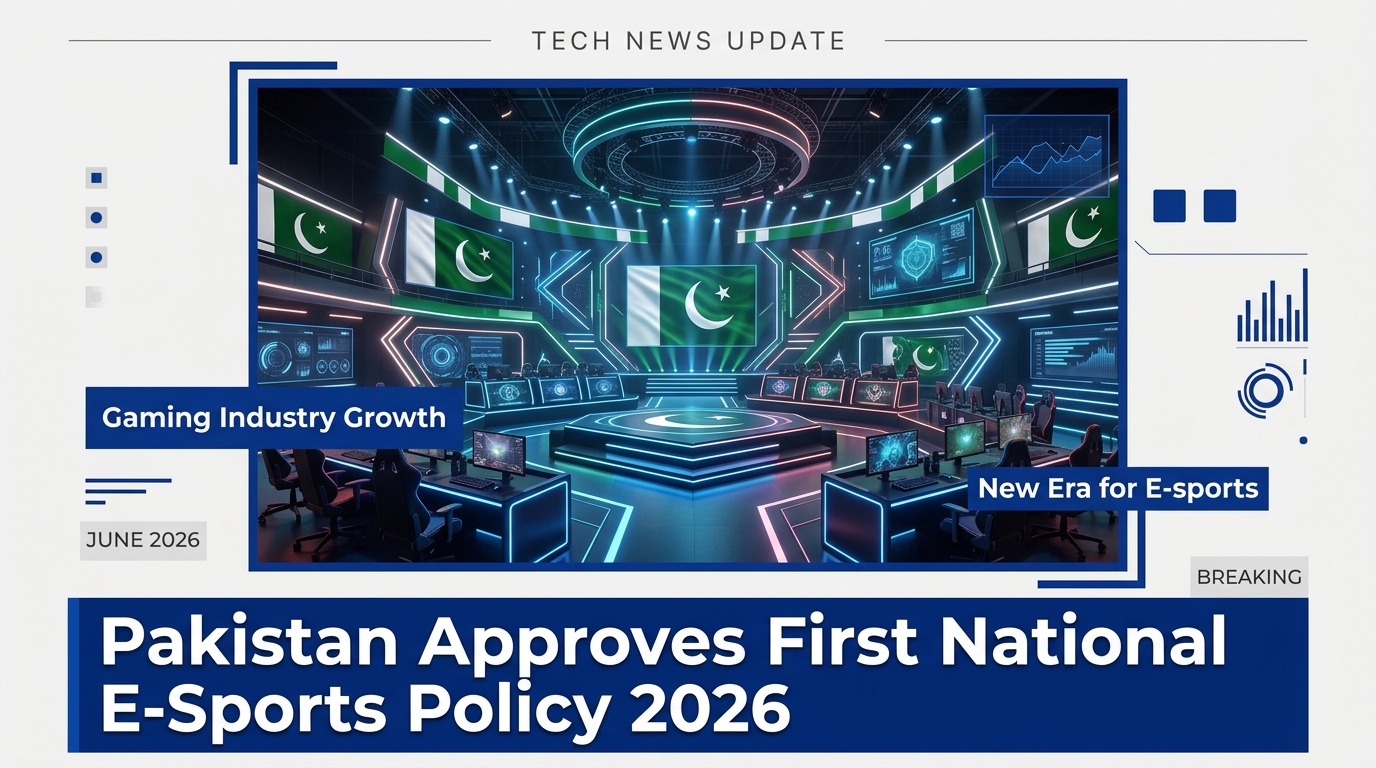
In a landmark decision that validates the passion of millions of youth, the federal government officially approved Pakistan’s first-ever National E-sports Policy in July 2026.
This move transitions competitive gaming from an ad-hoc, self-funded hobby into a state-supported, professionalized pillar of the national digital economy. With the local gamer population projected to hit an astounding 50.9 million by the end of 2026, the policy arrives at a critical tipping point for the industry.
Recognizing the Digital Athlete
Spearheaded by the Pakistan E-sports Task Force under the Prime Minister’s Youth Programme (PMYP), the policy directly addresses the historical challenges faced by local gamers—including lack of institutional support, hardware costs, and exclusion from global payment gateways.
The cornerstone of the new framework is the establishment of the Esports Federation of Pakistan. This regulatory body will act as the official governance structure, organizing sanctioned national tournaments, scouting local talent, and providing structured pathways for Pakistani digital athletes to compete on the global stage.
Furthermore, the government has committed to investing in purpose-built digital gaming arenas and boot camps across major cities, ensuring players have access to top-tier hardware and uninterrupted power supplies.
Building the Backend for E-Sports
While producing world-class talent like Arslan Ash has proven Pakistan’s mechanical skill on the global stage, the country’s local gaming infrastructure has long been a bottleneck.
Competitive tactical shooters like Counter-Strike 2 (CS2) and Valorant demand uncompromising network conditions. When playing on Middle Eastern or European servers, Pakistani players frequently face a “ping disadvantage,” where network latency of 60ms to 120ms can cost them crucial milliseconds in reaction time.
Local Server Hosting is the Solution
To foster a truly competitive local scene, hosting local servers is not just an option—it is a mandatory requirement.
For local tournament organizers, game developers, and private esports leagues looking to host massive multiplayer events, Nextgen Hosting’s Dedicated Servers provide the ultimate low-latency advantage. By deploying match servers on Nextgen’s local KVM VPS infrastructure, organizers can offer participants blazing-fast pings (often under 10ms). This localized hosting eliminates packet loss and lag, creating a perfectly level playing field required for professional-grade competition.
Educating the Next Generation
The National E-sports Policy isn’t just about playing games; it is heavily focused on making them. The framework emphasizes academic integration, pushing for formal degrees and vocational training in game development, 3D animation, and VFX at local universities.
By turning gaming into a structured academic and professional pathway, Pakistan is not only nurturing the next generation of esports champions but also building an army of developers ready to capture a share of the trillion-dollar global gaming software market.
To launch tournament registration systems and esports media portals, request a website design proposal.
