
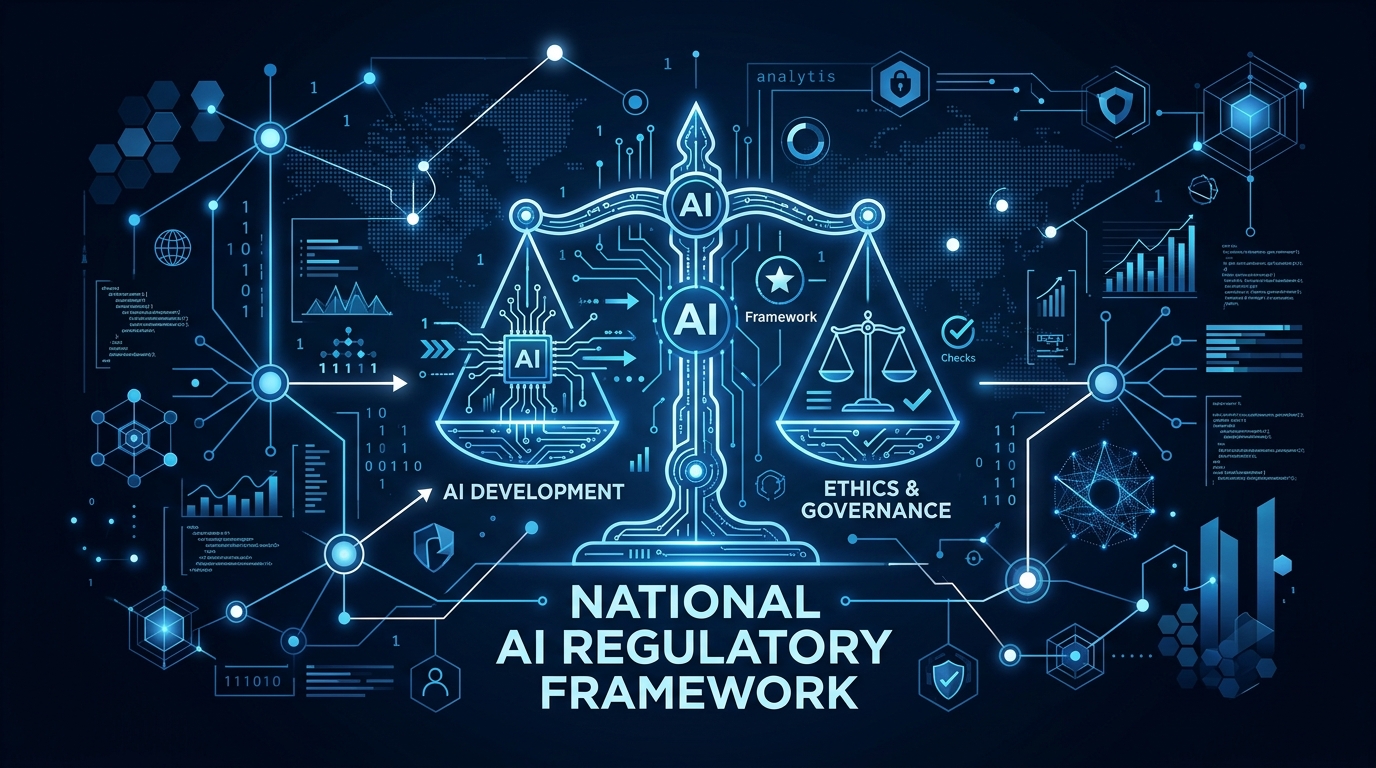
Following the ambitious launch of the Islamabad AI City, the Ministry of Information Technology and Telecommunication (MoITT) has officially ratified the highly anticipated National AI Regulatory Framework 2026.
This comprehensive policy aims to provide legal clarity, foster responsible innovation, and set strict data residency mandates for Artificial Intelligence development within the country.
Core Pillars of the 2026 AI Framework
The new framework introduces several critical guidelines that will reshape how tech startups and enterprise firms develop, train, and deploy AI models in Pakistan.
1. Mandatory Local Data Residency for Sensitive Models
To protect citizen data and national security, the framework mandates that any AI model trained on sensitive financial, healthcare, or government data must adhere to strict data residency laws.
Startups building these models can no longer rely entirely on foreign cloud infrastructure for data storage. Instead, training datasets and the resulting weights must reside on local infrastructure. This has triggered a massive shift towards hybrid cloud architectures, where companies leverage high-performance local Pakistan VPS instances and bare-metal servers to maintain compliance while training models.
This regulation directly complements the recent National Cybersecurity Framework 2.0, which similarly pushed for localizing sensitive infrastructure.
2. The AI Sandbox and Algorithmic Audits
To ensure that AI applications do not propagate bias or violate ethical standards, the government has established an AI Regulatory Sandbox.
Before a commercial AI product—especially those impacting employment, credit scoring, or law enforcement—can be widely deployed, it must undergo algorithmic auditing within this sandbox. Startups will be given a grace period to test their models in a controlled environment under the supervision of the newly formed AI Ethics Board.
3. Intellectual Property (IP) Protections for AI Startups
One of the most significant wins for the tech community in this framework is the explicit clarification on Intellectual Property (IP) rights concerning AI-generated content and proprietary training methodologies.
The policy clearly outlines how startups can patent novel neural network architectures and copyright specialized datasets, providing much-needed confidence to venture capitalists looking to invest in local talent.
Accelerating the 2026 Export Target
This framework is seen as the missing piece of the puzzle in Pakistan’s broader tech strategy. By providing a stable, clear, and globally competitive regulatory environment, the government hopes to accelerate FDI (Foreign Direct Investment) and push IT exports towards the $5 billion milestone.
With the Free AI Certification Program rapidly upskilling the youth and this new framework providing legal certainty, Pakistan is positioning itself as a serious contender in the regional AI race.
