
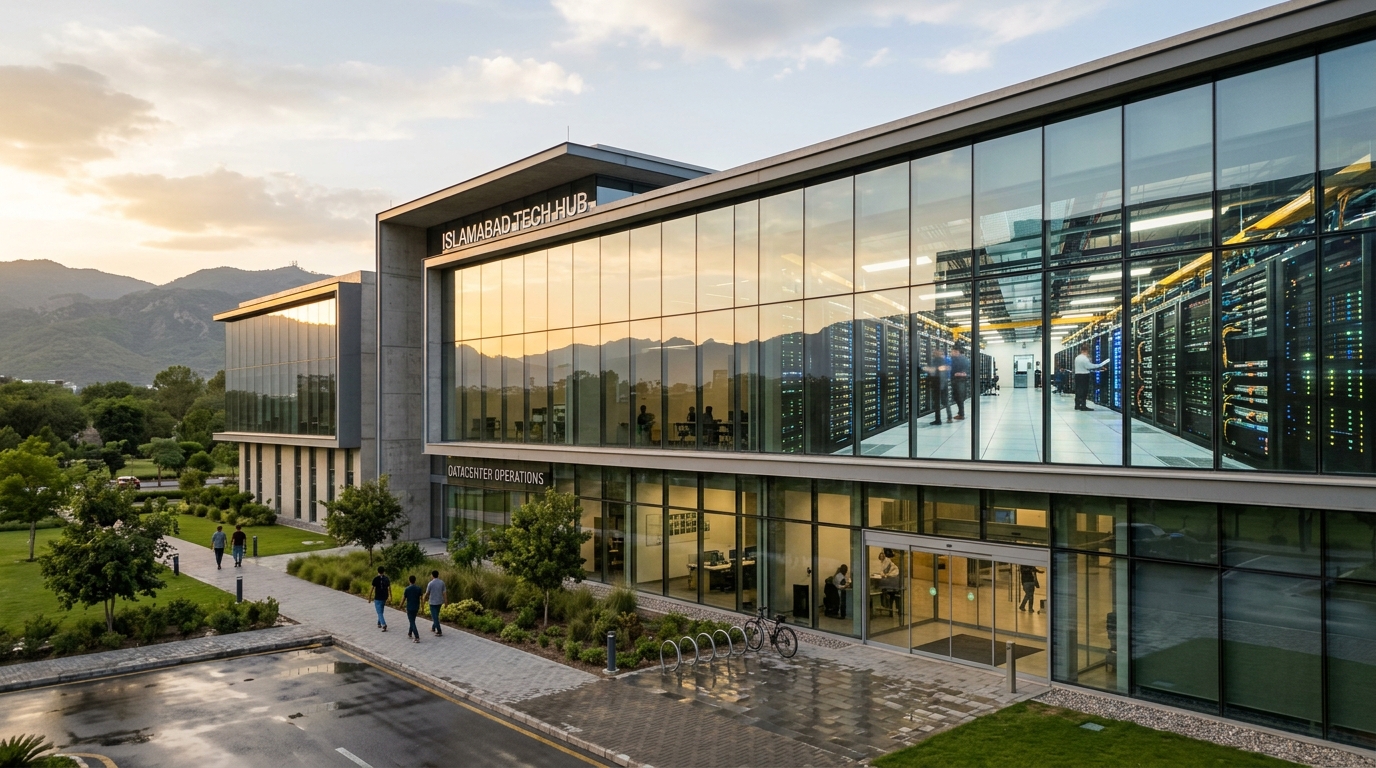
In a landmark step toward establishing national digital sovereignty and compute self-reliance, the Special Technology Zones Authority (STZA) and the Ministry of Information Technology and Telecommunication (MoITT) have signed a definitive $120 million infrastructure agreement with an international datacenter consortium to construct Pakistan’s first certified Tier-4 Sovereign AI & High-Performance Computing (HPC) Datacenter Zone in Islamabad.
The facility represents the largest single private-public infrastructure commitment dedicated to high-density compute in the nation’s history. Engineered to support the next generation of generative AI foundation models, scientific simulations, and mission-critical enterprise workloads, the sovereign campus will deliver carrier-neutral colocation, direct integration with the national data backbone, and dedicated bare-metal capabilities.
For Pakistani enterprises, fintech operators, and research labs that require mission-critical compute availability and strict data sovereignty, modern workloads can be provisioned through Dedicated Servers and localized Dedicated Servers in Pakistan engineered for ultra-low latency.
1. Project Overview & Institutional Backing
The signing ceremony, held at the STZA Headquarters in Islamabad, brought together senior leadership from MoITT, the Pakistan Telecommunication Authority (PTA), sovereign investment delegates, and global cloud infrastructure engineers. The consortium will break ground on a designated 15-acre plot within the Islamabad Special Technology Zone, with Phase 1 operational deployment slated within 18 months.
The zone leverages the full legislative support of the STZA Act of 2021, extending unprecedented fiscal and regulatory incentives designed to attract advanced semiconductor hardware and hyperscale investments into the country:
- 10-Year Corporate Income Tax Holiday: Complete exemption from federal, provincial, and local corporate income taxes for zone enterprises and infrastructure operators for a continuous decade.
- Zero Customs Duties & Tariffs: 0% import duties and sales tax on server hardware, liquid cooling distribution units (CDUs), high-density PDUs, optical transceivers, and enterprise storage racks imported into the zone.
- Unrestricted Capital & Dividend Repatriation: Guaranteed foreign currency repatriation corridors, insulating international co-investors from foreign exchange capital controls.
- Fast-Track Regulatory Clearances: One-window facilitation for construction permits, environmental clearances, dark fiber rights-of-way, and direct utility power interconnects.
2. Engineering Architecture & Tier-4 Fault-Tolerant Specifications
Unlike traditional Tier-3 colocation facilities that rely on concurrently maintainable paths, the Islamabad Sovereign AI Datacenter Zone is architected to strict Uptime Institute Tier-4 Fault-Tolerant standards, ensuring continuous operation through unplanned site emergencies and hardware component failures without impacting running compute instances.
Key Architectural Specifications
| Engineering Subsystem | Technical Specification | Operational Impact |
|---|---|---|
| Grid Power Capacity | 25 Megawatts (MW) dedicated feed | High-density load provisioning up to 45 kW per rack |
| Availability Rating | 99.995% Uptime SLA | Maximum allowable downtime of under 26.3 minutes per year |
| Power Distribution | 2N+1 Fully Compartmentalized Paths | Independent dual substations with automated static transfer switches |
| Thermal Management | Direct-to-Chip Liquid Cooling + DLC Closed-Loop | PUE (Power Usage Effectiveness) targeted at 1.18 |
| Network Interconnect | Direct 100Gbps cross-connects to PKIX | Sub-5ms latency across Rawalpindi-Islamabad, sub-12ms nationwide |
| Physical Security | Multi-tier biometric access & perimeter isolation | SOC 2 Type II, ISO/IEC 27001, and Tier-4 physical compliance |
Direct-to-Chip Liquid Cooling for AI Superclusters
Modern accelerated workloads—particularly clusters housing NVIDIA Hopper, Blackwell, and AMD Instinct accelerators—generate thermal densities exceeding 35 kW to 60 kW per rack, far surpassing the cooling envelope of legacy raised-floor chilled-air systems.
The Islamabad facility incorporates direct-to-chip liquid cooling manifolds paired with secondary cooling distribution units (CDUs). Closed-loop circulating fluid extracts heat directly from GPU cold plates, rejecting thermal energy through dry coolers equipped with adiabatic trim cooling. This enables dense AI supercomputing arrays while maintaining an exceptional annualized Power Usage Effectiveness (PUE) below 1.2, even during peak summer ambient temperatures in the federal capital.
3. Preserving Foreign Exchange & Halting Dollar Outflows
Over the past five years, Pakistan’s software industry, digital banking platforms, and e-commerce enterprises have experienced escalating operating costs due to dollar-denominated cloud billing from international hyperscalers such as AWS, Microsoft Azure, and Google Cloud Platform.
Every monthly billing cycle drains foreign reserves as Pakistani companies convert local revenue into foreign currency to pay offshore infrastructure invoices. Furthermore, currency fluctuations directly hit domestic startup runway, making multi-year machine learning research projects cost-prohibitive.
The STZA Tier-4 sovereign compute initiative addresses this structural vulnerability on multiple fronts:
- Local Currency Billing: Enterprise organizations and software exporters can contract high-density compute, dedicated bare-metal hosts, and private cloud partitions billed in Pakistani Rupees (PKR), eliminating cross-border bank charges and currency hedging risk.
- Import Substitution: By retaining high-value computing workloads domestically, economic planners project an annual foreign exchange savings exceeding $45 million within three years of full commissioning.
- Regulatory Data Compliance: Sensitive datasets—including State Bank of Pakistan (SBP) regulated banking records, NADRA identity integrations, health records, and defense analytics—can now reside in a certified Tier-4 environment without violating territorial data residency directives.
4. Network Interconnects: 100Gbps Direct PKIX Peering
A core highlight of the zone’s design is carrier neutrality and low-latency domestic transit. The facility connects directly to the Pakistan Internet Exchange (PKIX) via redundant 100Gbps optical rings across multiple physical fiber conduits.
By peering directly at the Islamabad PKIX exchange node:
- Intra-Country Traffic Localization: Domestic packet traffic between local ISPs, mobile operators (Jazz, Zong, Telenor, Ufone), and enterprise datacenter racks resolves locally without international IP transit roundtrips via Muscat, Dubai, or Marseille.
- Sub-10ms Domestic Latency: Users accessing hosted microservices, payment gateways, and API endpoints experience deterministic round-trip times (RTT) under 8ms across the northern cluster and under 18ms from Karachi.
- Unmetered Domestic Bandwidth: Local peering significantly reduces transit costs, allowing infrastructure providers to provide unmetered domestic bandwidth for data-intensive backup replication, large language model weights distribution, and streaming media workloads.
5. Strategic Implications for Pakistani Startups & Enterprise Hosting
The creation of a sovereign Tier-4 high-performance datacenter fundamentally alters the economics of running complex production workloads in Pakistan. Local software development houses building computer vision models for agri-tech, fintech automated credit-scoring algorithms, and natural language interfaces can now access localized GPU and high-density CPU instances without provisioning offshore infrastructure.
Furthermore, this megaproject accelerates the maturity of Pakistan’s commercial hosting market. As high-availability standards become standard across public and private sectors, organizations are transitioning from legacy shared hosting environments to fault-tolerant bare-metal infrastructure.
Whether deploying distributed Kubernetes clusters, enterprise database replicas, or low-latency financial gateways, modern engineering teams can leverage bare-metal isolation through Dedicated Servers and locally hosted Dedicated Servers in Pakistan.
Related infrastructure and enterprise hosting guides:
- Linux eBPF & XDP DDoS Mitigation at Line Rate
- Web Hosting in Lahore: Tier-3 Datacenter Peering
- Windows Server 2025 RDP Multi-Session Configuration
Deploy Mission-Critical Compute with Nextgen
High-performance Dedicated Servers and Cloud VPS solutions engineered with pure NVMe Gen4 storage, redundant power delivery, low-latency domestic peering, and 24/7 technical operations in Pakistan.
