
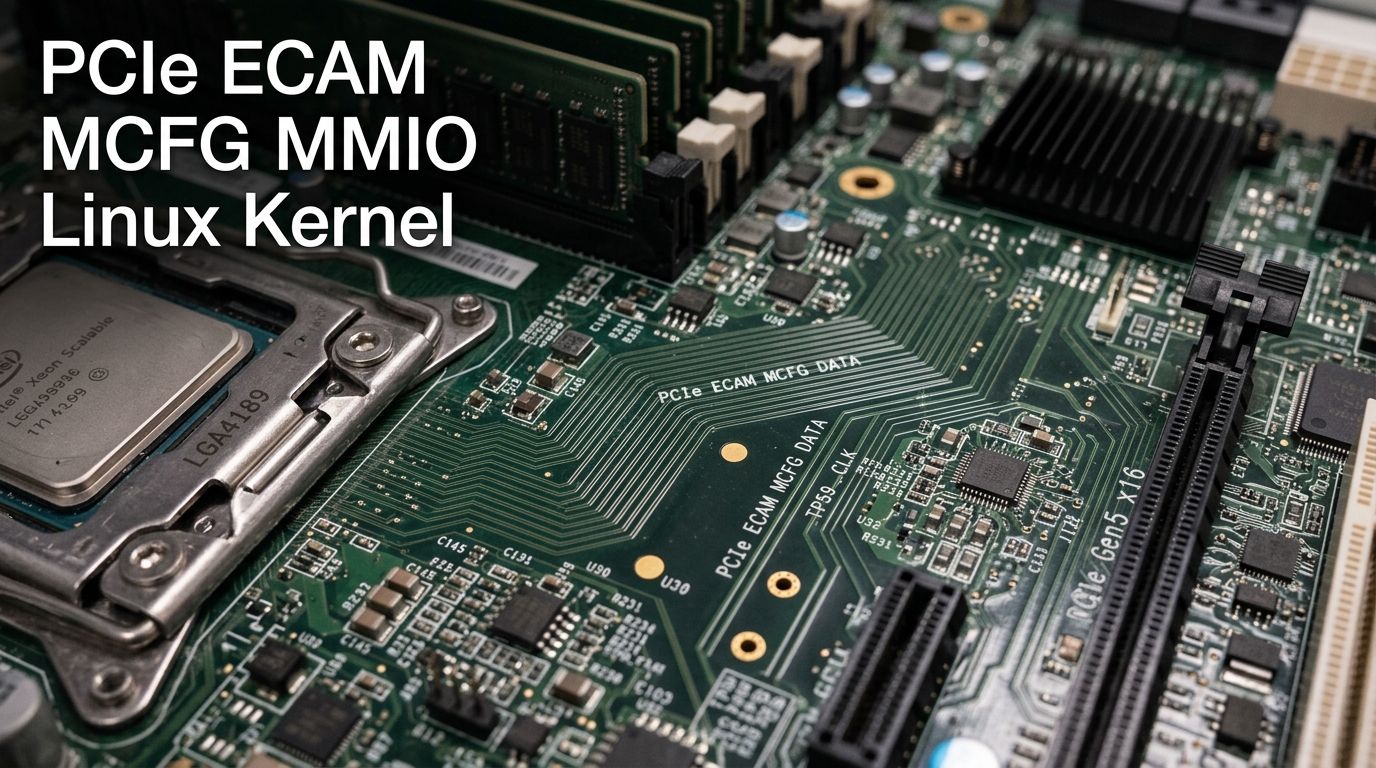
On high-density enterprise servers housing multi-socket Intel Xeon Scalable or AMD EPYC processors, hundreds of PCIe devices operate concurrently: dual-port 100GbE NICs, NVMe U.2/U.3 storage controllers, hardware RAID arrays, and CXL memory accelerators. To configure, power, and initialize these hardware endpoints, the operating system must access each device’s configuration space.
In legacy PCI architectures, the CPU communicated with devices using I/O ports 0xCF8 (CONFIG_ADDRESS) and 0xCFC (CONFIG_DATA), a rigid mechanism restricted to 256 bytes of configuration registers per device. Modern PCI Express overcomes this constraint with the Enhanced Configuration Access Mechanism (ECAM).
Defined in the PCI Express specification and described to the Linux kernel via the ACPI MCFG (Memory Mapped Configuration Space) table, ECAM maps each device’s 4,096-byte configuration space directly into the physical memory address map (MMIO). On bare-metal Dedicated Servers in Pakistan, misconfigured MCFG tables or MMIO window resource collisions can trigger silent PCIe device drops, PCIe link downgrades, or kernel boot panics.
Architectural Evolution: Legacy I/O Ports vs. PCIe ECAM
1. Legacy PCI Configuration Access (I/O Port Mechanism):
   +-----+    OUT to 0xCF8 (Bus/Dev/Fn/Reg)     +---------------------+
   | CPU | -----------------------------------> | Host PCI Controller |
   |     | <----------------------------------- |                     |
   +-----+    IN/OUT to 0xCFC (Data Value)      +---------------------+
   - Restricted to 256 bytes per device.
   - Non-atomic, serial execution across cores.

2. Modern PCIe ECAM (Memory-Mapped I/O Architecture):
   +-----+    Standard CPU Memory Read/Write    +---------------------+
   | CPU | -----------------------------------> | MMIO ECAM Window    |
   +-----+    [Base + (Bus<<20) + (Dev<<15)...] | (Up to 256MB DRAM)  |
                                                +----------+----------+
                                                           | Direct Bus Access
                                                           v
                                                +---------------------+
                                                | 4KB Extended Config |
                                                | Space per PCIe Slot |
                                                | (SR-IOV, AER, CXL)  |
                                                +---------------------+
ECAM transforms PCIe configuration into standard memory load/store operations:
- Extended Registers (4,096 Bytes): Provides room for advanced PCIe capabilities: Advanced Error Reporting (AER), Single Root I/O Virtualization (SR-IOV), Latency Tolerance Reporting (LTR), and Compute Express Link (CXL).
- Atomic Operations: Multi-core CPUs access independent devices simultaneously without contention on legacy shared I/O ports.
- Physical Address Formula: For any given PCIe device, its physical MMIO configuration address is calculated as: [ \text{Physical Address} = \text{Base} + (\text{Bus} \times 2^{20}) + (\text{Device} \times 2^{15}) + (\text{Function} \times 2^{12}) + \text{Register} ] Each bus consumes (1,\text{MB}) ((32 \text{ devices} \times 8 \text{ functions} \times 4,\text{KB})). A full 256-bus segment occupies a (256,\text{MB}) contiguous physical address range.
Inspecting the ACPI MCFG Table in Linux
When a server boots, BIOS/UEFI firmware constructs the ACPI MCFG table detailing the base address and bus ranges assigned to each PCIe segment (segment group).
To inspect the live MCFG table on your Dedicated Server:
# Dump and disassemble the ACPI MCFG table
acpidump -t MCFG -b > /tmp/mcfg.dat
iasl -d /tmp/mcfg.dat
cat /tmp/mcfg.dsl
Disassembled MCFG Output:
[000h 0000   4]                    Signature : "MCFG"    [Memory Mapped Configuration table]
[004h 0004   4]                 Table Length : 0000003C
...
[024h 0036   8]         Base Address (MMIO) : 00000000E0000000
[02Ch 0044   2]         Segment Group Number : 0000
[02Eh 0046   1]               Start Bus Number : 00
[02Fh 0047   1]                 End Bus Number : FF
This confirms that Segment 0 (covering Buses 0x00 through 0xFF) is mapped to physical address 0xE0000000 with an extent of (256,\text{MB}) (0xE0000000 to 0xEFFFFFFF).
Verify that the Linux kernel successfully reserved this MMIO window during boot:
dmesg | grep -i -E "mcfg|ecam"Kernel Output:
[    0.342101] ACPI: MCFG 0x0000007FE3B000 00003C (v01 ALASKA A M I   01072009 AMI  00010013)
[    0.342105] PCI: MMCONFIG for domain 0000 [bus 00-ff] at [mem 0xe0000000-0xefffffff] reserved to E820
[    0.342110] PCI: MMCONFIG at [mem 0xe0000000-0xefffffff] reserved in E820
[    0.342512] PCI: Using host bridge windows from ACPI; if necessary, use "pci=nocrs" and report a bug
Diagnosing ECAM Resource Collisions & Kernel Fixes
In multi-socket architectures featuring high numbers of PCIe NVMe drives or GPU accelerators, firmware bugs can cause the MCFG MMIO window to overlap with system DRAM or host bridge apertures. When this occurs, the Linux kernel logs:
PCI: MMCONFIG address not reserved in E820!
PCI: MMCONFIG [mem 0xe0000000-0xefffffff] not reserved in ACPI or E820
PCI: BIOS bug: MCFG area is not marked in E820; falling back to type 1 configuration
When Linux falls back to “type 1 configuration,” it reverts to legacy I/O ports 0xCF8/0xCFC. This disables access to extended configuration registers (bytes 256–4095), breaking:
- PCIe Gen4/Gen5 Equalization: Devices lock to Gen1/Gen2 speeds.
- PCIe AER (Advanced Error Reporting): Hardware bus errors cannot be diagnosed.
- SR-IOV: Virtual functions cannot be instantiated for virtualization.
How to Resolve the BIOS MCFG Bug
-
Kernel Boot Parameter Override: If upgrading motherboard BIOS is not immediately viable, force the kernel to respect the MCFG MMIO window by updating
/etc/default/grub:GRUB_CMDLINE_LINUX="... pci=mmconfig pci=ecam_force"Or, if the host bridge windows conflict with ACPI allocations:
GRUB_CMDLINE_LINUX="... pci=use_crs"Rebuild GRUB and reboot:
grub2-mkconfig -o /boot/grub2/grub.cfg -
Verify Memory Reservations in
/proc/iomem: Ensure the ECAM region is properly declared and isolated from general system RAM:grep -i -C 2 "PCI MMCONFIG" /proc/iomemOutput:
e0000000-efffffff : PCI MMCONFIG 0000 [bus 00-ff]
  e0000000-efffffff : Reserved
ECAM vs. Legacy PCI Architecture Comparison
| Architectural Feature | Legacy PCI (Type 1) | PCIe ECAM (Memory-Mapped) |
|---|---|---|
| Addressing Method | I/O Ports 0xCF8 / 0xCFC |
Direct Physical MMIO (via ACPI MCFG) |
| Register Space | 256 Bytes | 4,096 Bytes |
| SR-IOV & AER Support | No (registers beyond 256 inaccessible) | Full Support |
| CXL 2.0 / 3.0 Coherency | Incompatible | Native Supported |
| Multi-Core Concurrency | Serialized (spinlocks on port access) | Fully Concurrent Atomic Memory Access |
| Access Latency | High (I/O bus cycles ~1.2 µs) | Low (Memory Controller Load ~80 ns) |
For hardware engineers and cloud architects looking to extend PCIe hardware reliability, explore our analyses on PCIe Hot-Plug via ACPI (pcihp) and CXL Fabric Switching & Memory Pooling. For virtualized environments requiring reliable I/O performance, explore our Cloud VPS hosting options.
Harness maximum NVMe throughput, GPU compute acceleration, and zero hardware bottlenecks with custom-engineered Dell, HPE, and Supermicro bare-metal servers hosted in Pakistan.
