
In a decisive regulatory breakthrough designed to overcome range anxiety and catalyze green mobility across the country, the National Electric Power Regulatory Authority (NEPRA) has officially notified a dedicated, subsidized tariff framework for commercial Electric Vehicle Charging Stations (EVCS) in Pakistan.
Under the landmark determination, commercial charge point operators (CPOs) will receive off-peak grid power at a preferential national flat rate of PKR 39.50 per kilowatt-hour (kWh), exempt from peak-hour surcharges and minimum billing penalties.
Concurrently, the National Highway Authority (NHA) in collaboration with private energy consortiums (including Hubco Green, Shell Recharge, and TotalEnergies) has granted site clearance and grid interconnection permits for 120 ultra-fast DC charging plazas spanning the M-2 (Islamabad-Lahore), M-9 (Karachi-Hyderabad), and M-5 (Multan-Sukkur) motorways.
For telematics platforms, cloud-connected charging network aggregators, and mobile payment gateways requiring real-time telemetry processing, reliable hosting architecture can be deployed immediately on Dedicated Servers and locally hosted Dedicated Servers in Pakistan.
1. Eliminating the Inter-City Travel Bottleneck for EV Owners
While EV adoption has surged across urban centers like Karachi, Lahore, and Islamabad—driven by locally assembled models from BYD, MG, Deepal, and Changan—inter-city highway journeys were previously constrained by a shortage of high-voltage charging points.
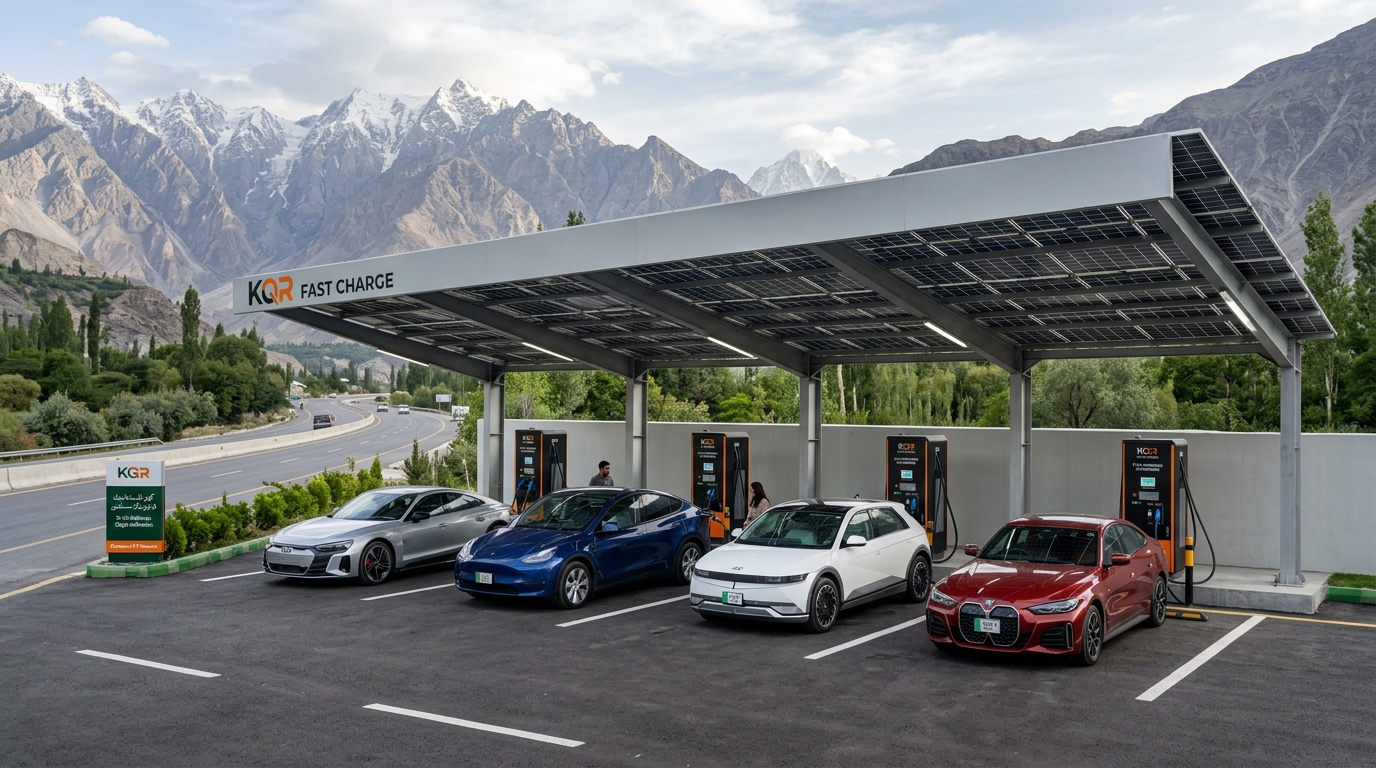
The newly sanctioned highway hubs feature:
- Ultra-Fast 180kW to 360kW Dual-Gun Dispensers: Compatible with European CCS2 and Chinese GB/T charging standards, enabling contemporary 800V EV architectures to replenish 10% to 80% battery capacity in under 18 minutes.
- Solar-Battery Buffer Microgrids: Each motorway charging plaza incorporates a minimum 150kW rooftop solar canopy paired with an industrial Lithium Iron Phosphate (LFP) Battery Energy Storage System (BESS) to shield the national grid from instantaneous megawatt load spikes.
- Automated M-Tag & Raast Billing: Drivers can pay seamlessly via QR-code Raast instant transfers, credit cards, or integrated NHA M-Tag balances without downloading fragmented third-party charging apps.
2. Regulatory Architecture: NEPRA EVCS Guidelines
To ensure consumer protection and technical safety, NEPRA’s notification establishes mandatory technical standards across all licensed commercial charging facilities:
| Regulatory Parameter | NEPRA Standard Mandate | Consumer Impact |
|---|---|---|
| Grid Power Tariff | Flat PKR 39.50 / kWh (Off-Peak Basis) | Prevents exploitative retail electricity pricing |
| Maximum Operator Margin | Capped at PKR 18.00 / kWh markup | Guarantees clear, transparent charging rates |
| Hardware Compliance | IEC 61851 / IEC 62196 (CCS2 & GB/T) | Prevents charging damage to imported & local EVs |
| Uptime Guarantee | 98.5% mandatory hardware availability | Eliminates broken or unpowered highway plugs |
| Cloud Telemetry Standard | Open Charge Point Protocol (OCPP 2.0.1) | Real-time plug availability on Google Maps & apps |
3. Telematics & Cloud Architecture: Real-Time Grid Balancing
Every charging station dispenser streams continuous telemetry over cellular IoT connections to a centralized Charge Point Management System (CPMS).
- Dynamic Load Management (DLM): Automatically balances power output between neighboring chargers when multiple EVs connect simultaneously, preventing local distribution transformer overloads.
- Pre-Booking & Queue Reservation: Motorway travelers can reserve a 20-minute charging slot up to 45 minutes in advance through mobile navigation apps, eliminating holiday congestion at service areas (Bhera, Sukheki, Kalar Kahar).
- Vehicle-to-Grid (V2G) Pilot: A secondary framework outlines future protocols allowing commercial electric fleet operators to inject stored battery power back into the grid during emergency summer load-shedding peaks.
4. Official Statements & Environmental Outlook
Speaking at the launch ceremony in Islamabad, the Chairman of NEPRA highlighted:
“Electric mobility is not merely a transport evolution; it is a vital macroeconomic imperative to curtail Pakistan’s annual $17 billion fossil fuel import bill. By establishing a fair, predictable, and investor-friendly EV tariff, we are empowering private enterprise to construct a world-class nationwide charging spine from Peshawar to Karachi.”
The Ministry of Climate Change noted that transitioning 30% of new passenger vehicles and 50% of two-wheelers to electric powertrains by 2030 will prevent over 15 million metric tons of carbon emissions annually while revitalizing domestic clean-tech manufacturing.
5. Resilient Infrastructure for High-Volume Telematics Workloads
Operating IoT charge point management networks, processing millisecond telematics events, and executing real-time financial authorizations demands dependable, zero-latency cloud infrastructure.
Explore our related infrastructure analyses:
- IESCO & LESCO Complete Phase-1 AMI Smart Meter Deployment
- PTA Authorizes 2Africa Pearls Subsea Cable Landing in Karachi
- Deploying Apache Guacamole Clientless HTML5 Gateway on VPS
To run high-availability OCPP brokers, distributed time-series databases, and mission-critical SaaS platforms with low-latency local routing across Pakistan, deploy on Dedicated Servers in Pakistan.
Power Your Smart Infrastructure with Nextgen
Run scalable MQTT brokers, OCPP charging backends, and high-concurrency payment APIs on dedicated bare-metal servers hosted in Tier-3 Pakistani datacenters.
