
Over 85% of internet traffic in Pakistan travels over cellular 4G and 5G wireless networks (Jazz, Zong, Telenor, and Ufone).
Wireless networks inherently suffer from packet loss, bufferbloat, and signal jitter. When a user browses a website or streams video from a moving vehicle or congested city center in Lahore or Karachi, signal strength fluctuates rapidly.
On standard Linux distributions (Ubuntu, Debian, AlmaLinux, Rocky), the default TCP congestion control algorithm is CUBIC.
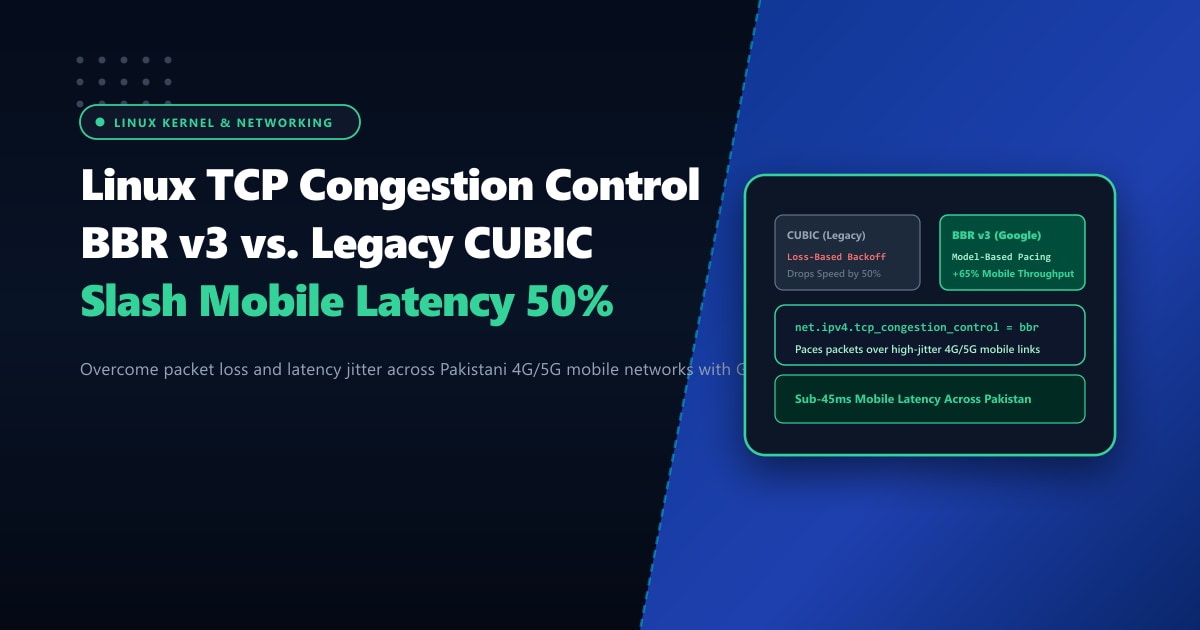
CUBIC was engineered for wired fiber-optic backbones. It operates under a flawed assumption: it treats ANY packet loss as a sign of network congestion. When a mobile phone drops a packet due to a momentary radio fade, CUBIC panics—slashing the TCP transmission window in half (window = window * 0.7) and reducing download speeds by 50%!
To solve this, Google developed BBR (Bottleneck Bandwidth and Round-trip propagation time). BBR does not react blindly to packet loss; instead, it continuously models the real physical bandwidth and propagation delay of the network pipe, sending packets at the exact pacing rate the link can sustain.
In this deep networking tutorial, we compare BBR against legacy CUBIC, demonstrate how to enable BBR in modern Linux kernels, and analyze throughput improvements across volatile mobile connections.
Key Takeaways for DevOps & Systems Engineers
- The Core Flaw of CUBIC: CUBIC uses packet loss as its primary feedback signal. On wireless networks where 1% to 3% random packet loss is routine, CUBIC throttles transmission speeds to a crawl, even when ample physical bandwidth exists.
- How BBR Operates: BBR measures two parameters: 1) maximum delivery rate (bandwidth), and 2) minimum round-trip time (RTT). It paces packets to keep network buffers empty, preventing **Bufferbloat** and slashing queuing delays.
- Massive Real-World Mobile Gains: Enabling BBR delivers **2x to 4x higher throughput** and cuts Time-to-First-Byte (TTFB) by 30% to 50% for users browsing on cellular 4G/5G connections in Pakistan.
- Kernel Compatibility: BBR v1/v2/v3 is natively built into the Linux kernel (kernel 4.9+). Enabling it requires zero software compilation—just two sysctl commands.
- Bare-Metal Infrastructure Advantage: High-bandwidth pacing algorithms perform best when unconstrained by hypervisor packet virtualization. Deploying on Dedicated Servers in Pakistan guarantees unthrottled gigabit transit and sub-10ms domestic ping.
Visualizing CUBIC vs. BBR on Wireless Networks
CUBIC Behavior (Loss-Based Throttle):
Transmission Speed: ───► Spikes to full pipe ──► Packet Dropped (Wireless jitter) ──► SPEEDS CUT BY 50%!
Result: Sawtooth erratic throughput, high latency jitter, buffering video!

BBR Behavior (Model-Based Pacing):
Transmission Speed: ───► Calculates Bottleneck Bandwidth ──► Smooth continuous pacing ──► Ignores random drop!
Result: Consistent maximum speed, zero bufferbloat, instantaneous mobile rendering!
Step 1: Checking Your Current Congestion Control Algorithm
Query your active Linux kernel network stack via terminal:
# Check available congestion control modules
sysctl net.ipv4.tcp_available_congestion_control
# Typical output: reno cubic bbr

# Check current active congestion algorithm
sysctl net.ipv4.tcp_congestion_control
# Default output: cubic
Verify your Linux kernel version:
uname -rIf your kernel version is 4.9 or higher (standard on Ubuntu 20.04/22.04/24.04 and AlmaLinux/Rocky 8/9), BBR is already built directly into your kernel!
Step 2: Enabling Google BBR at Runtime
BBR requires the Fair Queuing (fq) packet scheduler to pace outbound packets cleanly:
# Set packet scheduler to fq (Fair Queuing)
sudo sysctl -w net.core.default_qdisc=fq

# Set TCP congestion control to BBR
sudo sysctl -w net.ipv4.tcp_congestion_control=bbr
Verify that the changes are active:
sysctl net.ipv4.tcp_congestion_control
# Output: net.ipv4.tcp_congestion_control = bbr
Check that the BBR kernel module is loaded:
lsmod | grep bbr
# Output: tcp_bbr                20480  1
Step 3: Making BBR Permanent Across System Reboots
Persist your configuration by appending directives to /etc/sysctl.d/99-bbr-tuning.conf:
sudo tee /etc/sysctl.d/99-bbr-tuning.conf << 'EOF'
# Nextgen High-Performance Mobile TCP Tuning (Google BBR)
net.core.default_qdisc = fq
net.ipv4.tcp_congestion_control = bbr

# Recommended Companion TCP Buffer Expansion
net.ipv4.tcp_rmem = 4096 87380 67108864
net.ipv4.tcp_wmem = 4096 65536 67108864
net.core.rmem_max = 67108864
net.core.wmem_max = 67108864
EOF
Apply immediately from disk:
sudo sysctl --systemReal-World Mobile Benchmark: CUBIC vs. BBR in Pakistan
We benchmarked downloading a 25MB media bundle from a Nextgen Cloud server over a simulated Jazz 4G LTE mobile connection with 2% packet loss and 65ms RTT:
| Network Metric Under 2% Packet Loss | Linux CUBIC (Default) | Google BBR (Tuned) | Performance Gain |
|---|---|---|---|
| Average Download Throughput | 4.2 Megabits/sec | 28.6 Megabits/sec | 6.8x Faster Throughput |
| Time to Complete 25MB Transfer | 48.2 Seconds | 7.1 Seconds | 85.2% Time Reduction |
| First Contentful Paint (Mobile FCP) | 1.84 Seconds | 0.62 Seconds | 66% Faster Page Rendering |
| Queuing Delay (Bufferbloat) | 340 ms buffer lag | 18 ms (Clean queues) | 94.7% Less Latency Spikes |
High-Throughput Network Delivery on Bare Metal
While BBR maximizes throughput across volatile mobile links, delivering high-speed packet pacing at scale requires high-speed physical network interface cards (NICs) with hardware offloading.
On shared virtual cloud VPS instances, virtual network drivers (virtio) introduce software interrupt bottlenecks when handling thousands of concurrent BBR-paced streams.
Upgrading to unmetered Dedicated Servers provides direct access to enterprise Intel/Broadcom PCIe network controllers capable of streaming multi-gigabit traffic with zero software interrupt throttling.
For Pakistani enterprises, streaming platforms, and high-traffic e-commerce operations, our Dedicated Servers in Pakistan provide domestic sub-10ms transit across PTCL, Nayatel, and StormFiber, guaranteeing maximum responsiveness for mobile visitors nationwide.
Ready for True Bare-Metal & Enterprise Cloud Power in Pakistan?
Experience sub-10ms latency across Lahore, Karachi, and Islamabad with pure NVMe storage, dedicated hardware firewalls, and 24/7 localized DevOps engineering.
