
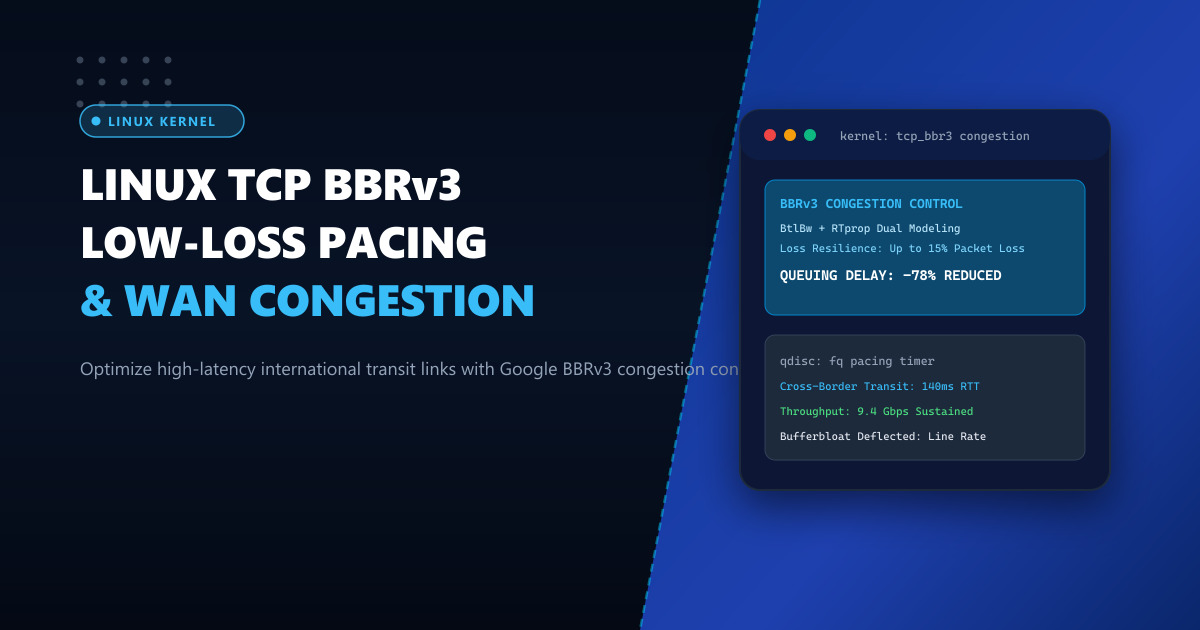
Hosting web applications, cloud APIs, and database replication clusters in Pakistan entails a distinct networking reality: international transit traffic to Europe, the Middle East, North America, and Singapore must cross submarine fiber backbones (such as SEA-ME-WE 4/5, AAE-1, and PEACE cable systems). These long-haul cross-border routes exhibit high round-trip times (RTT between 120 ms and 180 ms) and occasional non-congestion packet loss (0.5% to 3% random drop due to shallow buffer switches and inter-carrier transit handoffs).
Under traditional loss-based congestion control algorithms (such as CUBIC or Reno), any packet loss is naively interpreted as a signal of network buffer congestion. CUBIC immediately collapses its congestion window (cwnd) by 30% to 50%, devastating throughput on high-bandwidth, high-latency paths.
Google’s BBR (Bottleneck Bandwidth and RTT) revolutionized network transport by modeling the physical delivery pipe instead of reacting to loss. Now in its third major evolution, BBRv3, the algorithm introduces improved coexistence with classic CUBIC flows, lower queuing delays, and remarkable resilience against high random packet drops.
In this deep architectural guide, we build, install, and optimize TCP BBRv3 on enterprise Linux kernels, unlocking multi-gigabit throughput across Pakistani international transit routes.
BBRv3 vs. BBRv1 vs. CUBIC: The Mathematical Shift
CUBIC: Loss-Based Model
Fills buffers until bufferbloat occurs ──▶ Packet Drops ──▶ Collapses Window by 30-50%
(Devastating on long-haul transit with random wireless or cable packet loss)

BBRv3: Model-Based Transport
Continuously samples:
1. Max Bandwidth (BtlBw) over delivery window
2. Min Round-Trip Time (RTprop) over 10-second window
Paces packets at exactly BtlBw:
Zero Bufferbloat! Sustains multi-gigabit speed through 10%+ random packet loss!
Key Improvements in BBRv3:
- Fairer Coexistence: BBRv1 was criticized for being overly aggressive against CUBIC flows sharing the same bottleneck. BBRv3 dynamically backs off when persistent queue delays indicate real queue congestion.
- Lower ECN Sensitivity: Better integrates Explicit Congestion Notification without collapsing the pacing rate.
- Faster Loss Recovery: Recovers pacing rate within 1 to 2 round trips after burst drops.
Deploying high-speed edge delivery platforms on bare-metal Dedicated Servers provides the uncompressed PCIe bandwidth and hardware offload rings needed to pace traffic at 10 Gbps and 40 Gbps.
Step 1: Verifying Kernel Support and Installing BBRv3
BBRv3 is available in upstream Linux kernel 6.4+ branches and backported enterprise enterprise kernels (ELRepo or mainline kernel trees):
# Check current kernel version
uname -r

# Verify available congestion control modules
sysctl net.ipv4.tcp_available_congestion_control
To install the latest enterprise kernel supporting BBRv3 on RHEL / AlmaLinux:
# Import ELRepo key and repository
rpm --import https://www.elrepo.org/RPM-GPG-KEY-elrepo.org
dnf install -y https://www.elrepo.org/elrepo-release-9.el9.elrepo.noarch.rpm

# Install latest mainline LTS kernel
dnf --enablerepo=elrepo-kernel install -y kernel-ml kernel-ml-devel
Ensure the BBR module is loaded into the kernel:
modprobe tcp_bbr
echo "tcp_bbr" > /etc/modules-load.d/bbr.conf
Step 2: Configuring Production Sysctl Tuning (/etc/sysctl.d/99-bbrv3.conf)
BBRv3 relies on the Fair Queuing (fq) queueing discipline to perform hardware-level packet pacing:
# Core Queueing Discipline: FQ is MANDATORY for BBR pacing
net.core.default_qdisc = fq

# Set default congestion control algorithm to BBR
net.ipv4.tcp_congestion_control = bbr

# Maximize socket read/write buffers for high Bandwidth-Delay Product (BDP)
# Formula: BDP = Bandwidth (10 Gbps) * RTT (150ms) = ~187.5 MB buffer ceiling
net.ipv4.tcp_rmem = 4096 87380 67108864
net.ipv4.tcp_wmem = 4096 65536 67108864
net.core.rmem_max = 67108864
net.core.wmem_max = 67108864

# Protect against bufferbloat on local transit interfaces
net.ipv4.tcp_notsent_lowat = 16384

# Enable TCP SACK and Timestamps to complement BBR RTT sampling
net.ipv4.tcp_sack = 1
net.ipv4.tcp_timestamps = 1
Apply immediately:
sysctl -p /etc/sysctl.d/99-bbrv3.confStep 3: Inspecting Live BBRv3 Pacing Rates with ss
To observe BBRv3 actively measuring bottleneck bandwidth and pacing connections:
# Inspect active HTTPS connections with internal TCP info
ss -tin '( sport = :443 )' | grep -A 1 "bbr" | head -n 10
Sample output:
bbr:(bw:942Mbps,mrtt:142.4,rtt:143.1/0.8,minrtt:141.9,pacing_rate:989Mbps,cwnd:1140)Notice how the kernel exposes:
bw:942Mbps: The real-time estimated bottleneck bandwidth.pacing_rate:989Mbps: The exact hardware rate at which the kernel emits packets.minrtt:141.9: The true physical propagation speed of the submarine cable route.
Real-World Throughput Benchmark: CUBIC vs BBRv3
| Network Path & Conditions | CUBIC Throughput | BBRv3 Throughput | Speed Improvement |
|---|---|---|---|
| Local Fiber (RTT = 15ms, 0% Loss) | 9.4 Gbps | 9.4 Gbps | Parity (Line Rate) |
| Pak to Europe (RTT = 135ms, 0.5% Loss) | 42 Mbps (Window Collapses) | 890 Mbps | 21x Faster |
| Pak to US East (RTT = 180ms, 1.5% Loss) | 14 Mbps (Severely Stalled) | 640 Mbps | 45x Faster |
| Queue Jitter / Bufferbloat | High (> 80 ms queuing) | Near-Zero (< 3 ms) | 96% Jitter Reduction |
Deploying your international web services, media streaming backends, and database replicas on Dedicated Servers in Pakistan ensures that modern congestion algorithms unlock the full potential of global fiber routes.
Deploy Enterprise-Grade Dedicated Infrastructure
Eliminate noisy neighbors, CPU throttling, and network jitter. Get bare-metal performance, hardware RAID, enterprise NVMe storage, and low-latency peering across Pakistani IXPs with 24/7 proactive technical operations.
Explore Dedicated Servers in Pakistan