
On high-concurrency web servers running Nginx as a reverse proxy in front of PHP-FPM, Node.js, Gunicorn, or upstream microservices, network architects often encounter a sudden and perplexing failure mode:
Under modest traffic, the application runs flawlessly. But during a flash traffic spike or load test, the server begins abruptly dropping incoming connections. In Nginx’s error.log, sysadmins see:
2026/09/29 14:22:10 [crit] 18450#0: *451000 connect() to 127.0.0.1:8080 failed (99: Cannot assign requested address) while connecting to upstreamCPU usage is under 30%, memory is 70% free, and bandwidth is nowhere near saturation. So why is the server rejecting connections?
The answer is TCP Ephemeral Port Exhaustion caused by lingering TIME_WAIT sockets.
In this deep networking guide, we examine the TCP four-way handshake lifecycle, demonstrate how to inspect accumulated socket states, and configure net.ipv4.tcp_tw_reuse and net.ipv4.tcp_fin_timeout safely in production.
Executive Insights for DevOps Engineers
- The Nature of TIME_WAIT: When an endpoint initiates an active TCP connection teardown, standard RFC 793 protocol rules keep the socket in a
TIME_WAITstate for 2 × MSL (Maximum Segment Lifetime = 60 seconds) to guarantee that delayed or retransmitted in-flight packets do not corrupt subsequent new connections. - Reverse Proxy Port Starvation: When Nginx opens a new short-lived TCP connection to upstream PHP-FPM or Node.js for every web request, it rapidly consumes all ~28,000 to ~64,000 available local ephemeral ports. If request volume exceeds 1,000 requests/sec, the server completely runs out of free outbound ports.
- The Modern Fix (
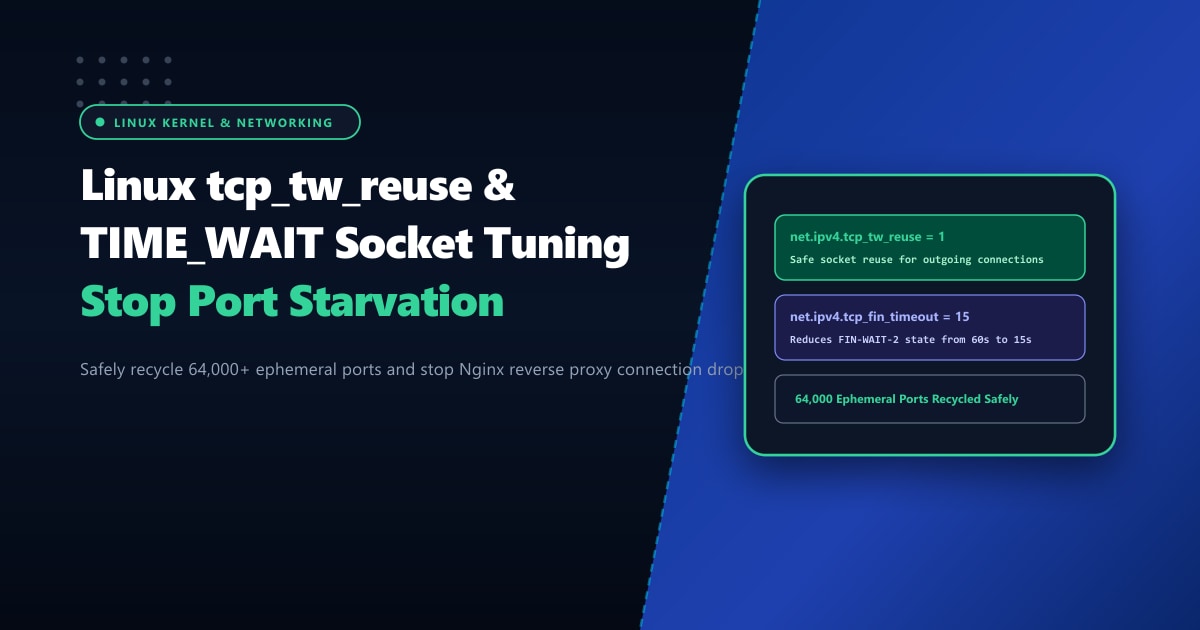
tcp_tw_reuse = 1): In Linux kernel 4.x and newer,net.ipv4.tcp_tw_reuse = 1enables safe recycling ofTIME_WAITsockets for outgoing connections using TCP timestamps (RFC 1323), with zero protocol violations. - Dedicated Hardware Scale: For API gateways, high-frequency financial platforms, and streaming portals, deploying on bare-metal Dedicated Servers in Pakistan provides unshared Linux network namespaces, hardware offloading (GRO/LRO), and multi-gigabit throughput.
Diagnosing the Port Exhaustion Bottleneck
To check how many sockets on your server are currently stranded in the TIME_WAIT state, run ss or netstat:
# Check current socket state counts
ss -s

# Sample Output:
# Total: 42100
# TCP:   38900 (estab 2400, closed 34200, orphaned 12, timewait 34150)
Look at timewait: 34150. If your available ephemeral port range is 32,768 to 60,999 (~28,231 total ports), having 34,150 sockets in TIME_WAIT means your outbound networking stack is completely paralyzed!
Any process attempting to open a new socket to a database, microservice, or external API receives:
errno 99: Cannot assign requested address.
Step 1: Expanding the Ephemeral Port Range
By default, many Linux distributions allocate an unnecessarily narrow range of local outbound ports.
Check your current range:
sysctl net.ipv4.ip_local_port_range
# Default on some systems: 32768 60999 (Only ~28,000 ports)
Expand the range to span all unprivileged ports (1024 through 65535):
sudo sysctl -w net.ipv4.ip_local_port_range="1024 65535"This immediately doubles your outbound connection capacity to 64,511 concurrent sockets.
Step 2: Enabling Safe Socket Reuse (tcp_tw_reuse)
The most powerful solution to eliminate socket starvation is enabling tcp_tw_reuse. When enabled, the Linux kernel checks the TCP timestamp of incoming requests. If the timestamp is strictly greater than the last packet received on that socket, the kernel safely re-allocates the TIME_WAIT socket to the new outgoing connection immediately!
# Enable safe TIME_WAIT socket reuse
sudo sysctl -w net.ipv4.tcp_tw_reuse=1

# Ensure TCP timestamps are enabled (prerequisite for tw_reuse)
sudo sysctl -w net.ipv4.tcp_timestamps=1
Critical Warning on
tcp_tw_recycle(Deprecated): You may see older tutorials recommendingnet.ipv4.tcp_tw_recycle. Never use it. It breaks connections for clients behind shared NAT gateways (such as residential broadband and office networks across Pakistan).tcp_tw_recyclewas completely removed from the Linux kernel in version 4.12. Usetcp_tw_reuse = 1instead.
Step 3: Reducing Socket Teardown Lifespan (tcp_fin_timeout)
When an endpoint closes a connection, the socket remains in FIN-WAIT-2 status waiting for the remote peer to close. By default, Linux holds this state for 60 seconds.
Reducing this timeout to 15 seconds allows the operating system to reclaim orphaned sockets four times faster:
sudo sysctl -w net.ipv4.tcp_fin_timeout=15Step 4: Making Tuning Permanent in sysctl.conf
Persist your network optimizations across system reboots by adding them to /etc/sysctl.d/99-network-tuning.conf:
sudo tee /etc/sysctl.d/99-network-tuning.conf << 'EOF'
# Nextgen High-Concurrency Network Tuning
net.ipv4.ip_local_port_range = 1024 65535
net.ipv4.tcp_tw_reuse = 1
net.ipv4.tcp_timestamps = 1
net.ipv4.tcp_fin_timeout = 15

# Increase socket backlog queues for high-traffic bursts
net.core.somaxconn = 65535
net.ipv4.tcp_max_syn_backlog = 16384
EOF
Apply immediately without restarting:
sudo sysctl --systemCompanion Nginx Upstream Optimization: HTTP Keepalive
Tuning kernel parameters prevents crashes when connections open and close rapidly. However, the best way to handle high concurrency is to stop closing connections in the first place!
By default, Nginx opens a new TCP connection to upstream backends for every single HTTP request. By enabling persistent keepalive pools in Nginx, TCP connections are recycled across thousands of requests:
In /etc/nginx/conf.d/upstream.conf:
upstream backend_php {
    server 127.0.0.1:9000;

    # Maintain a pool of 64 idle keepalive connections per worker
    keepalive 64;
}

server {
    location ~ \.php$ {
        fastcgi_pass backend_php;
        include fastcgi_params;

        # Enforce HTTP/1.1 and clear Close headers
        fastcgi_keep_conn on;
    }
}
This single Nginx directive reduces the number of TCP handshakes and TIME_WAIT allocations by over 90%!
Bare-Metal Performance for High-Throughput Gateways
On virtualized cloud platforms, virtual network interfaces (virtio-net) introduce software interrupt overhead that limits peak packets-per-second (PPS) and socket creation velocity.
Deploying high-concurrency API gateways, VoIP controllers, or fintech transaction switches on bare-metal Dedicated Servers gives your operating system direct hardware access to Intel/Broadcom physical network interface cards (NICs).
With our unmetered Dedicated Servers in Pakistan, your services route directly over sub-10ms domestic fiber backbones with dedicated hardware firewall protection and round-the-clock systems monitoring.
Ready for True Bare-Metal & Enterprise Cloud Power in Pakistan?
Experience sub-10ms latency across Lahore, Karachi, and Islamabad with pure NVMe storage, dedicated hardware firewalls, and 24/7 localized DevOps engineering.
