
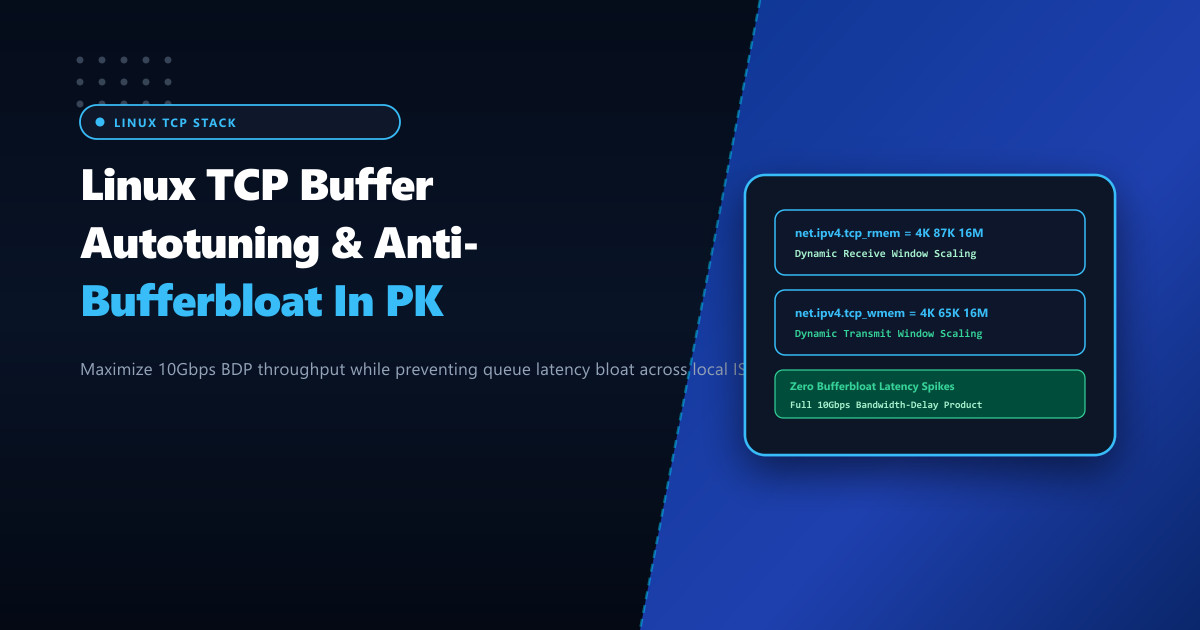
Modern data centers and enterprise web servers in Pakistan are equipped with 1Gbps, 10Gbps, or even 40Gbps redundant network uplinks. However, server administrators frequently discover that single-stream TCP transfers (such as large database backups, video streaming, or file downloads) plateau at a fraction of available physical link capacity. Conversely, during heavy concurrent client connections, latency suddenly jumps from 15ms to over 800ms—a crippling symptom known as bufferbloat.
Achieving peak network performance on bare-metal Dedicated Servers requires mastering the interplay between Linux kernel TCP socket buffers (tcp_rmem and tcp_wmem), dynamic buffer autotuning, and smart queuing disciplines (FQ / CAKE).
The Bandwidth-Delay Product (BDP) Formula
To transmit data across a network without stalling, the TCP sender’s buffer must hold enough unacknowledged bytes to keep the pipeline completely full for the entire duration of the round-trip time (RTT). This is governed by the Bandwidth-Delay Product (BDP):
$$\text{BDP (Bytes)} = \frac{\text{Link Bandwidth (bits/sec)} \times \text{RTT (seconds)}}{8}$$
Real-World Scenarios in Pakistan:
- Domestic Low Latency (Lahore to Karachi, 10Gbps, 22ms RTT): $$\text{BDP} = \frac{10 \times 10^9 \times 0.022}{8} \approx \mathbf{27.5\text{ MB}}$$
- International Transit (Pakistan to Western Europe / London, 1Gbps, 125ms RTT): $$\text{BDP} = \frac{1 \times 10^9 \times 0.125}{8} \approx \mathbf{15.6\text{ MB}}$$
If the Linux kernel’s maximum socket buffer (tcp_wmem / tcp_rmem) is capped at the default 4MB or 8MB, a 10Gbps pipe cannot physically achieve its full line rate on connections with round-trip times exceeding 5ms.
What is Bufferbloat and Why Do Huge Buffers Hurt?
While expanding buffers is necessary for throughput, oversized unmanaged FIFO queues introduce bufferbloat:
- Network packets accumulate in intermediate router and kernel queues.
- Senders keep filling deep queues before packet loss or delay is signaled.
- Interactive traffic (SSH keystrokes, DNS lookups, API micro-queries) gets stuck behind multi-megabyte bulk buffers, causing latency to skyrocket from 20ms to 800ms.
The modern Linux solution combines TCP buffer autotuning with Fair Queueing (FQ) and CoDel (Controlled Delay) packet schedulers.
Unmanaged FIFO Queues (Bufferbloat):
[Bulk Pkt] [Bulk Pkt] [Bulk Pkt] [Bulk Pkt] [Tiny SSH Keystroke Queued for 750ms!] ──> Stalled

Fair Queueing with Active Queue Management (FQ / CoDel):
Flow 1 (Bulk Download): [Bulk Pkt] ──> Queue 1 (Paced)
Flow 2 (Interactive API): [API Request] ──> Queue 2 (Instantly Dispatched in < 1ms!)
Linux Kernel Sysctl Tuning for High BDP & Low Latency
Configure modern socket buffer boundaries and fair queueing in /etc/sysctl.d/99-tcp-bdp-bufferbloat.conf:
# /etc/sysctl.d/99-tcp-bdp-bufferbloat.conf - NextGen 10G Low-Bufferbloat Stack

# Global core memory allocation limits for all network protocols
net.core.rmem_max = 67108864
net.core.wmem_max = 67108864
net.core.rmem_default = 1048576
net.core.wmem_default = 1048576

# Maximum socket receive buffer: min, default, max (Bytes)
# Max set to 64MB to fully saturate 10Gbps long-haul links
net.ipv4.tcp_rmem = 4096 1048576 67108864

# Maximum socket send buffer: min, default, max (Bytes)
net.ipv4.tcp_wmem = 4096 1048576 67108864

# Enable dynamic TCP receive buffer autotuning
net.ipv4.tcp_moderate_rcvbuf = 1

# Modern Queuing Discipline: Fair Queue (FQ)
# Paces TCP packets, eliminates buffer bursts, and coordinates with BBR
net.core.default_qdisc = fq

# Advanced Congestion Control: Google BBR (Bottleneck Bandwidth and RTT)
net.ipv4.tcp_congestion_control = bbr

# Increase maximum queued network device backlog for high-throughput bursts
net.core.netdev_max_backlog = 16384
Apply the parameters immediately without restarting:
sysctl -p /etc/sysctl.d/99-tcp-bdp-bufferbloat.confVerify active congestion control and queuing disciplines:
sysctl net.ipv4.tcp_congestion_control net.core.default_qdisc
# Output:
# net.ipv4.tcp_congestion_control = bbr
# net.core.default_qdisc = fq
Inspecting Live Socket Buffer Dynamics via ss
Monitor how the Linux kernel autotunes buffer allocations on active client sockets:
# Query detailed socket buffer memory and congestion window metrics
ss -ti '( dport = :https or sport = :https )' | head -n 20
Examine key performance indicators:
rcv_space: Dynamic receive buffer calculated by the autotuner.snd_buf: Allocated send buffer scaling up totcp_wmemmax.rtt: Real-time measured round-trip time.minrtt: Base physical latency without queueing delay.pacing_rate: Fair Queue pacing speed preventing router buffer explosions.
Hosting bandwidth-intensive applications on bare-metal Dedicated Servers in Pakistan provides direct fiber peering to the Pakistan Internet Exchange (PKIX) and local Tier-1 telcos, ensuring line-rate 10Gbps throughput with minimal jitter and zero bufferbloat.
Experience Line-Rate Throughput with NextGen Dedicated Servers
Eliminate bufferbloat and maximize network throughput with enterprise 10Gbps ports, kernel-level BBR congestion tuning, and local IXP peering across Pakistan.
Explore Pakistan Dedicated Servers