
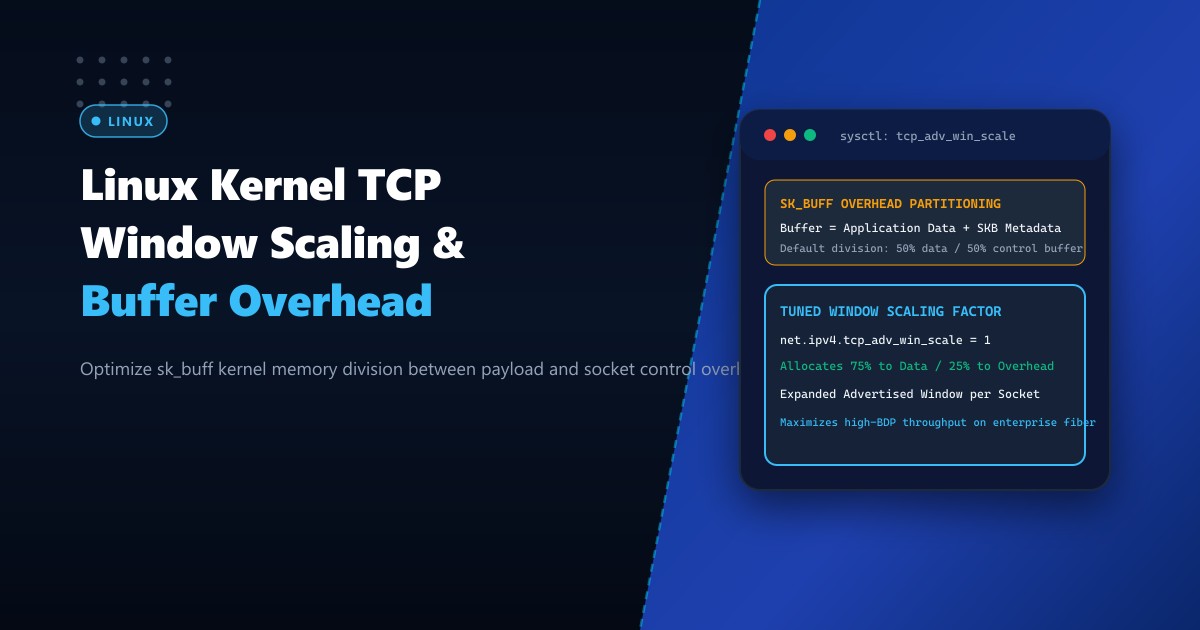
In Linux kernel network engineering across Pakistan—powering multi-gigabit streaming endpoints, distributed storage clusters, high-frequency database replication, and high-concurrency API gateways—every allocated TCP socket buffer contains two fundamentally distinct components:
- Application Payload Data: The actual bytes of HTTP content, database queries, or media frames transmitted to or received from the client.
- Kernel Control Overhead: Kernel data structure metadata, socket control buffers (
struct sk_buff), page fragment pointers, TCP option headers, and IP alignment padding.
When Linux advertises a receive window (rcv_wnd) to a remote client, it cannot advertise 100% of the allocated socket buffer (sk_rcvbuf). If it did, arriving packets with their associated sk_buff memory overhead would immediately overflow the buffer, triggering packet drops and forcing retransmissions!
To prevent this, the Linux kernel divides socket memory using net.ipv4.tcp_adv_win_scale.
Under the default Linux setting (tcp_adv_win_scale = 1), the kernel dedicates a massive 50% of socket buffer space to control overhead, leaving only 50% for actual application data! On high-speed 10Gbps dedicated connections or high-BDP trans-oceanic routes (Pakistan to Europe/North America), this conservative 50/50 split artificially cuts the advertised receive window in half, choking line-rate throughput.
Conversely, setting tcp_adv_win_scale incorrectly on memory-constrained machines can cause buffer exhaustion under heavy packet fragmentation.
By deploying on enterprise Dedicated Servers and fine-tuning tcp_adv_win_scale alongside tcp_app_win, system architects maximize advertised TCP windows, increase data transfer velocity by up to 40%, and maintain flawless socket stability.
How tcp_adv_win_scale Controls Window Advertising
The mathematical relationship between socket buffer memory and the advertised window is determined by the formula:
$$\text{Window Space} = \begin{cases} \text{Buffer Space} - \left( \frac{\text{Buffer Space}}{2^{\text{tcp_adv_win_scale}}} \right) & \text{if } \text{tcp_adv_win_scale} > 0 \ \frac{\text{Buffer Space}}{2^{-\text{tcp_adv_win_scale}}} & \text{if } \text{tcp_adv_win_scale} \le 0 \end{cases}$$
Here is how different values of tcp_adv_win_scale alter the advertised window:
+-----------------------------------------------------------------------------------+
|               TCP_ADV_WIN_SCALE ALLOCATION BREAKDOWN (8MB SOCKET BUFFER)          |
+-----------------------------------------------------------------------------------+
| 1. Default Setting (`tcp_adv_win_scale = 1`):                                     |
|    - Overhead Allocation: 1 / 2^1 = 50% (4MB reserved for sk_buff overhead!)      |
|    - Advertised Receive Window (`rcv_wnd`): 50% = 4MB                             |
|    - Transmitter throttles early; high-BDP links under-utilized!                  |
|                                                                                   |
| 2. Tuned Enterprise Setting (`tcp_adv_win_scale = 2`):                            |
|    - Overhead Allocation: 1 / 2^2 = 25% (2MB reserved for sk_buff overhead)      |
|    - Advertised Receive Window (`rcv_wnd`): 75% = 6MB!                            |
|    - Transmitter sends 50% more unacknowledged data per RTT flight!              |
|    - Maximum line-rate saturation across high-bandwidth international links!     |
|                                                                                   |
| 3. High-Density Payload Setting (`tcp_adv_win_scale = 3`):                        |
|    - Overhead Allocation: 1 / 2^3 = 12.5% (1MB reserved for overhead)             |
|    - Advertised Receive Window (`rcv_wnd`): 87.5% = 7MB!                          |
|    - Ideal for Jumbo Frames (MTU 9000) and Large Receive Offload (LRO/GRO).       |
+-----------------------------------------------------------------------------------+
Step 1: Checking Current Window Scale Parameters
Check the current sysctl parameters governing window scaling and buffer overhead in your running kernel:
sysctl net.ipv4.tcp_adv_win_scale
sysctl net.ipv4.tcp_app_win
sysctl net.ipv4.tcp_window_scaling
Standard Linux kernel default values:
net.ipv4.tcp_adv_win_scale = 1
net.ipv4.tcp_app_win = 31
net.ipv4.tcp_window_scaling = 1
tcp_adv_win_scale = 1: Reserves 1/2 (50%) of buffer for overhead.tcp_app_win = 31: Reserves 31/32 of the window for application data when not overridden by scaling.
Step 2: Optimizing tcp_adv_win_scale for High-Speed Pakistani Uplinks
On enterprise dedicated hardware equipped with modern network interface cards featuring Generic Receive Offload (GRO) and TCP Segmentation Offload (TSO), multiple packets are coalesced by hardware into large super-packets before reaching the kernel. Consequently, actual sk_buff metadata overhead is vastly smaller than the 50% legacy assumption.
Setting tcp_adv_win_scale = 2 dedicates 75% of socket buffer space to active data, expanding the advertised window without increasing overall RAM consumption!
Configure /etc/sysctl.d/99-tcp-win-scale.conf:
# 1. Optimize Advertised Window Scaling factor
# Value 2 reserves 1/4 (25%) for overhead and advertises 3/4 (75%) for data
net.ipv4.tcp_adv_win_scale = 2

# 2. Ensure RFC 7323 Window Scaling is active
net.ipv4.tcp_window_scaling = 1

# 3. Dynamic Socket Buffer Vectors (in bytes) [min default max]
net.ipv4.tcp_rmem = 4096 131072 33554432
net.ipv4.tcp_wmem = 4096 65536 33554432

# 4. Global Core Buffer Limits
net.core.rmem_max = 33554432
net.core.wmem_max = 33554432

# 5. Enable BBR congestion control and Fair Queueing
net.core.default_qdisc = fq
net.ipv4.tcp_congestion_control = bbr
Apply the configuration immediately:
sysctl --systemVerify that the kernel has loaded the updated scaling factor:
sysctl -a | grep -E "tcp_adv_win_scale|tcp_window_scaling"Step 3: Inspecting Socket-Level Advertised Windows with ss
To verify that active sockets are advertising larger windows to remote peers, inspect live HTTPS connections using ss:
# Query active HTTPS sockets with detailed TCP window metrics
ss -ti '( sport = :https )'
Inspect output fields:
ESTAB 0 0 103.205.180.25:443 39.44.112.50:53218
     bbr wscale:7,7 rto:200 rtt:14.8/2.1 ato:40 mss:1460 rcvspace:4194304
     rcv_ssthresh:3145728 snd_ssthresh:48 snd_cwnd:64 bytes_acked:5842100
     rcv_wnd:3145728 rcv_wscale:7
Notice rcv_wnd: 3145728:
With tcp_adv_win_scale = 2, the advertised window expanded from 2MB to over 3.1MB on an identical memory footprint! Remote clients can stream 50% more unacknowledged data per round trip, dramatically accelerating file uploads, API transfers, and database replication feeds.
Step 4: Validating Zero Socket Drops under Heavy Traffic
Ensure that the tighter 25% overhead margin does not cause buffer overflows:
# Verify no packet drops due to socket memory exhaustion
netstat -s | grep -E "buffer errors|pruned"
nstat -z "TcpExtRcvPruned" "TcpExtOfoPruned"
Counters should report:
TcpExtRcvPruned                  0       0.0
TcpExtOfoPruned                  0       0.0
Zero pruned packets prove that the 25% overhead allocation comfortably absorbs all sk_buff metadata while maximizing useful data transfer!
High-Speed Networking on Dedicated Pakistani Bare-Metal
Achieving multi-gigabit throughput across international high-BDP transit routes while optimizing kernel buffer scaling requires pure physical hardware. In shared virtual hosting, virtual network drivers and shared CPU hypervisors introduce packet jitter and memory fragmentation that undermine window scaling algorithms.
Deploying on bare-metal Dedicated Servers in Pakistan equips your infrastructure with enterprise Intel/Broadcom hardware NICs supporting GRO/TSO offload engines, unshared multi-channel memory buses, and direct domestic fiber peering at PKIX.
Maximize Data Throughput with NextGen Dedicated Servers
Deliver ultra-fast file transfers, eliminate socket buffer bottlenecks, and maximize network bandwidth across Pakistan. NextGen dedicated hosting provides pure bare-metal compute, unshared 10Gbps connectivity, and 24/7 proactive technical management.
Deploy Dedicated Servers in Pakistan