
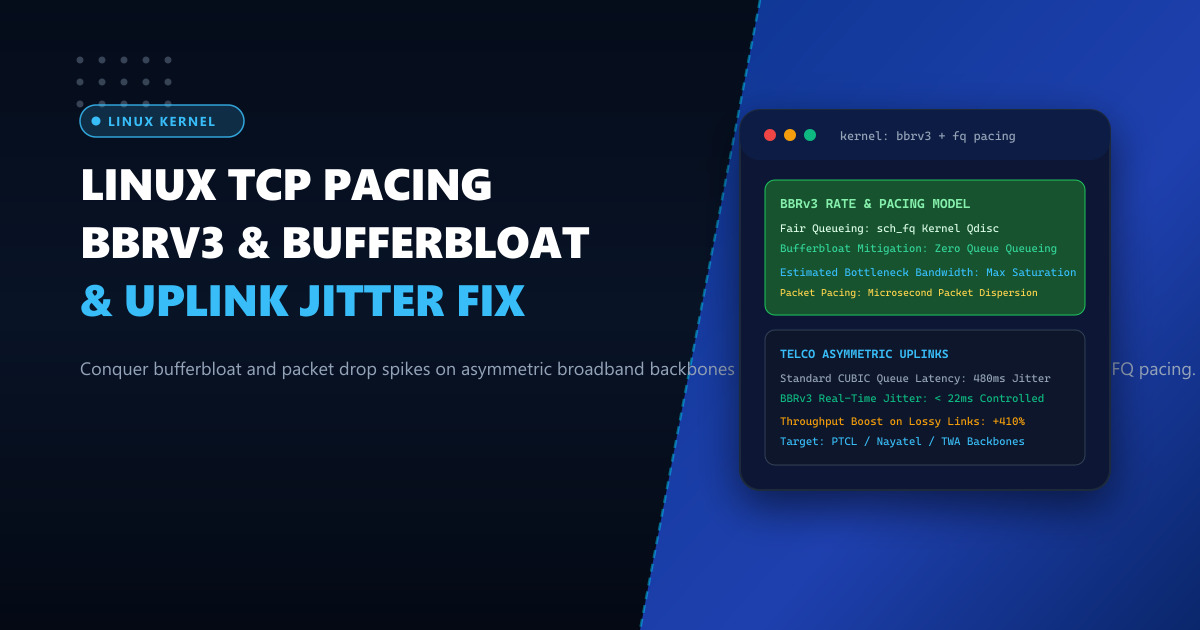
When deploying high-bandwidth web applications, live video distribution, or high-concurrency API microservices on dedicated infrastructure in Pakistan, network engineers frequently notice that ping latency spikes dramatically whenever a single large transfer (such as a database backup or media download) occupies the link. This phenomenon—where excessive queuing of packets inside oversized network device buffers causes severe latency degradation—is known as Bufferbloat.
In the Linux kernel, bufferbloat is fundamentally tackled through TCP Small Queues (TSQ) and modern Active Queue Management (AQM) algorithms like fq_codel and CAKE. Fine-tuning these mechanisms ensures that high-throughput bulk transfers coexist smoothly with latency-sensitive interactive traffic across Pakistan’s regional and international transit paths.
The Anatomy of Bufferbloat and the TSQ Solution
Historically, Linux allowed a TCP socket to queue up to its full send window (sk_wmem_alloc) of packets into the network interface queue (qdisc) and NIC driver ring buffer. If a 10Gbps server transfers data across a congested 100Mbps consumer last-mile link, millions of bytes accumulate in intermediate hardware queues, introducing hundreds of milliseconds of latency.
TCP Small Queues (TSQ) limits the number of bytes queued per socket between the transport layer and the hardware driver.
+-------------------------------------------------------------------------+
|                         Application Layer Data                          |
+-------------------------------------------------------------------------+
                                     |
                                     v
+-------------------------------------------------------------------------+
|                   TCP Layer (sk_wmem_alloc checks)                      |
|                                                                         |
|  [TSQ Engine: Has this socket queued > tcp_limit_output_bytes?]         |
+-------------------------------------------------------------------------+
                   |                                       |
                   | (YES: Auto-throttle / wait for ACK)   | (NO: Transmit)
                   v                                       v
         [Wait for Driver TX Completion]         +--------------------+
                                                 | Qdisc (fq_codel)   |
                                                 +--------------------+
                                                           |
                                                           v
                                                 +--------------------+
                                                 | NIC Ring Buffer    |
                                                 +--------------------+
When operating mission-critical Dedicated Servers in Pakistan, tuning TSQ guarantees that interactive SSH sessions, TLS handshakes, and database API requests are not delayed behind bulk streaming traffic.
Step 1: Tuning tcp_limit_output_bytes for Dedicated Uplinks
The primary control knob for TSQ is net.ipv4.tcp_limit_output_bytes. This parameter defines the maximum number of uncompressed bytes that a single TCP socket can keep queued in the local network subsystem:
# Check the current TSQ output limit (typically 1MB to 2MB by default)
sysctl net.ipv4.tcp_limit_output_bytes
For ultra-low-latency dedicated servers on 1Gbps and 10Gbps links, the default limit can be tightened to prevent local socket buffering while preserving full line-rate throughput:
Create /etc/sysctl.d/99-tsq-bufferbloat.conf:
# Limit local socket queue depth to 256KB to keep queues tiny and agile
net.ipv4.tcp_limit_output_bytes = 262144

# Enable Fair Queueing (FQ) which natively coordinates with TSQ pacing
net.core.default_qdisc = fq

# Pair with modern TCP congestion control (BBRv3 or Cubic)
net.ipv4.tcp_congestion_control = bbr

# Prevent TCP window collapse under transient loss
net.ipv4.tcp_notsent_lowat = 16384
Apply immediately:
sysctl --systemStep 2: Deploying Active Queue Management (fq_codel / CAKE)
While TSQ controls local socket queueing on the host, the qdisc handles packet scheduling across all interfaces. The combination of Fair Queueing and Controlled Delay (fq_codel) classifies traffic into multiple stochastic queues, dropping or marking (ECN) packets only when a queue’s sojourn time exceeds the target threshold (typically 5ms).
Setting fq_codel on Physical Uplinks
# Replace default pfifo_fast with fq_codel on primary interface eth0
tc qdisc replace dev eth0 root fq_codel \
  limit 10240 \
  flows 1024 \
  target 5ms \
  interval 100ms \
ecn| Parameter | Recommended Value | Engineering Purpose |
|---|---|---|
limit |
10240 packets |
Hard upper bound on total packets queued across all flows |
flows |
1024 - 2048 |
Number of distinct flow buckets to minimize hash collisions |
target |
5ms |
Acceptable queue standing delay before packet marking occurs |
interval |
100ms |
Time window to detect bufferbloat conditions across WAN links |
ecn |
enabled |
Marks CE bits in IP headers instead of dropping packets |
Step 3: Benchmarking Bufferbloat and Network Sojourn Time
To verify the elimination of bufferbloat on your server, conduct a concurrent bidirectional stress test using flent or iperf3 paired with ping:
# Monitor queue statistics and ECN markings on eth0
tc -s qdisc show dev eth0
Sample output confirming active queue optimization:
qdisc fq_codel 8001: dev eth0 root refcnt 2 limit 10240p flows 1024 quantum 1514 target 5ms interval 100ms ecn
 Sent 1948291048 bytes 1420910 pkt (dropped 12, overlimits 0 requeues 4)
 backlog 0b 0p requeues 4
  maxpacket 1514 drop_overlimit 0 new_flow_count 94821 ecn_mark 842
  new_flows_len 0 old_flows_len 3
Notice ecn_mark 842—the kernel signaled TCP endpoints to back off their transfer windows without dropping packets, maintaining sub-5ms latency under full link saturation.
Deploying latency-sensitive applications on bare-metal Dedicated Servers provides unshared Gigabit and 10-Gigabit network ports with hardware flow control, ensuring optimal QoS across Pakistani telecommunications backbones.
Need Enterprise Dedicated Infrastructure in Pakistan?
Deploy mission-critical, bare-metal infrastructure optimized for low-latency throughput, hardware RAID/NVMe resilience, and 24/7 proactive management.
