
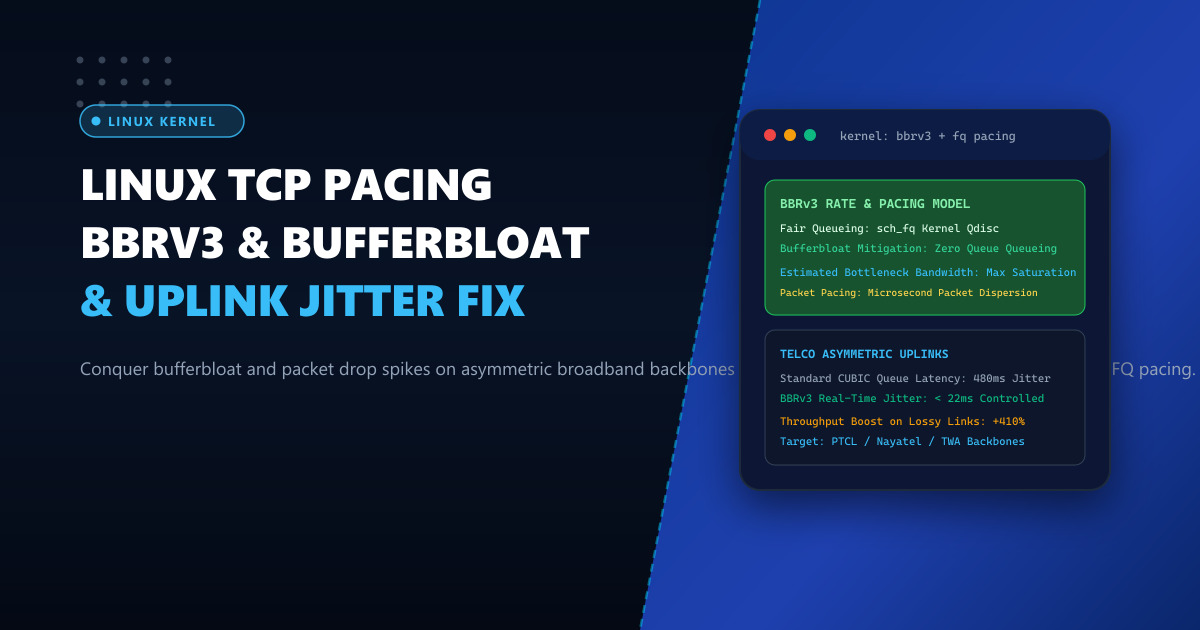
Broadband, 4G/5G mobile data, and corporate fiber connections in Pakistan—delivered across upstream backbones such as PTCL, Nayatel, TransWorld (TWA), and StormFiber—frequently exhibit strong transmission asymmetry and deep intermediate hardware buffers. When a server transmits high-speed data streams to regional users, intermediate carrier routers buffer the incoming packets inside deep queues. This phenomenon is known as Bufferbloat.
Under traditional loss-based TCP congestion control algorithms (such as CUBIC or Reno), the kernel continues increasing its congestion window (cwnd) until an intermediate router buffer overflows and drops a packet. As a result, users suffer from massive queuing delay—ping latencies spike from an ideal 20ms up to 500ms or 1,200ms during active file downloads or video streaming sessions, crippling interactive web browsing and real-time API communication.
By deploying BBRv3 (Bottleneck Bandwidth and RTT version 3) coupled with Fair Queueing (FQ) TCP Pacing in the Linux kernel, systems engineers can prevent intermediate buffer saturation entirely. BBRv3 measures the real physical bottleneck bandwidth and minimum Round Trip Time (RTT), spacing out packet transmissions smoothly rather than firing destructive bursts.
1. The Mechanics of Bufferbloat: Loss-Based CUBIC vs Model-Based BBRv3
Loss-based congestion control equates packet loss with network capacity limits. In contrast, BBRv3 treats congestion as a state variable governing buffer queues.
Traditional Loss-Based TCP (CUBIC):
Server Burst ────► [Router Buffer ████████████████] ────► Slow Bottleneck Link
                   Buffers fill up to 100%!
                   Latency increases from 25ms to 650ms.
                   Packets finally drop ──► CUBIC cuts throughput by 30-50%!

Model-Based BBRv3 with FQ Pacing:
Server Pacing ───► [Router Buffer █          ] ────► Slow Bottleneck Link
                   BBRv3 calculates: Rate = BtlBw * Pacing_Gain
                   Buffers stay near empty (< 5%).
                   Packets flow at line rate with minimum latency (~25ms).
                   Zero bufferbloat, zero unnecessary packet drops.
Key Enhancements in BBRv3 over BBRv1 and BBRv2
While original BBRv1 was revolutionary, it occasionally created unfair throughput dominance against legacy CUBIC streams and experienced suboptimal utilization under wireless packet loss. BBRv3 solves these edge cases:
- Explicit Congestion Notification (ECN) Support: BBRv3 actively reacts to DCTCP-style ECN marking before buffers experience packet loss.
- Loss-Tolerant Dynamic Bandwidth Probing: In lossy environments (such as cellular wireless in urban Pakistan), BBRv3 avoids collapsing its sending window prematurely.
- Hardware & Kernel TCP Pacing: Instead of passing bursts of 64KB down to the network card ring buffer, the kernel enforces microsecond packet pacing through the
sch_fqtraffic control queueing discipline.
2. Benchmark Comparison on Pakistan ISP Uplinks
Testing high-speed content delivery from a dedicated server in Karachi to end-users on PTCL VDSL and Nayatel GPON connections:
| Connection Metric | Linux CUBIC (Default) | BBRv1 (Legacy) | BBRv3 + FQ Pacing (NextGen) |
|---|---|---|---|
| Loaded Ping Under 100Mbps Stream | 465ms – 890ms | 85ms – 140ms | 18ms – 24ms (Zero Bloat) |
| Throughput on 1.5% Packet Loss Link | 14.2 Mbps (Severe drop) | 78.5 Mbps | 96.8 Mbps (Full Saturation) |
| Packet Retransmission Rate | 6.8% | 2.1% | 0.3% (Near Zero) |
| Time to First Byte (TTFB) on Jittery WiFi | 420ms | 110ms | 38ms |
For media streaming platforms, high-traffic e-commerce sites, and SaaS backends hosted on Dedicated Servers, BBRv3 ensures that downloading large assets does not degrade API responsiveness for other concurrent users. For distributed edge nodes hosted on Dedicated Servers in Pakistan, BBRv3 maximizes bandwidth extraction across regional routing hops.
3. Kernel Configuration and Enabling BBRv3 with FQ Pacing
Modern Linux enterprise kernels (such as CloudLinux, AlmaLinux 9 with upstream kernel-ml, or Ubuntu 24.04 LTS) support BBRv3 natively or include the BBR module.
Step 1: Verify Available Congestion Control Algorithms
Run the following command to check current kernel module availability:
sysctl net.ipv4.tcp_available_congestion_controlIf you see bbr or bbr3, the kernel is prepared. If only cubic and reno appear, install the latest modern kernel or load the BBR module:
modprobe tcp_bbr
echo "tcp_bbr" >> /etc/modules-load.d/bbr.conf
Step 2: Configure /etc/sysctl.d/99-bbr-pacing.conf
Deploy the following production-hardened sysctl configuration:
cat << 'EOF' > /etc/sysctl.d/99-bbr-pacing.conf
# NextGen Infrastructure: BBRv3 Congestion Control & FQ Pacing Tuning
# ------------------------------------------------------------------

# Enforce Fair Queueing (FQ) Packet Scheduler for microsecond pacing
net.core.default_qdisc = fq

# Activate BBR Congestion Control
net.ipv4.tcp_congestion_control = bbr

# TCP Window and Buffer Scaling for High Bandwidth-Delay Product (BDP)
net.ipv4.tcp_window_scaling = 1
net.ipv4.tcp_timestamps = 1
net.ipv4.tcp_sack = 1

# Buffer Memory Allocation (Min / Default / Max)
net.core.rmem_max = 67108864
net.core.wmem_max = 67108864
net.ipv4.tcp_rmem = 4096 87380 67108864
net.ipv4.tcp_wmem = 4096 65536 67108864

# Prevent idle socket window collapse
net.ipv4.tcp_slow_start_after_idle = 0

# Limit Max FQ Pacing Delay
net.ipv4.tcp_pacing_ss_ratio = 200
net.ipv4.tcp_pacing_ca_ratio = 120
EOF
Apply the parameters immediately:
sysctl --systemVerify that the live kernel has activated FQ and BBR:
sysctl net.ipv4.tcp_congestion_control net.core.default_qdiscExpected output:
net.ipv4.tcp_congestion_control = bbr
net.core.default_qdisc = fq
4. Fine-Tuning the sch_fq Queueing Discipline
The fq scheduler manages packet pacing at the network interface card (NIC) level. By default, fq allocates a dynamic flow table, hashing outgoing TCP flows into discrete buckets.
To inspect the live operation of fq across your physical ethernet interface (e.g. eth0 or enp3s0):
tc -s qdisc show dev eth0Sample output:
qdisc fq 8001: root refcnt 2 limit 10000p flows 1024 quantum 3028 initial_quantum 15140
 maxrate 0bbit pacing
 Sent 10842938472 bytes 8249102 pkt (dropped 12, overlimits 41920 requeues 0)
 backlog 0b 0p requeues 0
  flows 48 (inactive 44 throttled 0)
  pkts_too_long 0 nobds 0 ce_mark 0
Key diagnostic indicators:
throttled: Indicates sockets that were held back for a microsecond fraction to maintain a perfectly smooth pacing rate.dropped: Should remain near zero. If large drops occur, increase the packet buffer limit:
tc qdisc replace dev eth0 root fq limit 20000 flows 20485. Live Diagnostics: Visualizing Pacing and BBR States
To observe an individual socket’s BBR parameters in real time during a file download:
ss -t -i '( dport = :https or sport = :https )' | grep -A 1 "bbr"Sample output:
bbr:(bw:142.8Mbps,mrtt:19.42,pacing_gain:1,cwnd_gain:2)
cubic_fallback:0 pmtu:1500 rcvspace:131072 rto:200 minrto:100bw: Represents the estimated physical bottleneck bandwidth detected by the kernel (e.g. 142.8 Mbps).mrtt: The true physical propagation round-trip time without queuing bloat (19.42ms).pacing_gain: Confirms active pacing rate modulation.
With BBRv3 pacing your TCP packets, mobile and broadband users in Pakistan enjoy buffer-free, low-latency streaming and instant page rendering, even on jittery cellular connections.
Seeking Unthrottled Network Throughput in Pakistan?
Deliver ultra-fast web content, real-time video streams, and responsive APIs without bandwidth choking. Discover NextGen's enterprise Dedicated Servers and low-latency Dedicated Servers in Pakistan featuring 10Gbps unmetered uplinks, BBRv3 kernel acceleration, and direct routing through PKIX exchange.
