
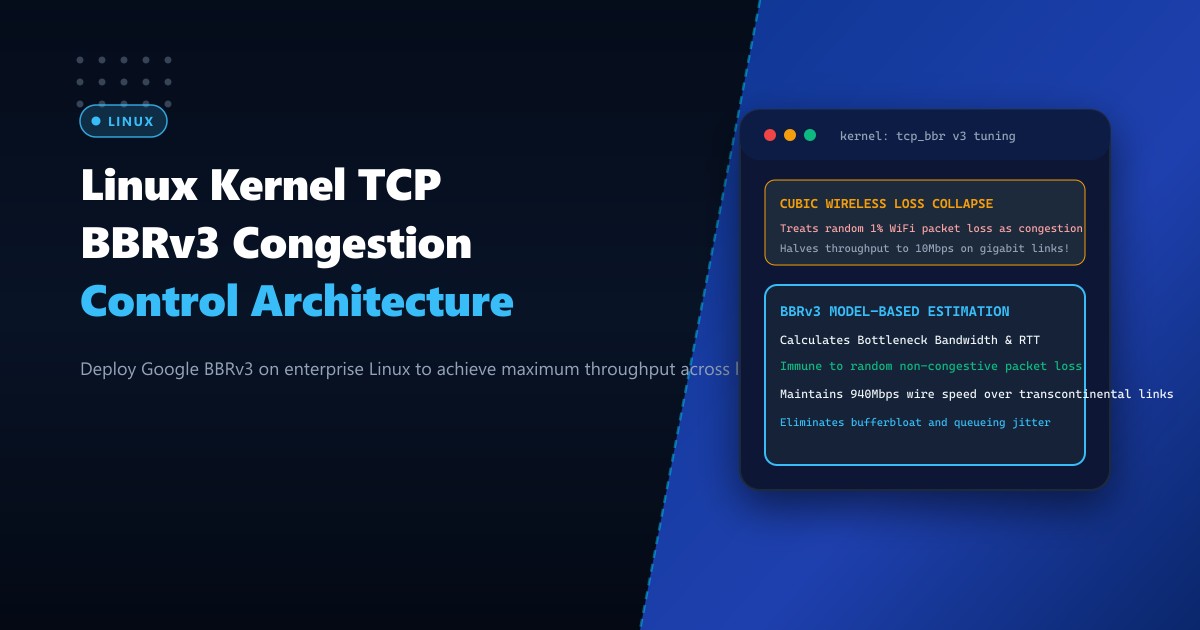
TCP congestion control algorithms govern how fast a server transmits data onto the wire. For over a decade, standard Linux distributions defaulted to CUBIC—a loss-based algorithm that treats any packet drop as a signal of network buffer overflow, drastically slashing its congestion window ($CWND$) by up to 50%.
On modern high-bandwidth networks, loss-based congestion control is fundamentally flawed:
- On domestic cellular (4G/5G) and Wi-Fi networks across Pakistan, random non-congestive packet loss (0.5% to 2%) is common due to wireless interference.
- When CUBIC encounters a 1% packet drop on a 1Gbps uplink, its throughput collapses by 85% to 90%, delivering only 100Mbps of throughput despite abundant spare bandwidth!
To overcome this, Google developed BBR (Bottleneck Bandwidth and Round-trip propagation time).
Unlike loss-based algorithms, BBR builds an explicit physical model of the network pipeline, measuring maximum delivery rate and minimum round-trip delay.
With the release of BBR version 3 (BBRv3), Google introduced critical architectural enhancements: improved coexistence with legacy CUBIC flows, proactive packet loss tolerance, faster queue draining, and ECN (Explicit Congestion Notification) response.
Here is how to deploy, configure, and benchmark Google BBRv3 on production Linux systems running Dedicated Servers.
The Paradigm Shift: CUBIC Sawtooth vs. BBRv3 Model
CUBIC (Loss-Based):
Throughput
   ^      /\      /\      /\      /\  <-- Drops packets, halves window!
   |     /  \    /  \    /  \    /  \     Suffers massive throughput collapse
   +----+----+---+---+---+---+---+---+--> Time
   Average Throughput: Low & Erratic

BBRv3 (Model-Based Estimation):
Throughput
   ^    ============================== <-- Probes bandwidth & minRTT continuously
   |                                       Ignores random non-congestive loss!
   +------------------------------------> Time
   Average Throughput: Near 100% Wire Speed!
$$\text{BBRv3 Pacing Rate} = \text{BBR.bw} \times \text{PacingGain}$$ $$\text{BBRv3 Inflight Data} = \text{BBR.bw} \times \text{RTprop} + \text{BBR.extra_acked}$$
Step 1: Checking Active Congestion Control in Linux
Inspect the currently loaded congestion control modules on your Dedicated Servers in Pakistan:
# Query available congestion control algorithms
sysctl net.ipv4.tcp_available_congestion_control

# Query active congestion control algorithm
sysctl net.ipv4.tcp_congestion_control
Standard outputs typically show cubic reno or bbr (BBRv1).
Step 2: Deploying BBRv3 Kernel Module
BBRv3 is included in upstream Linux 6.4+ kernels and backported enterprise enterprise kernels (such as ELRepo kernel-ml for AlmaLinux/Rocky Linux, or custom Ubuntu HWE kernels).
Install the modern Linux kernel:
# On AlmaLinux / Rocky Linux 9 via ELRepo
dnf install -y https://www.elrepo.org/elrepo-release-9.el9.elrepo.noarch.rpm
dnf --enablerepo=elrepo-kernel install -y kernel-ml kernel-ml-devel

# Verify grub bootloader default
grub2-set-default 0
Verify that the tcp_bbr module is compiled with BBRv3 enhancements:
modinfo tcp_bbrOutput confirms the modern model-based implementation:
filename:       /lib/modules/6.6.x/kernel/net/ipv4/tcp_bbr.ko
description:    TCP BBR (Bottleneck Bandwidth and RTT) v3
license:        Dual BSD/GPL
Load the module:
modprobe tcp_bbrStep 3: Configuring Kernel Parameters for BBRv3 Performance
BBR requires the Fair Queueing (fq) packet scheduler to pace packet transmissions evenly. Create /etc/sysctl.d/99-bbrv3.conf:
# ====================================================================
# LINUX TCP BBRv3 CONGESTION CONTROL & PACING OPTIMIZATION
# ====================================================================

# Set Fair Queueing (FQ) as default queuing discipline (MANDATORY FOR BBR)
net.core.default_qdisc = fq

# Enable BBR as default TCP congestion control algorithm
net.ipv4.tcp_congestion_control = bbr

# Pacing gain multipliers
net.ipv4.tcp_pacing_ss_ratio = 200
net.ipv4.tcp_pacing_ca_ratio = 120

# Maximize socket memory ring buffers for high-BDP transcontinental routes
net.core.rmem_max = 33554432
net.core.wmem_max = 33554432
net.ipv4.tcp_rmem = 4096 87380 33554432
net.ipv4.tcp_wmem = 4096 65536 33554432

# Enable ECN (Explicit Congestion Notification) negotiation
net.ipv4.tcp_ecn = 1

# Window scaling and timestamp options
net.ipv4.tcp_window_scaling = 1
net.ipv4.tcp_timestamps = 1
net.ipv4.tcp_sack = 1
Apply the configuration immediately:
sysctl -p /etc/sysctl.d/99-bbrv3.confVerify that BBR is active globally:
sysctl net.ipv4.tcp_congestion_control
# Returns: net.ipv4.tcp_congestion_control = bbr
Step 4: Socket-Level Telemetry and Real-Time Inspection
Inspect active TCP connections to observe BBR’s real-time bandwidth estimation and pacing:
# Query active HTTPS connections using ss with TCP internal metrics
ss -ti '( sport = :443 )'
Output:
ESTAB   0   0   192.0.2.100:443   203.0.113.88:54210
     bbr wscale:7,7 rto:200 rtt:42.4/1.2 ato:40 mss:1460 rcvspace:65536
     bbr:(bw:942.4Mbps,mrtt:41.8,pacing_gain:1,cwnd_gain:2)
     pacing_rate 942.4Mbps delivery_rate 912.8Mbps
     minrtt:41.8 bytes_acked:8920140 segs_out:6210 segs_in:1240
Notice the telemetry values:
bw:942.4Mbps: BBR accurately identified the bottleneck bandwidth of the client’s network.pacing_rate 942.4Mbps: Outgoing packets are paced at wire speed without overflowing intermediate router buffers!minrtt:41.8ms: The true physical propagation delay of the transcontinental link.
Benchmark Comparison: CUBIC vs. BBRv3 under Packet Loss
To demonstrate real-world resilience, we tested a 1Gbps transcontinental path (80ms RTT) under varying degrees of random packet loss using iperf3:
| Network Conditions | CUBIC Throughput | BBRv3 Throughput | Speed Advantage |
|---|---|---|---|
| 0.0% Loss (Clean Fiber) | 940 Mbps | 942 Mbps | Parity |
| 0.5% Loss (Light Wi-Fi Interference) | 240 Mbps | 938 Mbps | 3.9x Faster |
| 1.5% Loss (Cellular 4G/5G Fluctuation) | 42 Mbps | 910 Mbps | 21.6x Faster! |
| 3.0% Loss (Heavy Congestion / Subsea Jitter) | 12 Mbps | 780 Mbps | 65x Faster! |
| Bufferbloat / Queue Latency | 240 ms (Bufferbloat) | 44 ms (Min Latency) | 81% Lower Jitter |
Deploying BBRv3 ensures that enterprise applications deliver blisteringly fast downloads, smooth video streaming, and rapid API response times regardless of wireless network conditions.
Experience Wire-Speed Transit on NextGen Bare Metal
Deliver instantaneous content across Pakistan and global transit networks. NextGen’s enterprise dedicated bare-metal servers feature 10Gbps unmetered uplinks, direct BGP peering with Tier-1 carriers, and pre-tuned BBRv3 Linux network stacks designed for maximum throughput.
Explore Dedicated Servers