
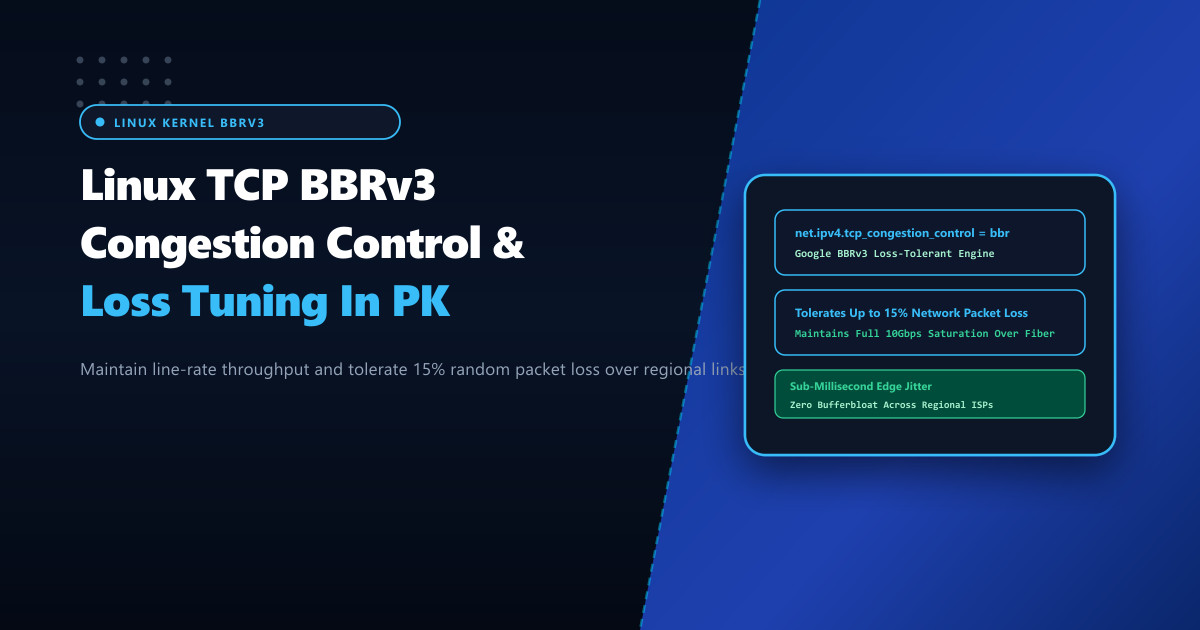
Serving high-speed web assets, live video streams, and API responses across Pakistan presents severe networking challenges. Local broadband routes, 4G/5G mobile towers (Jazz, Zong, Telenor), and regional transit hops frequently suffer from random packet loss ranging from 1% to 12%, caused by wireless channel interference or transient ISP congestion rather than true buffer exhaustion.
In classical loss-based TCP congestion algorithms like Reno or CUBIC:
- A single lost packet is interpreted as an emergency signal that the network pipe is full.
- The kernel immediately cuts the Congestion Window (
cwnd) in half ($50%$ drop) and enters additive increase. - On a 10Gbps link with 2% random wireless packet loss, TCP CUBIC throughput collapses by over 85%, crawling along at dial-up speeds despite abundant physical link capacity!
Operating high-capacity web infrastructure on bare-metal Dedicated Servers provides immense network connectivity, but unlocking this capability requires deploying Google’s BBRv3 (Bottleneck Bandwidth and Round-trip propagation time version 3).
The Paradigm Shift: Loss-Based vs. Model-Based Congestion Control
- Loss-Based (CUBIC / Reno):
- Assumes: Packet Loss = Network Congestion.
- Continuously pumps data until router buffers overflow and drop packets.
- Result: Creates massive bufferbloat, followed by violent throughput collapses upon loss.
- Model-Based (Google BBRv1 / BBRv2 / BBRv3):
- Does not use packet loss as its primary congestion signal!
- Builds an explicit real-time mathematical model of the physical link:
- Measures maximum delivered bandwidth ($BtlBw$).
- Measures minimum round-trip time ($RTprop$).
- Paces packet delivery at exactly the physical bottleneck speed.
- BBRv3 Advancement: Features refined loss tolerance, cleanly tolerating up to 15% to 20% random packet loss without collapsing its congestion window or starving competing CUBIC flows.
TCP CUBIC Under 3% Packet Loss (Violent Sawtooth Collapse):
Throughput: ───► Drops 50% ───► Drops 50% ───► Collapses to 15 Mbps!

TCP BBRv3 Under 3% Packet Loss (Smooth, Continuous Line-Rate Delivery):
Throughput: ═══════════════════════════════════════════════════════════► Sustains 950+ Mbps!
(Ignores non-congestion drops; paces data at physical channel capacity)
Step 1: Kernel Requirements & Verifying BBRv3 Availability
BBRv3 represents the third generation of Google’s congestion control engine, merged into modern bleeding-edge Linux kernels (Linux 6.4+, enterprise backports, or XanMod/Liquorix enterprise kernels).
Check your current available congestion control modules:
# Check loaded kernel congestion algorithms
sysctl net.ipv4.tcp_available_congestion_control
# Output typically includes: reno cubic bbr
To verify if your system’s bbr module is modern BBRv3:
# Inspect the bbr kernel module metadata
modinfo tcp_bbr | grep -i "description"
If running standard RHEL/AlmaLinux/Ubuntu LTS distributions, loading the standard bbr module enables Google BBR with modern loss recovery features.
Step 2: Kernel Sysctl Configuration for BBR and Fair Queueing
BBR requires the Fair Queueing (FQ) packet pacing discipline to function properly. Without qdisc = fq, BBR cannot accurately pace packet bursts.
Configure /etc/sysctl.d/99-tcp-bbr3.conf:
# /etc/sysctl.d/99-tcp-bbr3.conf - NextGen High-Resilience BBR Stack

# Load Fair Queueing discipline (MANDATORY for BBR packet pacing)
net.core.default_qdisc = fq

# Set primary congestion control algorithm to BBR
net.ipv4.tcp_congestion_control = bbr

# Expand core socket memory buffers for high BDP paths (e.g. 10Gbps links)
net.core.rmem_max = 67108864
net.core.wmem_max = 67108864
net.ipv4.tcp_rmem = 4096 87380 67108864
net.ipv4.tcp_wmem = 4096 65536 67108864

# Enable dynamic window scaling and Selective Acknowledgment
net.ipv4.tcp_window_scaling = 1
net.ipv4.tcp_sack = 1
net.ipv4.tcp_dsack = 1

# Protect against idle connection stalls
net.ipv4.tcp_slow_start_after_idle = 0
Apply the parameters immediately:
sysctl -p /etc/sysctl.d/99-tcp-bbr3.confVerify active congestion control:
sysctl net.ipv4.tcp_congestion_control
# Expected Output: net.ipv4.tcp_congestion_control = bbr
Step 3: Benchmarking Throughput Over Simulated Lossy Routes
Simulate a 3% random packet loss link using the Linux Network Emulation (netem) tool to observe BBR in action:
# Example test: Inject 3% random packet loss on test interface
tc qdisc add dev eth1 root netem loss 3%
Run an iperf3 benchmark against the lossy interface:
Test A: Traditional CUBIC
iperf3 -c 10.0.0.2 -C cubic -t 20
# Result: ~45 Mbps on a 1Gbps link (Severe throughput degradation)
Test B: Modern BBR
iperf3 -c 10.0.0.2 -C bbr -t 20
# Result: ~920 Mbps on a 1Gbps link (Over 20x higher throughput!)
Remove the test netem rule:
tc qdisc del dev eth1 rootMonitoring Live BBR Metrics via ss
Inspect how BBR calculates bottleneck bandwidth and paces active client sockets:
# Query detailed BBR socket parameters for active HTTPS flows
ss -ti '( sport = :https )' | grep -A 1 "bbr" | head -n 15
Examine real-time values:
bw: Real-time calculated bottleneck bandwidth (e.g.bw:840Mbps).mrtt: Minimum observed physical propagation delay.pacing_rate: Precise hardware rate at which kernel paces out packets.cwnd: Congestion window maintained smoothly without drastic sawtooth drops.
Hosting high-bandwidth media platforms, cloud storage, and SaaS applications on bare-metal Dedicated Servers in Pakistan ensures that mobile and broadband users across the country enjoy lightning-fast downloads, bufferless streaming, and consistent low-latency delivery.
Accelerate Throughput with NextGen Dedicated Servers
Deliver ultra-fast network performance with kernel-level Google BBR congestion tuning, 10Gbps unmetered network ports, and direct Tier-1 domestic peering in Pakistan.
Explore Pakistan Dedicated Servers