
The landscape of algorithmic trading has evolved rapidly in Pakistan. Retail traders and institutional investors alike are deploying sophisticated trading bots (Expert Advisors, or EAs) on platforms like MetaTrader 4 (MT4), MetaTrader 5 (MT5), cTrader, and NinjaTrader.
However, trading from Pakistan introduces two major technical hurdles: local power/internet instability (such as load shedding or sudden ISP fiber cuts) and geographical network latency to major financial hubs in New York, London, or Tokyo.
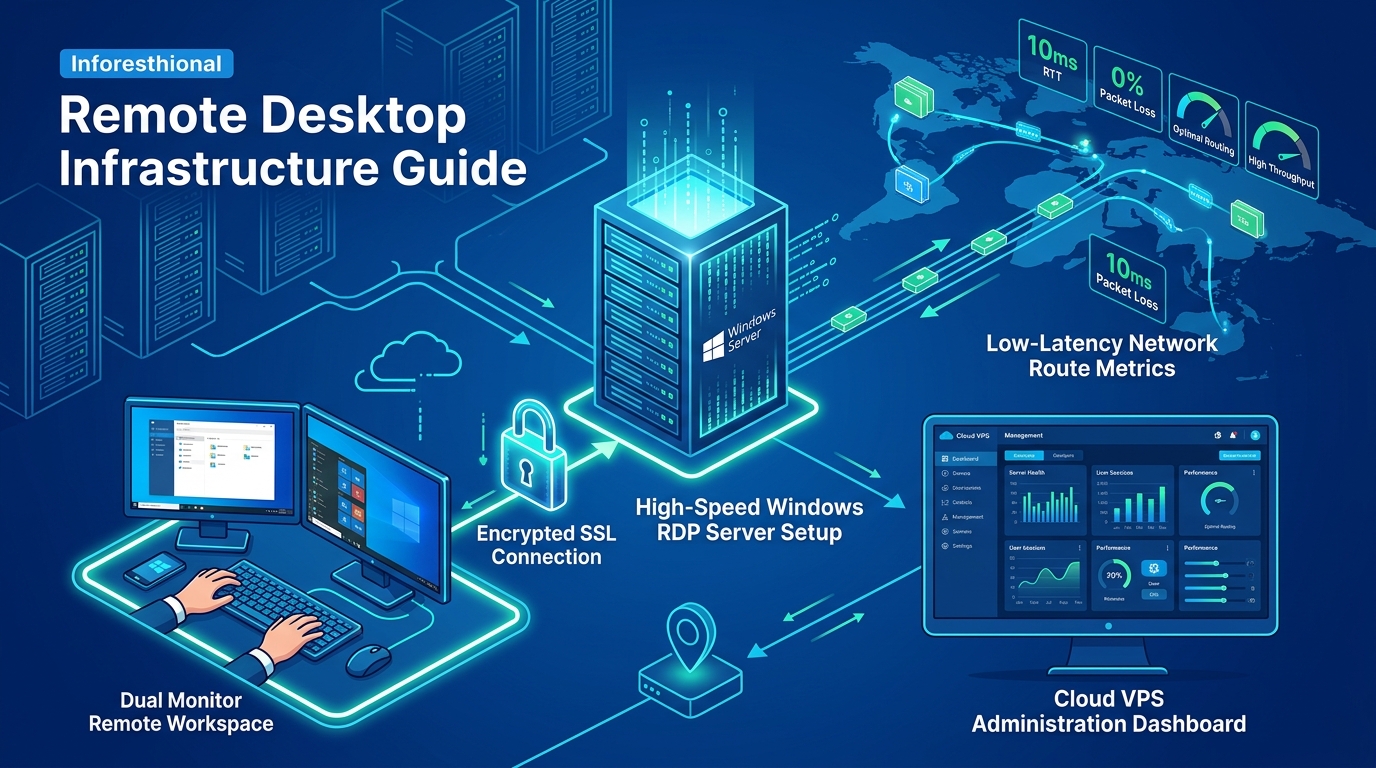
To bypass these bottlenecks, professional traders rely on a Windows RDP (Remote Desktop Protocol) server—a high-performance, always-on trading node. In this deep-dive guide, we will explore how to architect, deploy, and ruthlessly optimize a Windows RDP for high-frequency trading (HFT) and automated algorithms.
1. The Anatomy of a Low-Latency Trading Node
In algorithmic trading, latency is the time it takes for your trading software to receive a price tick, process it, and send a buy/sell order back to the broker’s matching engine. When execution speed is measured in milliseconds (ms), physical distance matters.
The Proximity Principle
Your trading server must be geographically close to your broker’s primary servers (e.g., Equinix NY4 in New York or LD4 in London). A Windows RDP located in the same data center—or the same city—as your broker can achieve sub-1ms execution speeds. Do not host your execution node in a local Pakistani data center if your broker is in London; the transatlantic fiber route will introduce 130ms+ of lag.
Hardware Prerequisites
Trading terminals are notoriously single-threaded. When provisioning your RDP, prioritize:
- High Clock Speeds: Processors like AMD Ryzen or Intel Core series with high single-core performance outperform server-grade CPUs with many slow cores.
- RAM: Minimum 4GB for a single MT4/MT5 instance. Complex multi-currency algorithms require 8GB+.
- Storage: NVMe SSDs are non-negotiable. They ensure rapid read/write operations for tick data logging and fast boot times.
2. Setting Up Your Windows RDP for Trading
Once you have provisioned your Windows RDP, the first step is to secure it and prepare the environment for stable, 24/7 operation.
Step 2.1: Initial Server Hardening
- Connect via RDP: Open Remote Desktop Connection on your local PC and log in using your server IP and credentials.
- Disable Windows Updates: Windows loves to force restarts for updates. Use the Group Policy Editor (
gpedit.msc> Computer Configuration > Administrative Templates > Windows Components > Windows Update) to Disable Automatic Updates. You should manually update the server on weekends when the markets are closed. - Power Settings: Ensure the server is set to “High Performance” and that the hard disk and display are set to never turn off or sleep.
Step 2.2: Platform Installation and Auto-Start
Install your trading terminal. To ensure your trading bot resumes immediately in the rare event of a server reboot:
- Create a shortcut to your MT4/MT5
terminal.exe. - Press
Win + R, typeshell:startup, and press Enter. - Paste the shortcut into the Startup folder.
3. Deep Optimization: Squeezing Out Every Millisecond
Out of the box, Windows Server is optimized for general-purpose workloads, not the hyper-responsive network streams required by algorithmic trading. Let’s tweak the network stack.
Disable Nagle’s Algorithm (TCP NoDelay)
Nagle’s algorithm buffers small packets of data to send them in one larger chunk, saving bandwidth but increasing latency. We must disable this to ensure instant transmission of trade orders.
- Open the Registry Editor (
regedit). - Navigate to
HKEY_LOCAL_MACHINE\SYSTEM\CurrentControlSet\Services\Tcpip\Parameters\Interfaces\. - Find the subkey corresponding to your active network adapter (look for your server’s IP address).
- Right-click, create two new DWORD (32-bit) Values:
TcpAckFrequency(Set value data to1)TCPNoDelay(Set value data to1)
- Restart the server.
Network Adapter Tuning
Open the properties of your Network Adapter in Device Manager. Under the Advanced tab:
- Disable Interrupt Moderation (Prioritizes immediate CPU attention over batch processing).
- Disable Energy Efficient Ethernet / Green Ethernet.
- Disable all Offload capabilities (Large Send Offload, Checksum Offload) to prevent the NIC from delaying packet transmission.
4. Scaling the Operation
As your quantitative trading operations grow, you might transition from running a simple forex EA to deploying complex statistical arbitrage models across multiple asset classes.
When you start handling massive concurrency, heavy enterprise data pipelines, institutional tick-data scraping, or running massive backtesting arrays simultaneously, a standard VPS won’t cut it. You’ll need to upgrade to bare-metal Dedicated Servers. Furthermore, if your primary command-and-control operations, local monitoring stacks, and heavy databases are situated regionally, investing in high-end Dedicated Servers in Pakistan ensures ultra-fast local management and data processing, while your remote execution nodes fire off the actual trades.
5. Best Practices for Uninterrupted Execution
- Disconnect, Don’t Log Off: When you are done checking your bots, close the RDP window via the ‘X’ button. Do not click “Start > Log Off” or “Shut Down”. Closing the window leaves your session active in the background, keeping the trading terminal running.
- Visual Optimizations: The visual lag of your RDP connection does not affect trading speed. However, for a smoother management experience from Pakistan over high-latency connections, lower the RDP color depth to 15-bit or 16-bit, and disable desktop composition, menu animations, and themes in the RDP client’s Experience tab.
- Third-Party Monitoring: Set up UptimeRobot to ping your server’s IP address. If the server drops offline, you will instantly receive an email or Telegram alert.
Conclusion
Deploying a trading node on a Windows RDP neutralizes the risks of internet outages and power failures in Pakistan, while simultaneously placing your execution engine adjacent to the world’s financial exchanges. By carefully selecting your server location, disabling latency-inducing network protocols, and structuring a resilient startup sequence, you can build an enterprise-grade algorithmic trading environment that rivals institutional setups.
