
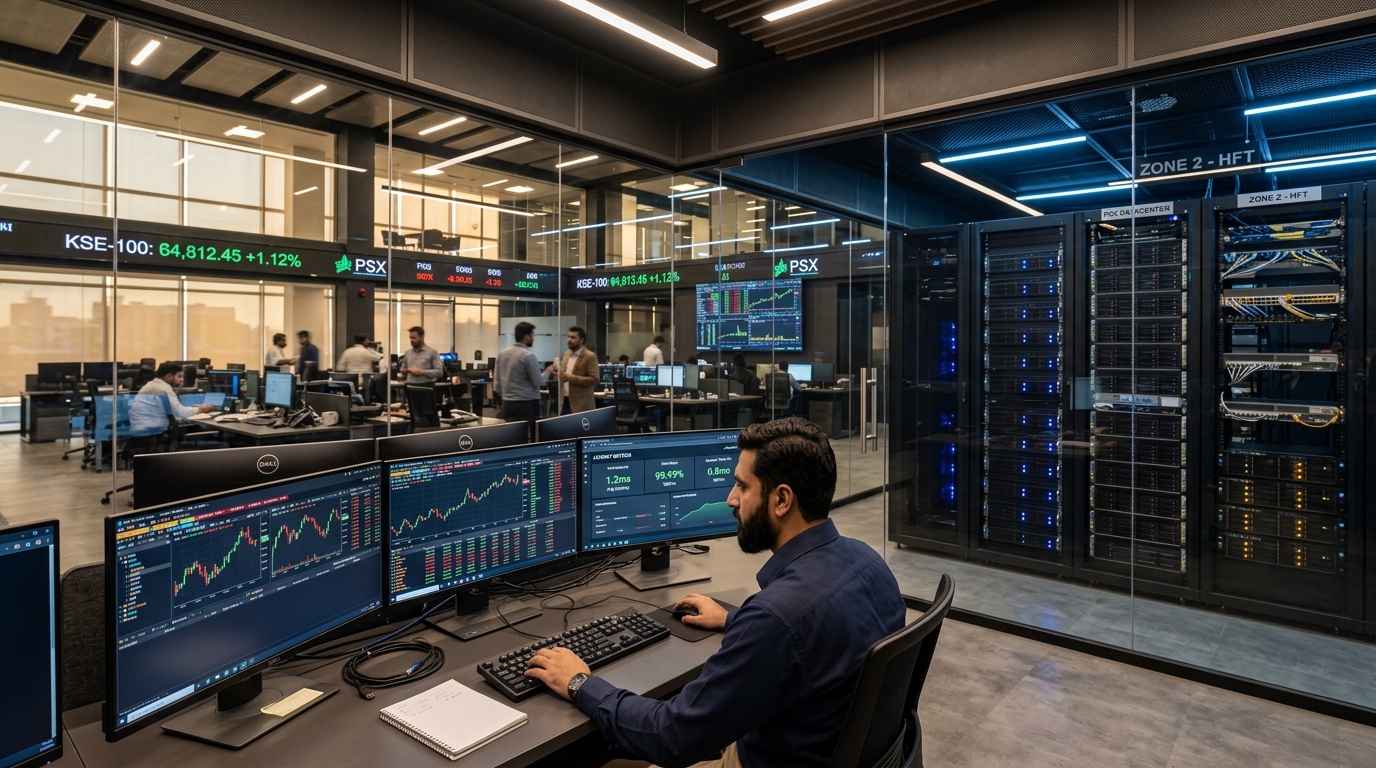
In a watershed reform for Pakistan’s capital markets, the Securities and Exchange Commission of Pakistan (SECP) and the Pakistan Stock Exchange (PSX) have formally notified and operationalized the Algorithmic Trading and Direct Market Access (DMA) Regulations 2026.
The regulatory milestone opens the gates for domestic brokerage houses, asset management firms, and international quantitative hedge funds to deploy automated trading engines, smart order routing (SOR), and high-frequency trading (HFT) strategies directly connected to the exchange’s core matching engine. Alongside the regulatory framework, PSX announced the commercial commissioning of its Tier-3 Financial Colocation Facility at the Exchange Building on Stock Exchange Road in Karachi, providing sub-millisecond round-trip execution latency for institutional market participants.
1. FIX Protocol 5.0 & Binary Market Data Feeds (FAST/ITCH)
For decades, trading on the Karachi Automated Trading System (KATS) and Jade Trading Workstations relied largely on manual trader keystrokes, browser-based portals, or high-level broker APIs subject to unpredictable queuing delays. Under the newly notified DMA framework, PSX has modernized its network architecture to support native Financial Information eXchange (FIX) Protocol 4.4 and 5.0 Service Packs 2 (SP2) alongside direct binary multicast market data feeds.
+-----------------------------------------------------------------------------------------+
|                  PSX Direct Market Access (DMA) & Colocation Flow                       |
+-----------------------------------------------------------------------------------------+
|                                                                                         |
|   +-----------------------+              Direct 10Gbps/25Gbps Fiber Cross-Connect       |
|   | Quantitative Engine   | --------------------------------------------------------+   |
|   | Bare-Metal Server     |                                                         |   |
|   | (Custom FPGA / C++)   | <----------------------------------------------------+  |   |
|   +-----------------------+              ITCH Direct Binary Multicast Feeds      |  |   |
|              |                                                                   |  |   |
|   FIX 5.0    | Outbound Order                                                    |  |   |
|   Tag Specs  | (NewOrderSingle - MsgType 'D')                                    |  |   |
|              v                                                                   |  |   |
|   +-----------------------+                                                      |  |   |
|   | SECP Pre-Trade Risk   | Validations: Credit, Price Band, Max Notional,        |  |   |
|   | Gateway (FPGA-Assisted| Order-Rate Throttles (Max 2,500 msgs/sec)            |  |   |
|   +-----------------------+                                                      |  |   |
|              |                                                                   |  |   |
|   Clean Order| Validated Packet                                                  |  |   |
|              v                                                                   |  |   |
|   +-----------------------+                                                      |  |   |
|   | PSX KATS Core         | Deterministic Matching Engine                        |  |   |
|   | Order Book & Matching | (Karachi Central Financial Datacenter)               |  |   |
|   +-----------------------+                                                      |  |   |
|              |                                                                   |  |   |
|              +------------------- Execution Reports & Market Depth --------------+  |   |
|                                                                                         |
+-----------------------------------------------------------------------------------------+
Protocol Modernization Details
- Deterministic FIX Session Gateways: Brokers and qualified institutional clients receive direct, bi-directional TCP sessions directly terminating at PSX DMA gateways. Institutional algorithms can submit
NewOrderSingle(MsgTypeD),OrderCancelRequest(MsgTypeF), andOrderCancelReplaceRequest(MsgTypeG) packets with microsecond execution acknowledgments (8=FIX.5.0SP2|35=8...). - Low-Overhead Binary Market Feeds (FAST/ITCH): Rather than polling RESTful endpoints or slow JSON sockets, quantitative algorithms ingest uncompressed Level-2 (Top-of-Book depth) and Level-3 (full tick-by-tick individual order queues) feeds over UDP Multicast.
- Microsecond Timestamping: Market data ticks and order acknowledgments are synchronized with hardware PTP (Precision Time Protocol IEEE 1588v2) across PSX’s core routing fabric, guaranteeing nanosecond-level sequencing transparency for disputed fills and regulatory audits.
2. Karachi Financial Colocation Infrastructure: Slashing Round-Trip Latency
The backbone of this automated transformation is the commissioning of PSX’s dedicated Tier-3 Financial Colocation Data Hall in Karachi. By eliminating hundreds of kilometers of backhaul fiber, telecom aggregation hops, and metropolitan ISP congestion, on-premise trading engines can interact with the matching engine at deterministic, sub-millisecond speeds.
| Infrastructure Parameter | Legacy Retail / Remote API Broker Link | Direct Market Access (DMA) Internet VPN | PSX Tier-3 Karachi On-Premise Colocation |
|---|---|---|---|
| Round-Trip Latency (RTT) | 35ms - 85ms | 8ms - 18ms | Sub-500 Microseconds (< 0.5ms) |
| Network Interface | Standard 1Gbps Copper / WAN | 1Gbps Dedicated Leased Line | 10Gbps / 25Gbps Optical Cross-Connect |
| Market Data Ingestion | Snapshot polling (500ms intervals) | Filtered L1/L2 Broadcast (100ms) | Tick-by-Tick Multicast ITCH (Real-Time) |
| Jitter / Latency Variance | High (± 25ms packet jitter) | Medium (± 4ms routing jitter) | Deterministic (< 15 microseconds jitter) |
| Redundancy Tier | N+1 Office UPS / Commercial Power | Dual Telco WAN Links | 2N Power UPS, Dual Generators, Spine-Leaf SDN |
The financial colocation floor provides high-density 42U server cabinets equipped with dual-redundant A+B power feeds, hot-aisle containment, and direct dark-fiber links to Karachi’s primary financial interconnects (including I.I. Chundrigar Road core banking backbones and national carrier points of presence).
3. Mandatory SECP Risk Controls & Circuit Breakers
To safeguard capital market integrity and avoid flash crashes similar to those witnessed in international equities venues, the SECP Algorithmic Trading Regulations 2026 mandate rigorous multi-tiered pre-trade risk management validation:
[ Algorithmic Engine ]
          |
          v
[ Gate 1: Fat-Finger & Price Band Check (±5% from Static / Dynamic Reference Price) ]
          |
          v
[ Gate 2: Maximum Notional Order Value & Cumulative Position Exposure Cap ]
          |
          v
[ Gate 3: Order-Rate Throttling (Enforcing max orders/sec limit per MPID) ]
          |
          v
[ Gate 4: Hardware Emergency Kill-Switch (Instant Cancel-on-Disconnect & Panic Drop) ]
          |
          v
[ Order Injected to PSX Matching Engine ]
Core Compliance Pillars
- Pre-Trade Risk Gateways (PTRG): All DMA orders—whether originating from proprietary algorithms or institutional DMA client desks—must pass through synchronous, ultra-low-latency risk validation filters before entering the matching engine. Any order breaching preset price bands (e.g., beyond the SECP circuit-breaker threshold from the last traded price) is dropped automatically at the gateway.
- Fat-Finger Prevention & Size Caps: Hard limits on single-order quantities and total notional rupee value prevent runaway loops from entering aberrant billion-rupee market orders.
- Automated Order Throttling: Trading applications are bound to strict message-per-second (MPS) quotas per Session ID, preventing algorithmic denial-of-service loops against PSX order books.
- Heartbeat Monitoring & Cancel-on-Disconnect (CoD): If an automated trading session loses socket heartbeat connectivity with the exchange gateway for more than 2,000 milliseconds, the matching engine executes an atomic
Cancel-on-Disconnectsequence, instantly cancelling all active resting passive limit orders placed by that algorithmic ID. - Physical & Software Kill Switches: Broker compliance officers and exchange surveillance teams retain authorized master kill-switches capable of severing a firm’s trading privileges or dropping all open resting orders within a single keystroke.
4. Market Impact: Algorithmic Strategies Reshaping Brokerages & Funds
Pakistan’s premier brokerage houses—including AKD Securities, Arif Habib Limited, Topline Securities, and JS Global Capital—alongside mutual funds and foreign institutional investors, have spent months preparing algorithmic execution models in the SECP regulatory sandbox.
The rollout of DMA unlocks several sophisticated execution and liquidity-provisioning strategies:
- VWAP / TWAP Execution Engines: Large institutional asset managers rebalancing multi-billion rupee equity portfolios can now slice massive blocks into hundreds of discrete orders timed to Volume-Weighted Average Price (VWAP) or Time-Weighted Average Price (TWAP) schedules, significantly mitigating market impact and slippage.
- Statistical Arbitrage & Spread Capture: Quantitative desks capture momentary pricing inefficiencies between the PSX Ready Cash Market, Deliverable Futures (DFM), and Single Stock Futures (SSF), maintaining tighter bid-ask spreads across the KSE-100 index constituents.
- Automated Market Making (AMM): Institutional market makers inject programmatic two-sided liquidity into second-tier equities and corporate debt instruments, boosting exchange-wide turnover and reducing volatility.
- Multi-Asset Hedging: Systematic trading desks can programmatically hedge stock positions against currency movements, Treasury Bills, and Sovereign Sukuk auctions in real time.
5. The Infrastructure Imperative: Bare-Metal Dedicated Servers vs. Virtualized Cloud
In algorithmic trading, execution speed and predictability dictate profitability. A 5-millisecond delay in receiving a market quote or firing an order can turn an arbitrage opportunity into a severe adverse execution fill.
Quantitative trading systems comprise three latency-critical layers:
- Market Data Feed Handlers: Parsing compressed, high-frequency multicast binary packets at line rate.
- Strategy Evaluation Engines: Executing quantitative alpha models, order book delta math, and risk evaluations in compiled C++, Rust, or FPGA hardware logic.
- FIX Protocol Session Managers: Serializing and transmitting TCP packets back out to the exchange gateway with deterministic timing.
Why Shared Virtualization Fails Algorithmic Workloads
In standard virtualized cloud environments (multi-tenant hypervisors), virtual machines share physical CPU cores, PCIe buses, and network interface cards. This architecture introduces severe performance bottlenecks:
- Hypervisor Jitter & Steal Time: Hypervisor context switching and CPU core sharing generate micro-stalls (CPU steal time), causing algorithmic threads to periodically freeze for 1 to 10 milliseconds—an eternity in high-frequency trading.
- Noisy Neighbor Contention: When another tenant on the same physical host runs heavy I/O or compilation scripts, the shared L3 cache and memory bus become saturated, degrading trading loop determinism.
- Lack of Kernel-Bypass Networking: High-frequency trading stacks rely on kernel-bypass technologies such as Solarflare OpenOnload, DPDK (Data Plane Development Kit), and SR-IOV (Single Root I/O Virtualization) to route network packets directly to userspace memory, bypassing Linux kernel network stack latency. Virtualized cloud hypervisors do not permit raw PCIe passthrough or bare-metal kernel-bypass tuning.
+-------------------------------------------------------------------------------+
|                       Bare-Metal vs. Virtualized Cloud                        |
+-------------------------------------------------------------------------------+
|                                                                               |
|  SHARED VIRTUAL CLOUD:                                                        |
|  [ Algorithm ] --> [ Guest OS ] --> [ Hypervisor Jitter ] --> [ Shared vNIC ] |
|  Result: 5ms - 15ms latency, non-deterministic spikes, CPU steal time         |
|                                                                               |
|  DEDICATED BARE-METAL SERVER:                                                 |
|  [ Algorithm ] ===> [ Kernel-Bypass (DPDK / Solarflare) ] ===> [ 25G NIC ]    |
|  Result: Sub-millisecond deterministic wire execution, zero jitter            |
|                                                                               |
+-------------------------------------------------------------------------------+
For institutional firms and fintech quantitative desks deploying algorithmic trading software in Pakistan, mission-critical execution demands dedicated bare-metal infrastructure. To eliminate unpredictable network routing hops, your trading engines must be hosted on high-performance Dedicated Servers optimized for single-tenant compute. For financial institutions requiring physical proximity to the Karachi financial district, deploying Dedicated Servers in Pakistan within local Tier-3 datacenter suites ensures lowest-possible round-trip times, dedicated high-clock CPUs (such as AMD EPYC and Intel Xeon Scalable processors), pure NVMe Gen4/Gen5 storage arrays, and unthrottled gigabit and 10-gigabit network uplinks.
Summary of Regulatory Timelines
The SECP and PSX have scheduled the full operational rollout across three distinct phases:
- Phase 1 (Immediate - Q4 2026): Qualified broker proprietary desks and institutional liquidity providers go live with DMA and algorithmic market-making frameworks in the PSX Karachi colocation suites.
- Phase 2 (Q1 2027): Direct Market Access extended to accredited institutional asset management companies (AMCs), pension funds, and foreign institutional portfolio investors (FIPI).
- Phase 3 (Q3 2027): Launch of certified third-party vendor algorithmic application marketplaces and expanded smart-order routing for algorithmic cross-asset matching.
As Pakistan’s financial technology sector accelerates, the convergence of progressive capital market regulation and enterprise bare-metal hosting infrastructure firmly establishes the Pakistan Stock Exchange as an attractive destination for modern quantitative finance.
Power Your Trading & Mission-Critical Engines with Nextgen
Deploy high-frequency bare-metal dedicated servers and low-latency cloud infrastructure engineered with unshared CPU cores, pure NVMe Gen4 storage, and direct high-capacity Karachi peering.
