
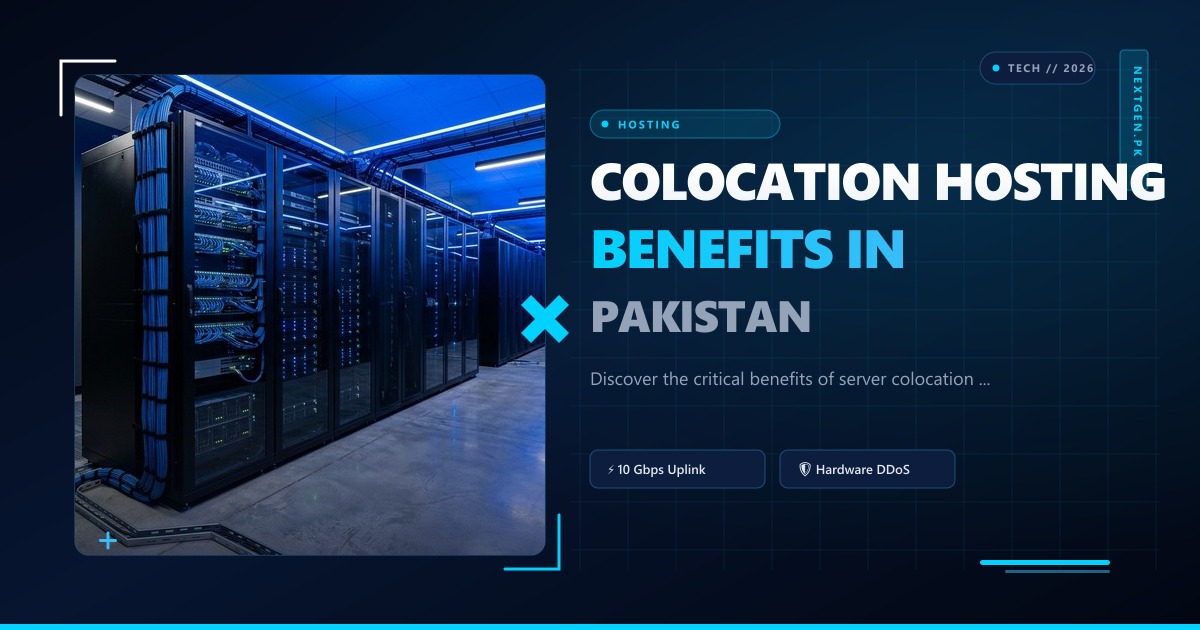
Walk into almost any mid-sized enterprise, corporate head office, or growing software house in Lahore, Karachi, or Islamabad, and you’ll likely find a familiar sight: a locked glass cabinet tucked inside a repurposed storeroom, with two split air conditioners humming desperately against the summer heat and a tangled mess of blue CAT6 patch cords.
Somewhere in that closet sits hundreds of thousands of dollars worth of Dell PowerEdge or HPE ProLiant hardware running the company’s ERP, core accounting database, Active Directory domain controller, and internal web portals.
And every sysadmin in Pakistan knows the underlying dread that comes with it.
What happens when K-Electric or WAPDA drops power during a monsoon thunderstorm, the building’s backup generator takes 90 seconds to crank, the office UPS batteries fail under the surge, and the split AC trips off while the temperature outside hits 44°C?
Within 40 minutes, your server room becomes an oven. CPU thermal throttling kicks in, NVMe controllers trigger emergency emergency shutoffs, and your executive team is screaming because the entire business has halted.
This is precisely why serious enterprises, financial institutions, logistics networks, and telecom operators migrate their critical hardware to server colocation in Pakistan.
What is Colocation Hosting?
Colocation (or “colo”) hosting is a deployment model where you own the physical server hardware, but you rent secure floor space, electrical power, cooling, and internet bandwidth inside a purpose-built Tier-3 datacenter facility.
Unlike cloud hosting or managed shared hosting where the provider owns and operates the physical server beneath an abstraction layer, colocation gives you 100% control over the machine. You select the exact CPU architecture, configure your own hardware RAID controllers, insert your own enterprise SAS/NVMe drives, and physically manage your own firewalls.
The datacenter provider supplies what an ordinary commercial office building cannot realistically deliver:
- Continuous, conditioned electrical power backed by industrial N+1 UPS banks and multi-megawatt diesel generators.
- Precision Computer Room Air Conditioning (CRAC) maintaining strict humidity and temperature tolerances.
- Biometric physical access control, CCTV monitoring, and multi-stage security perimeters.
- Carrier-neutral high-throughput fiber cross-connects directly linked to national exchange points like the Pakistan Internet Exchange (PkIX).
Office Server Closet vs. Tier-3 Colocation Datacenter: A Brutal Comparison
Let’s break down the reality of running servers in-house versus collocating in an enterprise-grade Pakistani datacenter facility:
| Operational Metric | Office Server Room / Closet | Tier-3 Colocation Datacenter (Nextgen) |
|---|---|---|
| Power Reliability | Standard commercial grid (LESCO/K-Electric) + small office UPS | Dual A+B utility feeds, redundant N+1 flywheel/battery UPS, 72+ hour onsite diesel reserves |
| Cooling & Thermal Control | Domestic split ACs (prone to freezing or dripping water onto racks) | Precision CRAC/CRAH downflow units with cold-aisle containment (18°C–22°C constant) |
| Network Redundancy | Single or dual broadband fiber drops (PTCL/Nayatel) subject to local road cuts | Carrier-neutral BGP multi-homing (PTCL, Transworld, Nayatel, StormFiber) with automated failover |
| Domestic Latency | Variable (often routed overseas and back depending on local ISP routing) | Direct 100G PkIX peering in Islamabad & Karachi (<5ms domestic latency nationwide) |
| Physical Security | Keycard or physical key to an office door (receptionist or night guard) | Multi-factor biometric mantraps, 24/7 armed security, caged racks, tamper alarms |
| Fire Suppression | Handheld chemical extinguishers (which ruin server motherboards if sprayed) | FM-200 / Novec 1230 clean agent gas suppression (extinguishes flames without damaging silicon) |
| Regulatory Compliance | Fails SBP, SECP, and PTA high-availability data sovereignty audits | Meets ISO 27001, PCI-DSS Level 1, and SBP BCP/DR regulatory mandates |
The 5 Core Benefits of Colocation Hosting for Pakistani Businesses
1. Immunity to Local Grid Instability & Power Surges
Pakistan’s electrical infrastructure is notoriously unpredictable. Voltage fluctuations, brownouts, and rolling blackouts are facts of life. In an office environment, unexpected power drops degrade enterprise power supply units (PSUs) and can cause catastrophic silent data corruption on uncommitted database write buffers.
Tier-3 colocation facilities operate with Concurrent Maintainability. This means every electrical transformer, uninterruptible power supply (UPS), switchboard, and backup generator can be taken offline for service or repair without a single millisecond of power disruption to your racks.
2. Carrier-Neutral Connectivity & PkIX Cross-Connects
In an office setting, you are at the mercy of whatever internet service providers happen to service your commercial plaza. If a municipal construction crew excavating a road accidentally cuts your ISP’s underground fiber duct, your entire business goes dark until a field technician splices the glass.
In a carrier-neutral colocation datacenter:
- You are not locked into any single telco.
- You can establish direct physical optical cross-connects to PTCL, Nayatel, Transworld, Cybernet, and Wateen simultaneously.
- Through direct connection to the Pakistan Internet Exchange (PkIX), your local traffic routes within the country without taking wasteful, high-latency detour hops across subsea cables to Singapore or Marseille.
3. Regulatory Compliance & Data Sovereignty Mandates
For banks, microfinance providers, payment gateways, healthcare institutions, and public-sector contractors, compliance is non-negotiable. The State Bank of Pakistan (SBP) and the Securities & Exchange Commission of Pakistan (SECP) enforce strict data localization guidelines:
- Sensitive customer financial records, transaction logs, and PII must reside on physical hardware located within Pakistani territorial borders.
- Offshoring core financial ledgers to foreign public clouds can trigger severe audit penalties.
Colocation allows your enterprise to satisfy sovereignty audits by retaining sole physical ownership of your hardware while housing it inside a certified, audit-compliant domestic facility.
4. CapEx vs. OpEx Cost Predictability
Building an on-premises datacenter room that satisfies Tier-3 standards requires millions of rupees in upfront capital expenditures: purchasing industrial UPS systems, sound-dampened generator enclosures, FM-200 gas canisters, anti-static raised flooring, and precision HVAC machinery.
Furthermore, you must employ full-time facility maintenance engineers just to test batteries, diesel levels, and cooling filters. Colocation converts that massive, unpredictable capital outlay into a predictable monthly operational expense (OpEx).
5. Dedicated Bare-Metal Performance Without Virtualization Tax
When running monolithic high-concurrency databases (such as Oracle Real Application Clusters, massive PostgreSQL read/write clusters, or in-memory analytics), the CPU overhead and storage I/O throttling of multi-tenant hypervisors can become a bottleneck.
Colocation allows your engineers to push raw hardware to its absolute limit—allocating 100% of memory bandwidth, PCIe Gen5 NVMe lanes, and multi-gigabit NIC queues directly to your application workloads.
When Should You Choose Dedicated Servers Over Colocation?
While colocation offers total control over your physical equipment, it does introduce a specific operational commitment: your team owns the hardware lifecycle.
If a memory DIMM dies at 3:00 AM or a hardware RAID controller throws an error, your systems engineers or remote-hands technicians must source the replacement parts and replace the module.
If your organization wants all the bare-metal power, single-tenant privacy, and PkIX low latency of colocation—without the capital expense of buying physical rack servers and shipping replacement drives—the smarter, faster alternative is leasing fully managed Dedicated Servers.
With enterprise Dedicated Servers in Pakistan, Nextgen provides:
- Enterprise Dell PowerEdge and Supermicro hardware provisioned instantly.
- Guaranteed 100% hardware replacement SLAs within hours if a component fails.
- Complete IPMI/iDRAC out-of-band remote console access.
- Tier-3 Islamabad and Karachi datacenter colocation environments included in a single monthly bill.
For smaller workloads or elastic microservices, our ultra-low latency Cloud VPS in Pakistan provides scalable, instant-provisioning virtual instances backed by enterprise NVMe storage.
Summary: Future-Proofing Your Enterprise Infrastructure
Leaving mission-critical infrastructure in an office closet or relying on offshore shared hosting for high-throughput enterprise systems is a liability modern Pakistani companies can no longer afford.
Whether you collocate your custom rack hardware or lease enterprise bare-metal infrastructure, Tier-3 datacenter hosting ensures your business remains online, compliant, and lightning fast 24/7/365.
Upgrade Your Enterprise to Tier-3 Pakistan Infrastructure
Protect your mission-critical applications with redundant N+1 power, carrier-neutral PkIX connectivity, and biometric security in Islamabad & Karachi. Explore custom rack colocation or deploy enterprise bare-metal dedicated servers today.
