
Over 65% of emerging digital businesses fail within their first five years. While conventional business school wisdom focuses heavily on macro-economic shifts and product-market fit, modern digital enterprises face a far deadlier set of silent killers: operational fragility, unmitigated technical debt, catastrophic data loss, and infrastructure bottlenecks that choke growth during peak revenue cycles.
If your core operations, customer databases, or sales funnels depend on fragile digital systems, your business is operating on borrowed time. Here are the six most common catalysts that kill modern businesses—and the concrete engineering practices required to neutralize them.
1. Single Points of Failure (SPOF) in Core Systems
Operating without redundancy is playing Russian roulette with your brand equity. A Single Point of Failure (SPOF) exists whenever a critical workflow depends on one server, one third-party API, or one key employee:
- Unreplicated Databases: Storing your production transactional database on a single shared VPS without live binary replication or real-time streaming replicas.
- Single Upstream Providers: Relying entirely on a single payment processor or single DNS provider with zero automated failover.
- Unmanaged Dependencies: Deploying mission-critical software without automated CI/CD containerization or codified disaster recovery runbooks.
┌────────────────────────────────────────────────────────┐
│             DISASTER RECOVERY ARCHITECTURE             │
├────────────────────────────────────────────────────────┤
│                    Production Traffic                  │
│                            │                           │
│                            ▼                           │
│                 [Anycast Global Gateway]               │
│                   │                │                   │
│         Active Primary             Standby Failover    │
│         [Primary Cluster] ──sync──► [Disaster Recovery] │
│         (Automated RPO < 1m)       (Automated RTO < 5m)│
└────────────────────────────────────────────────────────┘
When an inevitable hardware component or data center outage strikes, enterprises with multi-availability zone deployments fail over seamlessly within seconds, while unhedged competitors spend days offline apologizing to furious customers.
2. Inadequate Backup Hygiene and Data Recovery Illusions
Most founders believe they have backups—until the day a catastrophic ransomware infection, database corruption, or accidental rm -rf command tests their recovery pipeline.
A backup that has never been tested through a simulated restore drill is not a backup; it is an unverified assumption.
To survive worst-case scenarios:
- Enforce the 3-2-1 Backup Rule: Maintain at least 3 copies of your data, across 2 different storage media, with at least 1 offsite, immutable, write-once-read-many (WORM) replica.
- Automate Snapshot Verification: Schedule automated weekly headless restore scripts that mount production backup snapshots into an isolated staging sandbox, verify database table integrity, and alert your sysadmin if checksum mismatches appear.
3. Ignoring Technical Debt Until the Platform Stalls
In the race to launch a Minimum Viable Product (MVP), cutting engineering corners is common practice. However, treating technical debt as free leverage eventually grinds development to a halt:
- Monolithic codebases that take 45 minutes to compile and test.
- Relational databases cluttered with unindexed queries that cause CPU throttling whenever 50 concurrent users browse products.
- Legacy software runtimes (such as deprecated PHP 7.x or Node 14) that expose unpatched Zero-Day vulnerabilities.
Top-tier engineering organizations allocate 20% of every sprint exclusively to refactoring database queries, updating runtime dependencies, and pruning legacy code.
4. Sluggish Time to Market and Fragile Scalability
When a product goes viral on TikTok, LinkedIn, or national news, traffic surges can multiply by 50x in under 15 minutes. Fragile shared hosting environments buckle under sudden memory allocation limits, serving 504 Gateway Timeout or 500 Internal Server Error screens.
Potential buyers abandon your site within 3 seconds of delay, immediately seeking out competitors with responsive, reliable infrastructure.
5. Weak Cybersecurity Posture and Insider Threat Blindspots
A single high-profile data breach can incur severe regulatory penalties, ruin vendor agreements, and permanently destroy brand reputation. Modern threat actors rarely brute-force complex firewalls; they exploit:
- Weak SSH credentials without public-key authentication or Multi-Factor Authentication (MFA).
- Stale employee access accounts left active months after resignation.
- Missing Web Application Firewall (WAF) rule sets that leave WordPress and API endpoints open to SQL injection and cross-site scripting (XSS).
6. Failing to Match Hardware Infrastructure to Business Growth
Running an enterprise-scale operation on bargain-basement shared hosting is an existential risk. Shared hosting places your business in a noisy-neighbor environment where another tenant’s compromised script or crypto-miner can consume CPU cores and trigger IP blacklisting for your transactional emails.
To ensure deterministic performance, regulatory compliance, and total resource isolation:
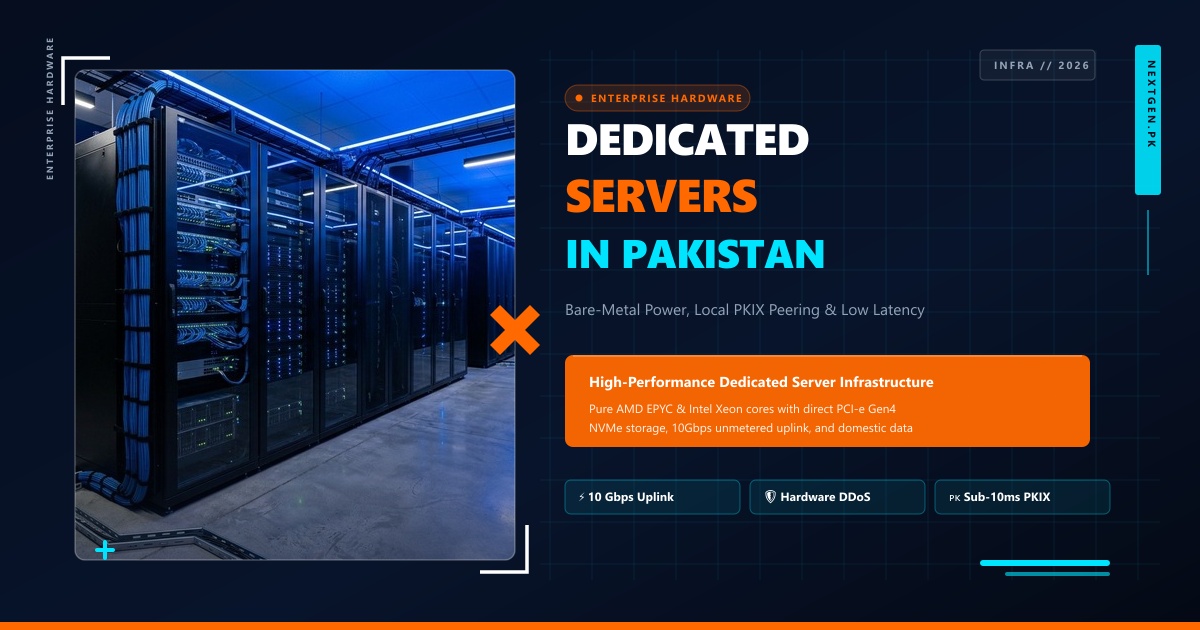
- Migrate high-concurrency SaaS applications, enterprise ERPs, and heavy CRM systems to bare-metal Dedicated Servers, featuring dedicated Xeon or AMD EPYC silicon, multi-gigabit uplinks, and hardware-grade RAID protection.
- For domestic Pakistani corporations, banks, and e-commerce leaders requiring adherence to domestic data sovereignty directives and sub-10ms network ping nationwide, our Dedicated Servers in Pakistan provide an uncompromised enterprise-grade hosting foundation.
Protect Your Business with Unbreakable Cloud Uptime
Eliminate single points of failure. Nextgen Hosting delivers 99.99% SLA uptime, automated snapshot backups, DDoS protection, and 24/7 dedicated engineering response.
