
The Death of Fragmented Checkout Counters and Prohibitive Interchange
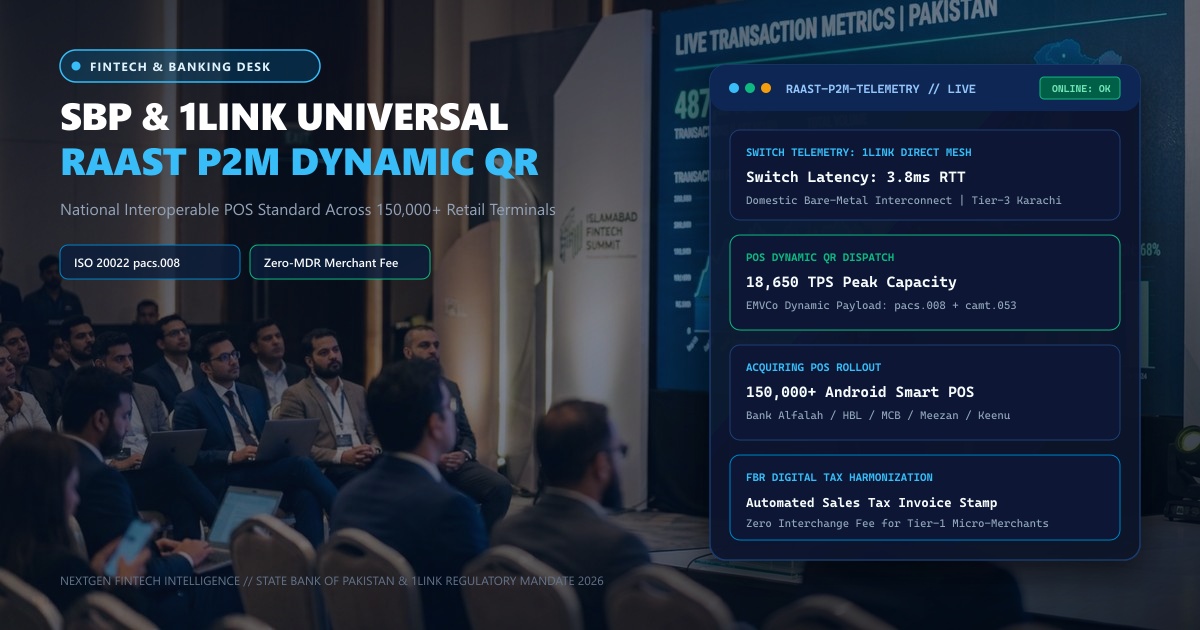
The State Bank of Pakistan (SBP), in direct regulatory concert with 1LINK and commercial banking acquirers, has formally notified the National Universal Raast Person-to-Merchant (P2M) Dynamic QR and Interoperable Point of Sale (POS) Mandate 2026. Under this binding directive, all commercial acquiring banks, payment service operators (PSOs), payment service providers (PSPs), and licensed electronic money institutions (EMIs) must decommission proprietary, siloed merchant QR codes and upgrade every deployed retail POS terminal to support dynamic, interoperable Raast P2M payment rails.
For over a decade, retail digitization across Pakistan’s estimated PKR 45 trillion retail sector was severely constrained by structural inefficiencies within traditional payment card rails. The primary roadblock has been the Merchant Discount Rate (MDR) imposed on international card scheme transactions (Visa and Mastercard), which ranges between 1.5% and 2.5% of gross invoice value. In high-volume, low-margin retail segments—such as grocery supermarkets, petroleum forecourts, pharmaceutical chains, and wholesale distributors—an MDR of 2.5% frequently consumes 20% to 40% of the merchant’s net operating margin.
Furthermore, acquiring banks passed hardware rental fees ranging from PKR 3,000 to PKR 6,000 per month per terminal onto merchants, regardless of transaction throughput. Consequently, fewer than 150,000 POS terminals were actively deployed across a country of 240 million citizens, creating an entrenched dependency on cash. Cash-on-delivery (COD) and physical banknotes continued to dominate over 80% of total offline commerce and e-commerce disbursements. Physical cash logistics incurred significant friction: reconciliation delays stretching from T+3 to T+7 business days, high return-to-origin (RTO) overheads, cash float leakage, and the persistent security vulnerabilities of moving physical currency.
Where digital alternatives existed, market fragmentation crippled consumer adoption. Retail checkouts became cluttered with acrylic display stands bearing incompatible, closed-loop static QR codes from JazzCash, Easypaisa, HBL, Bank Alfalah, and Nayapay. A consumer using one banking app could not scan the static QR code issued by an alternative acquirer.
The SBP-1LINK 2026 mandate dissolves these proprietary silos, establishing a unified national protocol that turns every retail checkout into a frictionless, zero-MDR, instant-settlement endpoint.
Technical Anatomy of the Universal Raast P2M Dynamic QR Protocol
Unlike legacy static QR stickers that encode only a merchant’s static identifier—requiring the customer to manually type the exact invoice amount and confirm the payee details—the Universal Raast P2M standard relies entirely on EMVCo-compliant Dynamic QR Payloads.
+-----------------------------------------------------------------------------+
|              Universal Raast P2M Dynamic QR Architecture (2026)             |
+-----------------------------------------------------------------------------+
|                                                                             |
|  Merchant POS / ERP               Consumer Smartphone        1LINK / Raast  |
|  (Smart Android Terminal)        (Any Banking/Wallet App)    Core Switch    |
|                                                                             |
|  [Generate Bill]                                                            |
|          |                                                                  |
|          v                                                                  |
|  [EMVCo Dynamic QR] ----------> [Scan Camera]                               |
|  - TRID: UUIDv4                       |                                     |
|  - ISO 20022 pacs.008                 v                                     |
|  - HMAC Signature              [Customer App mTLS] ------------------------>|
|  - FBR Invoice Hash                   |                         |           |
|                                       |                     [Validate]      |
|                                       |                     [Deb/Cred]      |
|                                       |                         |           |
|                                  [ISO pacs.002] <---------------+           |
|                                  Authorization Confirmation                 |
|                                       |                                     |
|                                       v                                     |
|  [WebSocket Notification] <-------------------------------------+           |
|  Terminal Screen Green                                                      |
|  Sub-800ms End-to-End SLA                                                   |
+-----------------------------------------------------------------------------+
EMVCo Data Structures and ISO 20022 Financial Messaging
The dynamic QR generated at the point of sale encapsulates standard EMVCo Merchant-Presented Mode (MPM) data objects formatted as Type-Length-Value (TLV) strings. Nested within these primitives is the full ISO 20022 transactional metadata required for real-time interbank execution:
- Payload Format Indicator (Tag 00): Defined as
01. - Point of Initiation Method (Tag 01): Set to
12(Dynamic QR), indicating that the transaction amount is pre-bound and the payload expires after a short temporal window (typically 120 seconds). - Globally Unique Merchant Identifier (Tag 26-51): Assigned to Raast Pakistan (
pk.gov.sbp.raast), encoding the Merchant Category Code (MCC Tag 52), acquiring bank routing identifier, and Merchant Account Number. - Transaction Currency (Tag 53): Hardcoded to
586(Pakistani Rupee - PKR). - Transaction Amount (Tag 54): Exact invoice amount formatted to two decimal points, preventing customer data-entry errors.
- Transaction Reference Identifier (Tag 62 / Subtag 05): A cryptographically unique, non-repeating Transaction Reference Identifier (TRID) generated as a UUIDv4 combined with an epoch timestamp.
- Digital Signature & Integrity Block (Tag 64): An HMAC-SHA256 hash or elliptic-curve signature (ECDSA over
secp256r1) calculated over the concatenated TLV values using the merchant terminal’s hardware-bound cryptographic key. This prevents dynamic payload tampering or man-in-the-middle manipulation over unsecured wireless links.
Under the hood, when the customer’s mobile banking app scans the QR, it constructs a native ISO 20022 pacs.008.001.10 (Financial Institutional Customer Credit Transfer) XML message. This message is transmitted over mutual TLS (mTLS 1.3) directly to the paying customer’s financial institution, which routes it through the 1LINK core switch into the State Bank’s Raast settlement core.
Sub-Second Asynchronous Confirmation Engine
A critical failure point of early QR implementations was terminal latency: cashier staff were reluctant to accept QR payments because waiting for SMS confirmation or manual refresh buttons created cashier bottleneck lines.
Under the 2026 mandate, the Raast P2M architecture implements a dual-path, asynchronous confirmation pipeline:
- Immediate Interbank Settlement: The payer’s bank debits the consumer account and transfers reserves via Raast RTGS in under 400 milliseconds, outputting an ISO 20022
pacs.002.001.12Payment Status Report. - WebSocket / Webhook Push Dispatch: The 1LINK acquiring switch pushes an authenticated event to the merchant acquirer’s gateway. The acquirer’s message broker (running Apache Kafka or RabbitMQ clusters) pushes a binary confirmation frame across persistent WebSocket tunnels maintained directly by the merchant’s Android POS terminal.
- Deterministic SLA: The entire cycle—from the customer biometric touch to the POS terminal screen flashing green and printing a thermal receipt—executes within a sub-800-millisecond window.
Implementation Reference: Constructing and Verifying the Raast Dynamic QR Payload
The following reference implementation illustrates how an enterprise acquiring switch or smart POS microservice builds an EMVCo-compliant Raast dynamic payload with embedded cryptographic signatures:
package main

import (
	"crypto/hmac"
	"crypto/sha256"
	"encoding/hex"
	"fmt"
	"time"
)

type RaastDynamicQRPayload struct {
	PayloadFormatIndicator string // Tag 00
	InitiationMethod       string // Tag 01 (12 = Dynamic)
	RaastAID               string // Tag 26 Subtag 00: pk.gov.sbp.raast
	MerchantID             string // Tag 26 Subtag 01: SBP Registered MID
	AcquirerRoutingCode    string // Tag 26 Subtag 02: 1LINK Bank BIC
	MCC                    string // Tag 52: ISO 18245 Merchant Category
	CurrencyCode           string // Tag 53: 586 (PKR)
	Amount                 string // Tag 54: Invoice Amount
	CountryCode            string // Tag 58: PK
	MerchantName           string // Tag 59: Trade Name
	MerchantCity           string // Tag 60: City
	TRID                   string // Tag 62 Subtag 05: Unique Transaction Ref
	ExpiryEpoch            int64  // Dynamic Expiry
}

// formatTLV formats string fields into EMVCo TLV (Tag-Length-Value) notation
func formatTLV(tag string, value string) string {
	return fmt.Sprintf("%s%02d%s", tag, len(value), value)
}

func GenerateRaastDynamicQR(p RaastDynamicQRPayload, secretKey []byte) (string, error) {
	// Construct Nested Tag 26 (Raast Payment Network Info)
	subtagAID := formatTLV("00", p.RaastAID)
	subtagMID := formatTLV("01", p.MerchantID)
	subtagRouting := formatTLV("02", p.AcquirerRoutingCode)
	tag26Value := subtagAID + subtagMID + subtagRouting
	tag26 := formatTLV("26", tag26Value)

	// Construct Nested Tag 62 (Additional Data / TRID)
	subtagTRID := formatTLV("05", p.TRID)
	tag62 := formatTLV("62", subtagTRID)

	// Concatenate Core Fields
	rawPayload := formatTLV("00", "01") +
		formatTLV("01", "12") +
		tag26 +
		formatTLV("52", p.MCC) +
		formatTLV("53", p.CurrencyCode) +
		formatTLV("54", p.Amount) +
		formatTLV("58", p.CountryCode) +
		formatTLV("59", p.MerchantName) +
		formatTLV("60", p.MerchantCity) +
		tag62

	// Compute Cryptographic Signature over the payload
	mac := hmac.New(sha256.New, secretKey)
	mac.Write([]byte(rawPayload))
	signature := hex.EncodeToString(mac.Sum(nil))[:16] // Truncated high-entropy hash

	// Append Tag 64 (Cryptographic Integrity Tag)
	signedPayload := rawPayload + formatTLV("64", signature)

	// Compute ISO 13239 CRC16 Checksum (Tag 63)
	crcBase := signedPayload + "6304"
	crcValue := computeCRC16(crcBase)
	finalEMVCoString := crcBase + crcValue

	return finalEMVCoString, nil
}

func computeCRC16(data string) string {
	var crc uint16 = 0xFFFF
	for i := 0; i < len(data); i++ {
		crc ^= uint16(data[i]) << 8
		for j := 0; j < 8; j++ {
			if (crc & 0x8000) != 0 {
				crc = (crc << 1) ^ 0x1021
			} else {
				crc <<= 1
			}
		}
	}
	return fmt.Sprintf("%04X", crc)
}

func main() {
	payload := RaastDynamicQRPayload{
		RaastAID:            "pk.gov.sbp.raast",
		MerchantID:          "MID-KHI-8849201",
		AcquirerRoutingCode: "ALFH0001", // Bank Alfalah Switch
		MCC:                 "5411",     // Grocery Stores / Supermarkets
		CurrencyCode:        "586",      // PKR
		Amount:              "14580.00",
		CountryCode:         "PK",
		MerchantName:        "METRO HYPERMARKET KHI",
		MerchantCity:        "Karachi",
		TRID:                "TRX-20261027-99482104",
		ExpiryEpoch:         time.Now().Add(120 * time.Second).Unix(),
	}

	terminalHmacKey := []byte("0123456789ABCDEF0123456789ABCDEF")
	qrString, _ := GenerateRaastDynamicQR(payload, terminalHmacKey)
	fmt.Printf("EMVCo Raast Dynamic Payload:\n%s\n", qrString)
}
Commercial Acquirer Rollout and Hardware Modernization
To operationalize the mandate, commercial acquiring banks and licensed payment intermediaries are replacing legacy counter hardware with next-generation Android-based Smart POS terminals.
The Shift to Smart POS Ecosystems
Institutions including Bank Alfalah, Habib Bank Limited (HBL), Muslim Commercial Bank (MCB), Meezan Bank, and Faysal Bank, alongside fintech aggregators such as Keenu, PayFast, Safepay, JazzCash, and Easypaisa, are executing a nationwide fleet upgrade across more than 150,000 retail endpoints.
Legacy PSTN/2G standalone dial-up terminals (such as Verifone Vx520 or legacy Ingenico EFT units) are being retired in favor of high-performance Android devices manufactured by Sunmi, Pax, and Newland. These modern devices feature:
- Dual Color Touchscreens: A merchant-facing screen for billing entry and an ergonomic customer-facing display showing the dynamic Raast QR code and transaction breakdown.
- Embedded Multi-Network Connectivity: Dual-SIM 4G LTE/5G hardware failover combined with WPA3 enterprise Wi-Fi connectivity, eliminating terminal disconnection errors.
- Unified Processing Logic: The terminal runs a standardized acquirer runtime that accepts standard EMV contactless NFC (Visa, Mastercard, PayPak) while prioritizing the Raast Dynamic QR interface.
Complete Consumer Interoperability
The defining triumph of the 2026 mandate is universal, cross-app interoperability. When the dynamic QR is rendered on a retail terminal, consumers can open any banking or payment app:
- Conventional banking apps (HBL Mobile, Alfalah Alfa, Meezan Community, Standard Chartered Breeze)
- Telecommunications-backed wallets (Easypaisa, JazzCash)
- Pure digital retail banks and EMIs (Nayapay, Sadapay, Finja, Zindigi)
The customer uses their native banking camera to scan the terminal screen. Because the payload adheres strictly to the SBP 1LINK Raast directory standard, the initiating app parses the merchant details, validates the merchant’s verified commercial legal title, debits the user’s selected current or savings balance, and issues instant interbank credit without intermediary gateway redirects.
SBP Zero-MDR Policy and FBR Digital Tax Harmonization
Beyond technical specifications, the SBP circular introduces a revolutionary economic restructuring aimed at incentivizing unconditional merchant adoption.
Elimination of Interchange and MDR Caps
To level the playing field against physical cash, the SBP has capped merchant acquiring fees for Raast P2M transactions:
| Merchant Segment | Annual Turnover Threshold | Legacy Card MDR (Visa/MC) | Raast P2M MDR (2026 Mandate) | Settlement Window |
|---|---|---|---|---|
| Tier-1 Micro-Merchants | Under PKR 50 Million | 1.75% – 2.50% | 0.00% (Zero MDR) | Instant (Real-time RTGS) |
| SME & Commercial Retail | PKR 50M – PKR 300 Million | 1.50% – 2.00% | 0.15% (Capped Interchange) | Instant (Real-time RTGS) |
| Large Enterprise Chains | Above PKR 300 Million | 1.25% – 1.85% | 0.25% (Flat Acquiring Fee) | Instant (Real-time RTGS) |
By driving MDR to zero for micro-merchants and a negligible 0.15% for commercial SMEs, the central bank removes the primary economic disincentive that previously pushed retailers to decline digital payments or demand a 2% surcharge from consumers. Acquiring banks are compensated through nominal per-transaction switch-processing subsidies financed by the SBP Digital Financial Inclusion Fund, alongside treasury revenues generated from instant merchant deposits.
Seamless FBR Digital Invoicing Integration
Simultaneously, the Raast P2M rollout is structurally harmonized with the Federal Board of Revenue (FBR) Mandatory Digital Sales Tax Invoicing System.
Under statutory rules notified in SRO 456(I)/2026, all Tier-1 retailers integrated with the FBR POS invoicing system must link invoice generation directly with the payment rail:
- When a cashier rings up items on the POS ERP, the terminal transmits an invoice digest to the FBR Digital Tax Engine via a domestic API bridge.
- The FBR engine signs the invoice, generates an FBR Invoice Tracking Number, and embeds the cryptographic tax verification hash directly into the dynamic Raast QR payload (within EMVCo Proprietary Tag 62).
- Upon customer payment authorization via Raast, the 1LINK switch notifies both the merchant’s bank and the FBR gateway in a single transactional write.
- The merchant receives automated tax credit verification, eliminating the need for burdensome monthly manual sales tax Annex-C reconciliations.
This closed-loop integration drastically curbs under-invoicing and tax evasion while giving law-abiding retailers instant, verifiable digital records that qualify them for preferential working-capital lending from commercial banks.
The Infrastructure Imperative: Why Payment Switches Demand Domestic Bare Metal
The engineering demands of processing tens of millions of concurrent POS dynamic QR requests expose the vulnerabilities of legacy IT infrastructure. Commercial bank acquiring switches, payment aggregators, and real-time webhook dispatch systems cannot afford latency spikes, packet loss, or regulatory non-compliance.
+-----------------------------------------------------------------------------+
|               Domestic Bare Metal vs. Overseas Virtual Cloud                |
+-----------------------------------------------------------------------------+
|  METRIC                 OVERSEAS PUBLIC CLOUD       DOMESTIC BARE METAL     |
|                         (AWS / Azure Singapore)     (Tier-3 / 4 Karachi)    |
|                                                                             |
|  Network Latency (RTT)  85ms - 145ms (Subsea Risk)  1.8ms - 4.5ms (PKIX)    |
|  Jitter / Packet Drop   Unpredictable Routing       Deterministic Direct    |
|  Cryptographic HSM      Network-Emulated / Shared   Dedicated PCIe Thales   |
|  Data Residency         Non-Compliant (SBP SRO)     100% SBP / Data Sovereign|
|  FX Exposure            High USD Volatility         Predictable Local PKR   |
|  POS Timeout Failure    1.8% Peak Abandonment Rate  < 0.001% Zero-Timeout   |
+-----------------------------------------------------------------------------+
The Subsea Cable Latency Bottleneck
When a customer scans a dynamic QR at a high-volume supermarket checkout, the transaction budget permits an end-to-end latency of no more than 800 milliseconds. If the acquiring bank’s payment switch, tokenization engine, or webhook listener is hosted in overseas public cloud regions (such as AWS eu-central-1 in Frankfurt, Azure Singapore, or GCP Bahrain):
- Network packets must cross multiple international transit hops and subsea fiber links (e.g., SEA-ME-WE 4, IMEWE, or AAE-1).
- Base latency round-trip time (RTT) alone consumes 80 to 140 milliseconds.
- Any subsea cable degradation or fiber cut immediately triggers packet queuing, buffer bloat, and round-trip spikes exceeding 1,200ms, resulting in catastrophic POS gateway timeouts and abandoned checkout queues.
SBP Data Residency and Regulatory Sovereignty
The State Bank of Pakistan’s Cyber Security Framework and the National Payment Systems Act strictly prohibit the hosting of primary financial switching engines, customer account ledgers, and cryptographic key stores outside Pakistan’s territorial borders. Banking core data, cardholder information, and Raast transaction logs must reside exclusively within the sovereign jurisdiction of domestic data centers.
Hosting in foreign cloud regions also exposes financial institutions to volatile foreign exchange (USD) operational cost escalations, unpredictable multi-tenant “noisy neighbor” compute contention, and sudden compliance audits.
Enterprise Compute: The Role of Domestic Dedicated Servers
To satisfy SBP operational resiliency mandates and deliver deterministic sub-millisecond response times, tier-1 financial institutions, acquiring banks, and fintech unicorns rely on high-performance infrastructure. Mission-critical components—such as dynamic QR generation microservices, ISO 20022 message parsers, Kafka event streaming clusters, and Redis caching layers—must be deployed on robust Dedicated Servers.
For institutions operating within Pakistan, deploying on Dedicated Servers in Pakistan located in certified Tier-3 and Tier-4 domestic data centers (in Karachi, Lahore, and Islamabad) provides the ultimate technical foundation:
- Sub-5ms Transaction Latency: Direct, physical interconnects to the 1LINK core switch, PKIX (Pakistan Internet Exchange), and domestic telecom fiber backbones ensure sub-5ms round-trip latency to retail POS terminals nationwide.
- Hardware-Level Security (HSM Interconnects): Direct PCIe and fiber-channel access to dedicated, FIPS 140-2 Level 3 certified Hardware Security Modules (e.g., Thales payShield 10K or Entrust nShield) for real-time cryptographic validation and TRID key signing.
- Hardware Isolation and Zero Multi-Tenant Contention: Uncontended raw compute powered by AMD EPYC and Intel Xeon processors, Enterprise NVMe arrays in RAID-10 configurations, and dual redundant power grids with 99.999% availability guarantees.
Strategic Implications: Transforming Pakistan’s Macroeconomic Landscape
The SBP-1LINK Universal Raast P2M mandate represents more than a technical payment overhaul; it marks a structural turning point in Pakistan’s journey toward an inclusive, formalized digital economy.
Cash Displacement and Velocity of Money
By eliminating the 2.5% card tax and dismantling closed-loop QR silos, the State Bank is systematically neutralizing the primary economic justifications for cash usage. As merchant acceptance points cross 500,000 by 2027, the velocity of money across the national economy will accelerate dramatically. Formal bank deposits will swell as cash hoards transition into interest-bearing commercial balances, expanding the liquidity pool available for industrial lending and infrastructure development.
Democratizing Merchant Working-Capital Credit
Historically, small and medium enterprises (SMEs) in Pakistan struggled to obtain commercial bank credit due to the absence of verifiable financial statements. Cash sales left no auditable trail. Under the universal Raast P2M framework, every retail transaction creates an immutable, cryptographically verified record on the bank’s digital switch. Financial institutions can deploy automated cash-flow-based underwriting models, extending unsecured, algorithmic revolving credit lines to street vendors and retailers based on real-time transaction telemetry.
The Foundation for Autonomous Open Finance
With the dynamic QR protocol establishing universal retail connectivity, the groundwork is laid for the next frontier of Pakistan’s financial evolution: full Open Banking and Account Aggregation. Dynamic payloads can seamlessly accommodate instant direct debit mandates, automated point-of-sale split payments, digital escrow verifications for e-commerce, and real-time merchant loyalty disbursements.
The transition from physical currency to sovereign, instant digital rails is no longer a theoretical aspiration. Powered by the State Bank’s decisive regulatory framework, 1LINK’s core switching backbone, and resilient domestic bare-metal infrastructure, Pakistan’s retail commerce has officially entered the real-time, interoperable digital era.
Power Low-Latency Financial Switches with Pakistan Dedicated Servers
Complying with State Bank of Pakistan data residency mandates and achieving sub-millisecond transaction SLAs requires dedicated, unshared bare metal. Nextgen Hosting delivers enterprise-grade dedicated servers deployed in certified Tier-3 Karachi and Islamabad datacenters, equipped with direct 1LINK interconnects, low-latency PKIX peering, and unmetered domestic bandwidth.
Related Technical Analysis & Regulatory Architecture Guides
- SBP Mandates National Card-on-File Network Tokenization: Eliminates Stored Card Breaches Across Pakistani E-Commerce
- SBP Launches Raast Direct Debit and Standing Instructions API Architecture
- FBR Notifies Mandatory Digital Invoicing Rules: Technical Integration for Real-Time Sales Tax Reporting
- Enterprise Bare-Metal Dedicated Servers in Pakistan
- High-Performance Global Dedicated Server Solutions
- High-Throughput Low-Latency VPS Infrastructure in Pakistan