
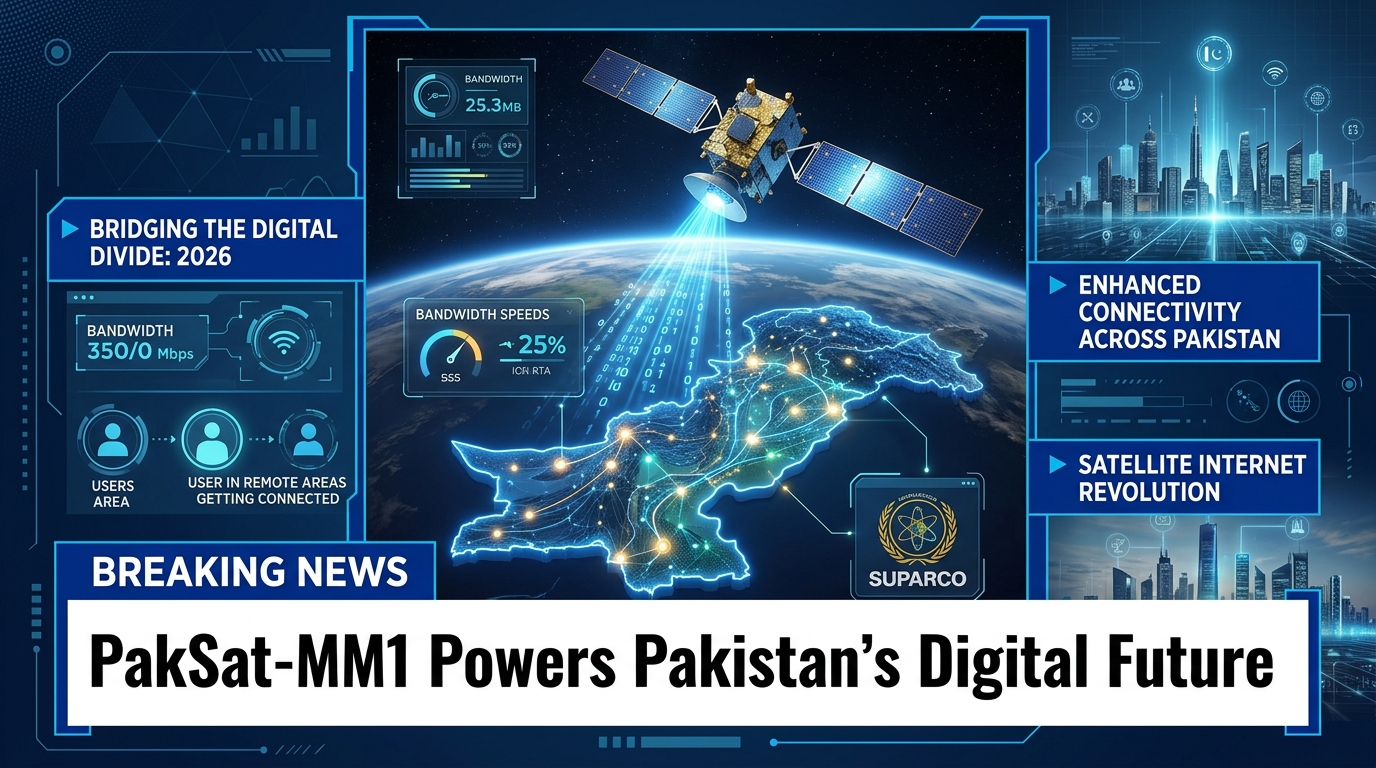
As of August 2026, Pakistan’s ambitious space and communication strategy has firmly taken root in the digital lives of its citizens. The nation’s crown jewel of orbital technology, the PakSat-MM1 communications satellite, is now operating at peak capacity, serving as the invisible backbone for the “Digital Pakistan” initiative.
Positioned strategically at 38.2° East, the satellite is doing much more than merely beaming television signals; it is actively closing the country’s historic digital divide.
Bridging the Connectivity Gap
For decades, geographic challenges have made it nearly impossible to lay fiber-optic cables in the remote, mountainous regions of Gilgit-Baltistan and the expansive deserts of Balochistan. PakSat-MM1 bypasses these terrestrial hurdles entirely.
Utilizing advanced high-throughput Ku and Ka-band transponders, the satellite is currently delivering high-speed broadband internet directly to some of the most underserved communities in the nation. This orbital connectivity has triggered a revolution in two critical sectors: Tele-education and Tele-medicine. Students in remote villages can now stream high-definition lectures from universities in Lahore and Islamabad, while rural clinics can instantly transmit medical data to specialists in Karachi.
The Synergy of Space and Ground Infrastructure
While PakSat-MM1 provides the high-speed pipeline connecting remote users to the internet, the actual data—the educational portals, the e-governance dashboards, and the streaming media—must reside on physical servers down on Earth.
If this critical national data is hosted on offshore servers in Europe or North America, the resulting latency (the time it takes for data to travel to space, down to Europe, and back again) creates a sluggish user experience. More importantly, hosting government and educational data abroad raises significant data sovereignty and security concerns.
Localizing the Cloud with Nextgen Hosting
To maximize the efficiency of satellite broadband, local institutions must adopt local hosting.
By utilizing Nextgen Hosting’s Dedicated Servers, national educational platforms and media broadcasters can ensure their databases and video streams are hosted physically within Pakistan. Furthermore, Nextgen’s KVM VPS platforms provide developers with the scalable, secure environments needed to build the next generation of e-governance applications. When local satellite internet requests data from a local Nextgen server, the data transfer is instantaneous, highly secure, and immune to international submarine cable cuts.
Looking to the Stars
The operational success of PakSat-MM1 is just the beginning. Emboldened by this achievement, the national space agency (SUPARCO) is already accelerating plans for future missions, including advanced Earth observation and environmental monitoring satellites.
As Pakistan continues to conquer space, the parallel growth of its terrestrial IT infrastructure ensures that the benefits of these orbital achievements are felt by every citizen, no matter how remote their location.
Related Technical Architecture Guides
- 7 Proven Ways for Marketing Your Business in 2026: Modern Digital Growth Tactics – Enterprise implementation details and deployment guide.
- How Much Hosting Space Do You Need? The Complete 2026 Sizing and Capacity Guide – Enterprise implementation details and deployment guide.
