
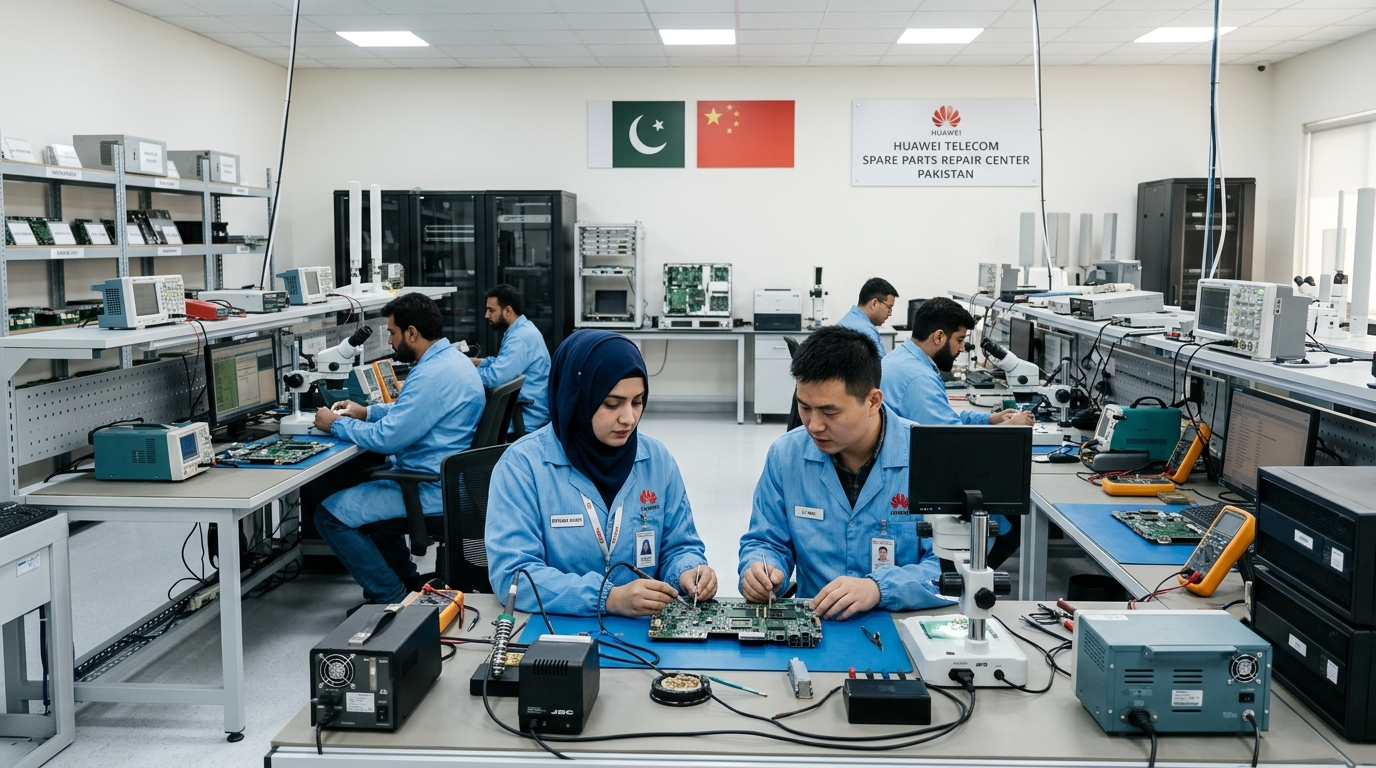
Pakistan took a landmark stride in telecom self-sufficiency on September 24, 2026, as Federal Minister for IT and Telecommunication Shaza Fatima Khawaja inaugurated Huawei’s first national-level Spare Parts Repair Center in Islamabad. The facility marks a pivotal shift in how Pakistan manages and maintains its mission-critical telecom infrastructure — and signals the country’s deepening commitment to transitioning from a consumer of technology to a builder and exporter of technical services.
What Is the Huawei Spare Parts Repair Center?
The newly opened center is a dedicated, high-standard facility designed exclusively for the repair and refurbishment of telecom network hardware — base stations, optical transmission modules, power systems, radio units, and a broad spectrum of enterprise networking equipment.
Unlike conventional Huawei consumer-device service centers (which handle smartphones and tablets), this is an industrial-grade repair hub targeting the telecom operators, ISPs, and government-owned network operators that form the backbone of Pakistan’s digital connectivity.
Key Technical Specifications at Launch
| Metric | Detail |
|---|---|
| Annual Repair Capacity | ~10,000 pieces of equipment |
| Hardware Types Supported | 180+ distinct telecom hardware variants |
| Foreign Exchange Savings | $1 million documented at inauguration |
| Location | Islamabad (exact address: Huawei Pakistan offices, Blue Area) |
| Standards | International-grade repair protocols |
| Regional Scope | Potential to serve regional clients beyond Pakistan |
Why This Matters: The Foreign Exchange Crisis Context
Pakistan has faced persistent pressure on its foreign exchange reserves over the past several years. Importing replacement parts or shipping damaged telecom equipment abroad for repair has been a silent but significant drain on scarce dollar reserves. Telecom operators — including PTCL, Jazz, Telenor, Zong, and Ufone — collectively operate hundreds of thousands of network elements nationwide, and even minor component failures historically required expensive international logistics cycles that could take weeks.
By establishing a local, internationally certified repair center, the government and Huawei have directly addressed this pain point:
- Faster turnaround: Instead of weeks-long international shipping cycles, repairs can now happen domestically within days.
- Cost reduction: Local labour and logistics dramatically reduce the per-unit repair cost.
- Forex savings: The $1 million documented at launch is only the beginning — analysts expect savings to scale significantly as more operators utilize the facility.
- Technology transfer: Pakistani engineers working in the facility gain hands-on experience with Huawei’s proprietary hardware platforms, building domestic talent that is otherwise rare and expensive.
The Broader Digital Pakistan Vision
This inauguration does not exist in isolation — it is one piece of an accelerating national technology transformation agenda:
IT Exports Hit Record $4.6 Billion in FY2025-26
Pakistan’s ICT export earnings crossed $4.6 billion in the fiscal year ending June 2026, a record that underscores the sector’s growing economic weight. The government’s strategy is to sustain this momentum by deepening local capabilities: not just exporting software services but also building indigenous capacity in hardware maintenance, manufacturing-adjacent services, and eventually component production.
From Consumer to Builder
Minister Shaza Fatima has repeatedly emphasized the government’s intent to move Pakistan “from buying technology to building it.” The Huawei repair center aligns perfectly with this philosophy — rather than simply procuring Chinese-made telecom equipment, Pakistan is now co-investing in the infrastructure to keep that equipment operational domestically.
Skill Development Pipeline
The center is expected to create a pipeline of high-skilled technical jobs for Pakistani engineers trained in advanced telecom hardware repair — a niche that commands premium salaries and is transferable across the regional telecom industry. Government officials have highlighted that if the facility meets international standards (which it does, by Huawei’s certification), it could attract regional repair contracts from neighbouring countries in South and Central Asia.
Infrastructure Demand Is Surging — Reliable Hosting Matters More Than Ever
Pakistan’s expanding telecom infrastructure directly feeds growing demand for resilient, high-performance digital services. As mobile operators deploy denser 4G networks and begin 5G build-outs, the demand for co-located servers, cloud applications, and high-bandwidth hosting rises in lockstep.
Businesses operating in Pakistan increasingly need rock-solid infrastructure to match this network growth. That’s why enterprise clients across Karachi, Lahore, and Islamabad are turning to Dedicated Servers — providing guaranteed performance, physical isolation, and full hardware control that shared infrastructure simply cannot match. For companies that want sovereign, low-latency access to Pakistan’s network fabric, Dedicated Servers in Pakistan eliminate international round-trip delays and ensure compliance with local data regulations.
As the telecom sector becomes more locally self-sufficient — repair centers, sovereign cloud initiatives, and 5G build-outs — the underlying hosting and server infrastructure must scale with it. Nextgen Hosting sits precisely at that intersection.
Pakistan–Huawei Partnership: A Deep and Strategic Relationship
Huawei is not a new player in Pakistan. The company has been deeply embedded in the country’s telecom ecosystem for over two decades:
- PTCL’s national fiber backbone uses significant Huawei equipment.
- Jazz (Veon), Zong (CMPAK/China Mobile), and Telenor all operate Huawei radio access network (RAN) gear.
- Huawei has previously contributed to Pakistan’s broadband expansion and submarine cable landing systems.
- The company operates ICT academies across Pakistan that have trained thousands of students in networking, cloud computing, and AI.
The repair center is therefore the latest chapter in a partnership that spans infrastructure, education, and now services — making the relationship significantly more reciprocal than a pure vendor-customer dynamic.
Regional Ambitions: Could Islamabad Become a Telecom Repair Hub?
Perhaps the most strategically significant detail from the inauguration is the government’s stated ambition for this facility to serve the wider region. Pakistan sits at the crossroads of South Asia, Central Asia, and the Middle East — a geographic reality that has been leveraged for trade for millennia.
If the Islamabad repair center can certify itself as a regional hub for Huawei-brand telecom hardware servicing, it would:
- Attract repair contracts from Afghanistan, Uzbekistan, Tajikistan, and potentially Gulf carriers.
- Earn foreign exchange from the region rather than spending it to send equipment abroad.
- Position Pakistan as a genuine technical services exporter — a category that currently barely appears in the country’s export statistics.
This is a realistic scenario: Huawei operates similar regional hubs in other countries (e.g., Malaysia for Southeast Asia), and Pakistan’s combination of geographic centrality, Huawei’s strong local presence, and lower labour costs could make it a compelling choice.
What Industry Observers Are Saying
TechJuice noted that the center’s capacity to handle 180 hardware types is especially significant, as it means the facility can service the full range of Huawei’s currently deployed telecom portfolio in Pakistan — not just legacy equipment. This forward-compatibility suggests the center was designed with the upcoming 5G deployment wave in mind.
Metis Global reported that the international-standard certification of the facility is a credibility benchmark, as it would allow repairs made here to be covered under Huawei’s global warranty and service agreements — a critical factor for telecom operators who cannot afford downtime from substandard repairs.
Radio Pakistan highlighted the foreign exchange angle most prominently, noting the $1 million in documented savings and government projections that this figure could grow significantly as more operators route maintenance through the domestic facility rather than sending gear to China, Dubai, or Malaysia.
Key Takeaways
- Pakistan’s first national Huawei telecom spare parts repair center opened in Islamabad on September 24, 2026.
- The facility handles 10,000+ equipment pieces annually across 180+ hardware types.
- It has already contributed to $1 million in foreign exchange savings — with larger savings projected as utilization grows.
- The center aligns with Pakistan’s broader digital economy strategy: grow IT exports, build local technical talent, and move from consumer to builder of technology.
- Regional ambitions: Officials see potential for the center to attract repair contracts from neighbouring countries, potentially making Islamabad a certified Huawei service hub for South and Central Asia.
- The initiative deepens an already extensive Pakistan–Huawei partnership that spans RAN infrastructure, fiber backbones, and ICT education.
Conclusion
Pakistan’s inauguration of Huawei’s national spare parts repair center is more than a ribbon-cutting ceremony. It represents a calculated, strategic investment in telecom self-sufficiency — one that saves foreign exchange, builds local skills, supports the country’s $4.6 billion IT export trajectory, and positions Pakistan for potential regional leadership in telecom hardware services.
For the tech and business community, the message is clear: Pakistan is no longer content to simply consume technology — it is actively investing in the infrastructure, skills, and partnerships needed to service it as well. In an era of geopolitical supply chain uncertainty and persistent pressure on developing-country forex reserves, this is exactly the kind of initiative that builds genuine long-term resilience.
Watch this space — the Islamabad repair center may be the first of several such facilities as Pakistan’s telecom hardware service ecosystem matures alongside its rapidly growing digital economy.
Published: September 24, 2026 | Category: Tech News | Source: Ministry of IT Pakistan, TechJuice, Metis Global, Radio Pakistan, APP
