
When evaluating web hosting plans, cloud virtual private servers (VPS), or dedicated bare-metal hardware in Pakistan, most buyers focus exclusively on CPU clock speeds and gigabytes of RAM.
Yet, ask any seasoned Linux datacenter sysadmin, and they will tell you a universal truth:
The number one bottleneck that slows down modern dynamic websites, freezes high-concurrency checkouts, and causes database lockups is almost always disk I/O (Input/Output).
Even if your server is powered by an ultra-fast 64-core AMD EPYC processor, if your storage drives cannot read database tables, write write-ahead redo logs (WAL), or flush dirty memory pages fast enough, the CPU cores are forced into a stalled state known as I/O Wait (%wa in top).
The solution to disk latency is PCIe Gen5 NVMe SSD technology.
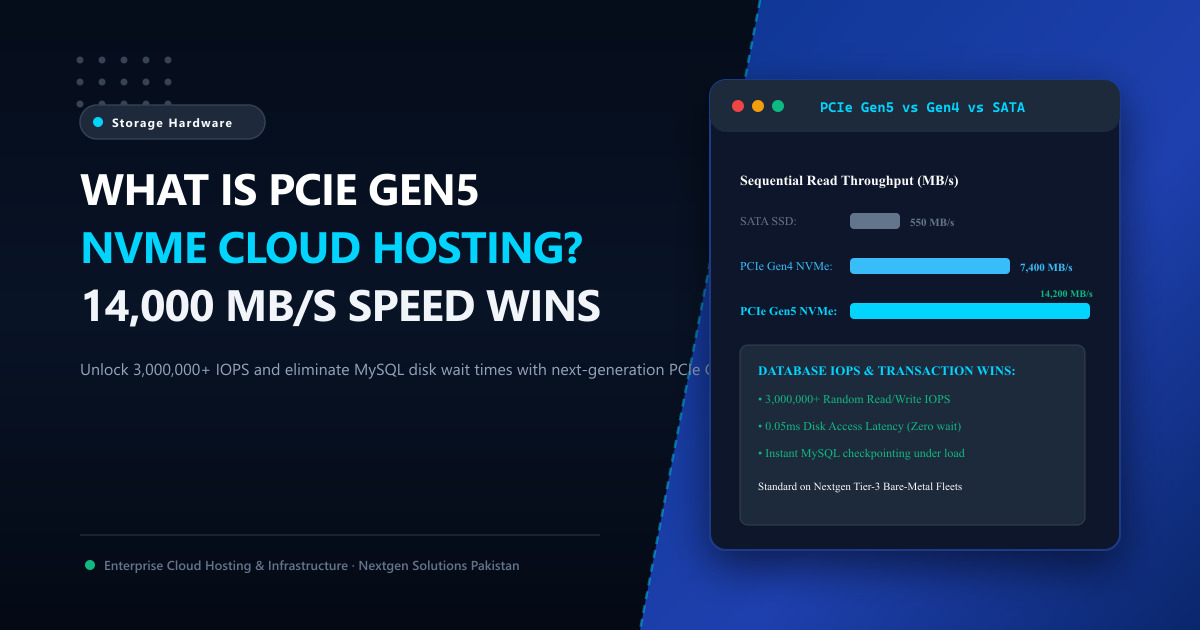
In this hardware engineering breakdown, we explore what PCIe Gen5 NVMe hosting actually means, compare it against legacy SATA SSDs and Gen4 drives, and demonstrate how 14,000 MB/s throughput transforms enterprise database performance in Pakistan.
⚡ The Evolution of Server Storage: SATA vs. Gen3 vs. Gen4 vs. Gen5
To appreciate the leap represented by PCIe Gen5, examine how storage bandwidth has expanded over recent hardware generations:
[ Legacy SATA III SSD ] ─────── 550 MB/s (600 MB/s theoretical ceiling)
                                       │
[ PCIe Gen3 x4 NVMe ]   ────────────── 3,500 MB/s (6x faster than SATA)
                                       │
[ PCIe Gen4 x4 NVMe ]   ───────────────────────────── 7,400 MB/s (13x faster than SATA)
                                       │
[ PCIe Gen5 x4 NVMe ] ────────────────────────────────────────────────────────── 14,200 MB/s (25x faster!)| Metric / Dimension | SATA III Enterprise SSD | PCIe Gen4 Enterprise NVMe | PCIe Gen5 Enterprise NVMe (E1.S / U.2) |
|---|---|---|---|
| Sequential Read Throughput | ~550 MB/s | ~7,400 MB/s | 14,000 – 14,500 MB/s |
| Sequential Write Throughput | ~500 MB/s | ~6,800 MB/s | 12,000 – 13,000 MB/s |
| Random 4K Read IOPS | ~95,000 IOPS | ~1,200,000 IOPS | 3,000,000+ IOPS |
| Access Latency | ~120 microseconds | ~20 microseconds | ~10 microseconds (Sub-millisecond) |
| Controller Interface | AHCI (Legacy single queue) | NVMe 1.4 (64,000 queues) | NVMe 2.0 (Dynamic dual-port fabric) |
🗄️ How PCIe Gen5 NVMe Eliminates Database Lockups
In a heavy MySQL, MariaDB, or PostgreSQL database environment, operations are broken into two categories:
- Random 4K Reads: When shoppers search for products, filter sizes, or query user permissions, the database engine executes thousands of small, non-sequential 4KB reads across disk blocks.
- Sequential Writes: When orders are placed, the database writes transactional audit trails to the InnoDB Redo Log (
ib_logfile0) and binary logs (binlog).
On budget shared hosting running legacy SATA SSDs or spinning hard drives, a flood of 200 concurrent shoppers instantly saturates the disk’s meager 95,000 IOPS capacity. The disk queue spikes (await > 50ms), transactions wait, and web workers throw 504 Gateway Timeouts.
On a PCIe Gen5 NVMe server:
- With over 3,000,000 Random IOPS, the drive processes thousands of simultaneous database queries concurrently with near-zero queueing.
- InnoDB buffer pool page flushing completes in microseconds.
- Restoring a 50 GB database backup—which used to take 25 minutes on a SATA drive—completes in under 45 seconds!
❄️ Enterprise Thermal & Controller Engineering
Running PCIe Gen5 NVMe drives at 14 GB/s requires significant engineering sophistication. At full read/write saturation, Gen5 controllers consume 11 to 14 watts of power, which can trigger thermal throttling if not cooled properly.
Budget hosting providers often attempt to mount consumer M.2 desktop drives without proper enterprise cooling, causing drives to throttle down to SATA speeds under sustained loads.
At Nextgen:
- We deploy genuine Enterprise U.2, U.3, and E1.S form-factor NVMe arrays engineered with high write-endurance (3 to 5 Drive Writes Per Day / DWPD).
- Mounted inside enterprise chassis with directed 12,000 RPM counter-rotating fan ducts in our Tier-3 Islamabad datacenters.
- Hardware-level Power Loss Protection (PLP) ensures in-flight database transactions in drive DRAM cache are safely flushed to NAND flash during any sudden power interruption.
🏢 Why Local Datacenter Infrastructure is Essential
Pairing PCIe Gen5 storage with local domestic routing creates the ultimate hosting combination:
- Zero Disk Wait: Microsecond data access inside the server.
- Zero Transit Delay: Sub-10ms domestic ping to Karachi, Lahore, Rawalpindi, and Islamabad via the Pakistan Internet Exchange (PkIX).
Whether you run a high-volume fintech transaction engine, an AI vector database, or an enterprise e-commerce platform, Nextgen bare-metal Dedicated Servers in Pakistan and high-IOPS Cloud VPS in Pakistan give you the undisputed speed advantage.
📚 Related Technical Architecture Guides & Reading
- What is Dedicated Hosting: 100% Bare-Metal Performance Explained – Unshared hardware RAID arrays, unthrottled CPU cores, and IPMI management.
- Colocation Hosting Benefits in Pakistan: Moving Beyond Office Closets – Physical redundancy, carrier neutrality, and Tier-3 datacenter security.
- Optimizing MariaDB Database Latency on Linux Servers – Buffer pool sizing, index tuning, and query performance.
Deploy Ultra-Fast PCIe Gen5 NVMe Servers in Pakistan
Experience the fastest web hosting in Pakistan. Nextgen provisions enterprise AMD EPYC bare-metal dedicated servers and KVM Cloud VPS equipped with PCIe Gen4 and Gen5 NVMe storage arrays in Tier-3 Islamabad datacenters.
