
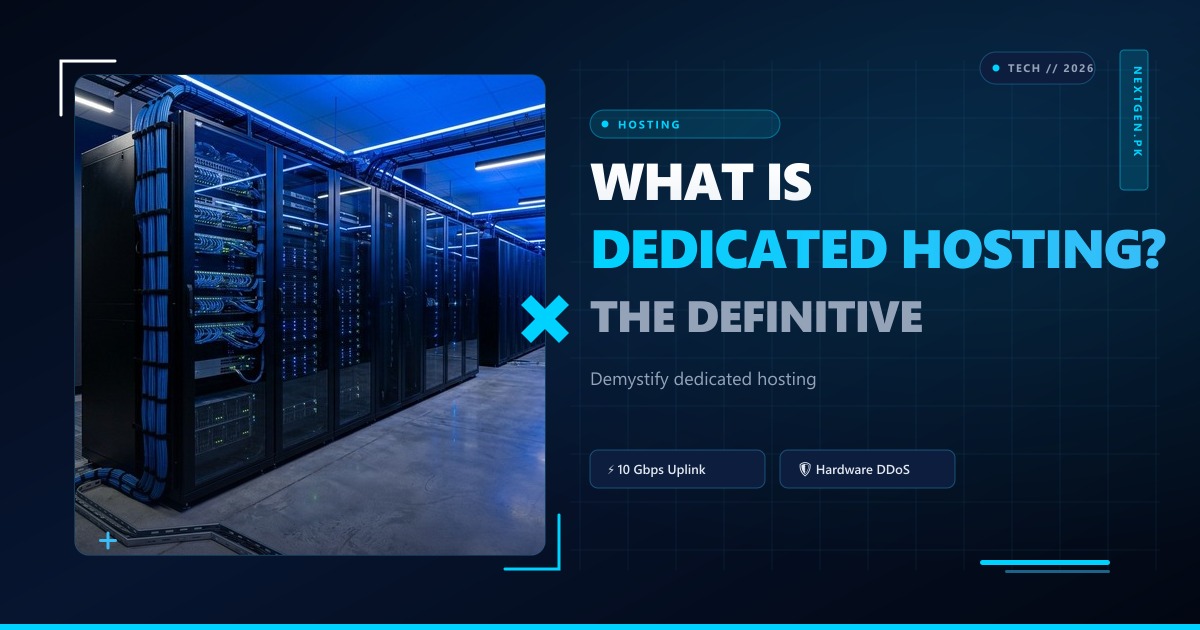
In an era where every hosting provider screams “Cloud! Serverless! Containers!”, why do the world’s most profitable fintech platforms, multiplayer game studios, database architects, and enterprise corporations still rent massive, heavy, physical rackmount servers?
Because virtualization has an inescapable dirty little secret: The Hypervisor Tax.
No matter how advanced VMware ESXi, KVM, or cloud orchestration platforms become, running a virtual machine means your application code must pass through an emulation layer before it touches the physical silicon. You share CPU cache lines, memory buses, PCIe lanes, and network interface cards (NICs) with dozens of other virtual machines.
When an unexpected workload or noisy neighbor on that same physical node spikes their CPU or hammers disk I/O, your latency jitters, your database transactions queue up, and your application response times degrade.
If you cannot afford a single millisecond of shared jitter, there is only one true solution: Dedicated Server Hosting.
Let’s explore what dedicated hosting really is, how bare-metal architecture works under the hood, and why high-throughput systems eventually abandon the virtual cloud for dedicated physical machines.
What is Dedicated Hosting?
Dedicated hosting (frequently referred to as Bare-Metal Hosting) is an infrastructure model where a customer leases an entire physical server machine located in a datacenter for their exclusive use.
Unlike shared hosting (where hundreds of websites share one operating system) or virtual private servers / cloud instances (where multiple virtual machines share physical CPU and RAM slices via a hypervisor), a dedicated server belongs 100% to you.
There are zero other tenants. Every single transistor on the dual Intel Xeon or AMD EPYC processors, every gigabyte of DDR5 ECC registered memory, every PCIe Gen4/Gen5 NVMe lane, and the entire 10Gbps/100Gbps network pipe belongs exclusively to your applications.
The 5 Core Benefits of Dedicated Hosting (Why Bare-Metal Wins)
1. Zero “Noisy Neighbors” and Zero Hypervisor Overhead
In virtualized cloud environments, “noisy neighbors” are a constant headache. If another tenant on the physical hypervisor starts running an intense video transcode or an unindexed SQL query, your virtual machine experiences CPU steal time (%st in Linux top) and memory latency stalls.
On dedicated hardware:
- CPU Steal is 0.00% permanently.
- All CPU L1, L2, and massive L3 cache lines are exclusively utilized by your threads.
- Memory read/write speeds operate at raw hardware clock frequencies without kernel hypervisor paging tables interfering.
2. Hardware RAID Controllers with Battery-Backed Write Cache (BBU)
Most cloud instances use software-defined storage or standard software RAID. If the host experiences a sudden power glitch, in-flight write operations can corrupt filesystems.
Enterprise dedicated servers feature dedicated hardware RAID controllers (such as Broadcom MegaRAID or HPE Smart Array) equipped with dedicated onboard processors and flash-backed battery cache (FBWC):
- Incoming write IOPS are acknowledged in nanoseconds from high-speed controller cache.
- Hard drive failures (RAID 10, RAID 5, or RAID 6) trigger automated hot-spare rebuilds in the background with zero performance degradation to the operating system.
- Hot-swappable enterprise SAS SSDs and NVMe U.2/U.3 drives can be ejected and replaced without shutting down the server.
3. Out-of-Band Remote Management (IPMI / iDRAC / iLO)
One of the most powerful features of bare-metal servers is Out-of-Band (OOB) hardware management via Intelligent Platform Management Interface (IPMI), Dell iDRAC, or HPE iLO:
- You have an independent physical management network interface card connected to the motherboard.
- If your operating system crashes, your Linux kernel panics, or a firewall misconfiguration locks you out of SSH, you don’t need a datacenter technician.
- You can open a virtual KVM (Keyboard, Video, Mouse) console in your web browser, mount a local ISO image from your laptop, reboot the physical power supply, view motherboard thermal sensors, and reinstall the operating system completely remotely.
4. Custom Kernel Tweaks & Hardware Passthrough
Cloud hypervisors restrict what you can do at the Linux kernel level. You cannot modify low-level CPU scheduler parameters, customize NUMA node balancing, or attach custom PCIe cryptographic acceleration cards.
With a dedicated machine, you have unrestricted UEFI/BIOS and root privilege:
- Load custom kernel modules (DPDK for line-rate packet processing, WireGuard kernel acceleration, custom eBPF probes).
- Direct access to hardware virtualization (run nested KVM hypervisors or Proxmox to build your own private internal cloud).
- Dedicated GPU passthrough for AI/LLM model inference and batch computer vision pipelines.
5. Cost Efficiency at High Scale
For small, low-traffic websites, cloud VMs are cheap. But as soon as you need 64 CPU cores, 256GB of RAM, and 10TB of high-speed NVMe storage running 24/7, cloud provider billing (AWS EC2, Google Cloud, Azure) becomes astronomical.
Public cloud providers charge heavily for raw compute capacity and penalize you with exorbitant outbound bandwidth egress fees. A dedicated server offers a fixed, predictable monthly lease with massive unmetered or high-terabyte bandwidth allowances.
Architectural Breakdown: Shared vs. Cloud VPS vs. Dedicated
| Metric | Shared Hosting | Cloud VPS | Dedicated Bare-Metal |
|---|---|---|---|
| Tenant Model | Multi-tenant OS layer | Multi-tenant Hypervisor | 100% Single-Tenant Physical |
| CPU Allocation | Shared time-slices | Virtual vCPUs (shared or reserved) | Dedicated Bare-Metal Physical Sockets |
| RAM Guarantee | Soft limits / LVE | Virtual memory allocation | Physical ECC DDR4/DDR5 Modules |
| Storage Architecture | Shared local drives | Network SAN / Ceph or virtual volume | Direct PCIe Gen4/Gen5 NVMe & Hardware RAID |
| Network Interface | Shared OS NIC | Virtual bridge / VirtIO NIC | Dedicated 1Gbps / 10Gbps Physical Switch Port |
| BIOS & Hardware Access | None | None | Full IPMI / iDRAC KVM Out-of-Band Control |
| Ideal Workloads | Blogs, small business sites | Medium SaaS, active WooCommerce | Big Data, Core Banking, Game Servers, High-IOPS DBs |
Who Actually Needs Dedicated Hosting?
Dedicated hosting is not necessary for a simple WordPress blog or a brochure site. But it is indispensable for:
- High-Concurrency Relational Databases: When running production MySQL/MariaDB, PostgreSQL, or Microsoft SQL Server instances processing thousands of transactions per second, disk I/O queue depth and memory bandwidth are critical. Dedicated bare-metal eliminates virtualized I/O throttling.
- Multiplayer Gaming Servers & Low-Tick Voice Systems: Games like CS:GO, Minecraft networks, Rust, or large-scale VoIP systems require rock-solid CPU clock frequencies and zero jitter. Hypervisor context switches introduce micro-stutter that ruins the real-time player experience.
- Fintech, Banking, and SBP/SECP Compliance: Financial institutions require physically isolated hardware to comply with data protection regulations, ensuring customer financial data is never co-mingled on physical memory sticks with unknown third parties.
- Virtualization Providers & Web Agencies: Hosting companies and development agencies can deploy Proxmox VE or VMware vSphere on a dedicated server to spin up dozens of isolated customer VPS containers at wholesale cost.
Deploying Dedicated Hardware: Global Fleet vs. Pakistan Local Datacenters
When procuring bare-metal hardware, geographic location dictates user experience:
- If your audience is international or you are running global SaaS services, our worldwide fleet of Dedicated Servers across North America, Europe, and Asia-Pacific provides massive multi-gigabit Tier-1 transit.
- If your primary customer base resides in Pakistan, hosting servers overseas introduces 140ms to 240ms of latency across subsea cables. By deploying sovereign hardware on Dedicated Servers in Pakistan, your servers sit directly inside Tier-3 datacenters in Islamabad and Karachi. With direct 100G peering at the Pakistan Internet Exchange (PkIX), your applications respond to PTCL, Nayatel, and StormFiber users in under 10 milliseconds.
For organizations scaling up toward dedicated hardware without ready-to-deploy bare-metal budgets, our high-performance Pakistan Cloud VPS offers an ideal stepping stone with dedicated resources and instant provisioning.
Conclusion: The Ultimate Performance Standard
Cloud instances provide incredible agility for rapid prototyping and unpredictable workloads. But when your enterprise matures, your traffic surges into the millions, and your database demands raw, uncompromised speed, nothing replaces the sheer brute-force power of bare-metal silicon.
Dedicated server hosting is not a legacy technology—it is the bedrock foundation upon which modern high-performance internet infrastructure is built.
Deploy Enterprise Dedicated Bare-Metal Servers Today
Eliminate the hypervisor tax. Get unthrottled Intel Xeon and AMD EPYC multi-core processing, hardware RAID, enterprise NVMe storage, and complete IPMI out-of-band management with 99.9% uptime SLA.
