
Performing schema modifications (ALTER TABLE) on large production database tables has historically been one of the highest-risk operations in database administration. Under traditional MySQL and MariaDB DDL algorithms (ALGORITHM=COPY or ALGORITHM=INPLACE), adding a single column to an 800 GB table requires copying every row into a temporary tablespace or rebuilding the entire primary clustered index.
During this multi-hour process:
- Disk write I/O surges, saturating NVMe storage controllers.
- The server acquires a Metadata Lock (MDL). Even if
ALGORITHM=INPLACEallows concurrent reads and writes, the initial and final MDL transitions can stall incoming transactions, creating catastrophic thread pool pileups. - Disk space must be doubled to hold the temporary table, risking emergency disk-full crashes.
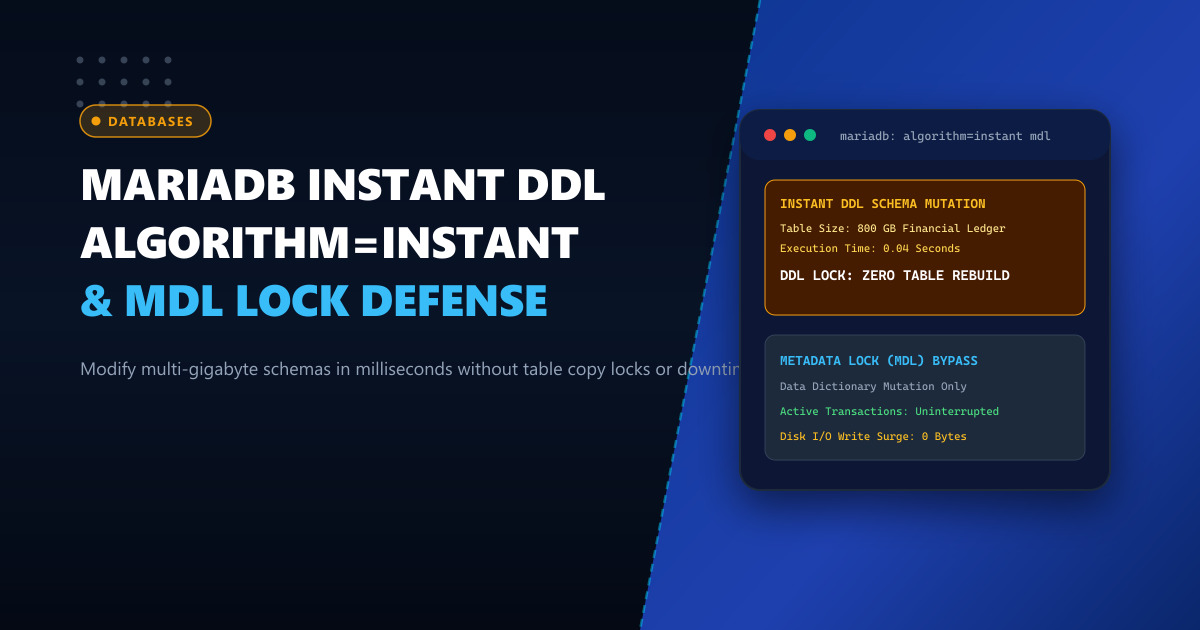
Starting in MariaDB 10.3+ and MySQL 8.0.12+, the storage engine introduced ALGORITHM=INSTANT. Instead of rewriting physical table blocks, instant DDL modifies only the data dictionary metadata in memory and disk headers. Adding a column to an 800 GB table executes in 0.04 seconds, with zero disk I/O, zero table rebuild, and near-zero metadata lock exposure.
In this deep architectural guide, we dissect the internal row format mechanics of instant DDL, identify supported instant operations, and avoid metadata lock deadlocks on enterprise database clusters in Pakistan.
How ALGORITHM=INSTANT Modifies Tables Without Rebuilding Rows
In traditional InnoDB storage:
- Every physical row record contains a fixed-length header and column offsets.
- Adding a new column requires re-writing every data page to insert the new column offset.
With Instant DDL:
+─────────────────────────────────────────────────────────────+
|               Instant Row Format Architecture               |
+─────────────────────────────────────────────────────────────+
  [ Data Dictionary Metadata ]
        │  Stores: "Table has 12 columns. Column 13 added instantly."
        │  Default Value for Column 13: 'PENDING'
        ▼
  [ Existing Physical Clustered Index Pages ]
        │  NEVER TOUCHED! (Zero Disk I/O!)
        │  Rows on disk still only contain 12 columns.
        ▼
  [ On-the-Fly Row Assembly in RAM ]
        │  When a query reads an old 12-column row:
        │  InnoDB detects missing column 13 and injects default value 'PENDING'
        │  Transparently assembled in Buffer Pool!
Only when a row is subsequently updated or a new row inserted is the physical record written with the new column layout.
Operating large transactional databases on bare-metal Dedicated Servers provides the dedicated memory bandwidth and raw multi-core processing needed to manage large data dictionaries and concurrent query streams without hypervisor stutter.
Step 1: Executing Instant Schema Changes
To add a column instantly to an existing multi-hundred-gigabyte table:
-- Explicitly require ALGORITHM=INSTANT to prevent accidental fallback to INPLACE or COPY
ALTER TABLE customer_transactions
    ADD COLUMN fraud_score DECIMAL(5,2) DEFAULT 0.00,
    ALGORITHM=INSTANT, LOCK=DEFAULT;
If MariaDB can execute the change instantly, the query returns immediately:
Query OK, 0 rows affected (0.041 sec)
Records: 0  Duplicates: 0  Warnings: 0
Notice the execution time: 41 milliseconds on an 800 GB table!
Supported vs. Unsupported Instant Operations in Modern MariaDB
| Schema Operation | ALGORITHM=INSTANT Supported? |
Engine Behavior |
|---|---|---|
| Add Column at End of Table | Yes (MariaDB 10.3+) | Metadata update only |
| Add Column in Middle of Table | Yes (MariaDB 10.4+) | Re-maps column indices in dictionary |
| Drop Column | Yes (MariaDB 10.4+) | Marks column hidden in metadata |
| Change Default Value | Yes | Updates default in data dictionary |
| Rename Column | Yes | Updates metadata name pointer |
| Change Column Data Type | No (Requires INPLACE/COPY) |
Full data conversion needed |
| Add Primary Key | No (Requires INPLACE) |
Primary clustered index rebuild |
Step 2: Mitigating Metadata Lock (MDL) Queue Traps
Even though ALGORITHM=INSTANT completes in milliseconds, it still requires an exclusive Metadata Lock (MDL_EXCLUSIVE) for a microsecond to update the data dictionary. If an uncommitted SELECT query or long-running report is currently reading the table, the ALTER statement waits in the lock queue:
[ Long-running Analytics Query ] ──▶ Holds Shared Read MDL Lock
                                                │
[ ALTER TABLE ... INSTANT ] ───────▶ Waits for Exclusive MDL Lock
                                                │
[ All New Incoming SELECTs ] ──────▶ BLOCKED BEHIND ALTER TABLE!
To prevent this cascading lock pileup, configure strict DDL lock timeouts before executing the ALTER:
-- Set DDL lock wait timeout to 3 seconds (Fails fast if table is busy)
SET SESSION lock_wait_timeout = 3;

-- Execute instant change
ALTER TABLE customer_transactions
    ADD COLUMN verification_status VARCHAR(32) DEFAULT 'UNVERIFIED',
    ALGORITHM=INSTANT;
If another transaction holds an MDL lock, the statement aborts after 3 seconds instead of blocking the entire database server.
Step 3: Inspecting Table Metadata & Instant Versioning
To inspect how many instant columns a table currently maintains:
SELECT TABLE_NAME, INSTANT_COLS, TOTAL_ROW_VERSIONS
FROM information_schema.INNODB_SYS_TABLES
WHERE NAME LIKE '%customer_transactions%';
Operational Comparison: Traditional DDL vs. ALGORITHM=INSTANT
| Metric (800 GB Table, 1.2 Billion Rows) | Traditional ALGORITHM=INPLACE |
Modern ALGORITHM=INSTANT |
|---|---|---|
| Execution Duration | 2 Hours 45 Minutes | 0.04 Seconds |
| Disk Space Required | +800 GB (Temporary space) | 0 Bytes |
| Disk I/O Write Surge | 800 GB written to NVMe | 0 Bytes written |
| Metadata Lock Exposure Window | Minutes (Rebuild phases) | < 1 Millisecond |
| Application Downtime / Lag | High connection latency | Zero User-Facing Impact |
Hosting your mission-critical database fleets on enterprise Dedicated Servers in Pakistan guarantees resilient NVMe storage, fast dictionary updates, and flawless operational agility for continuous software delivery.
Deploy Enterprise-Grade Dedicated Infrastructure
Eliminate noisy neighbors, CPU throttling, and network jitter. Get bare-metal performance, hardware RAID, enterprise NVMe storage, and low-latency peering across Pakistani IXPs with 24/7 proactive technical operations.
Explore Dedicated Servers in Pakistan