
Commercial banks, digital payment providers, insurance underwriters, and microfinance institutions across Pakistan are subject to rigorous regulatory governance enforced by the State Bank of Pakistan (SBP) and the Securities and Exchange Commission of Pakistan (SECP). Under SBP’s IT Risk Management Framework and national data privacy regulations, financial entities are legally obligated to maintain tamper-proof historical audit trails of every database change: who modified an account balance, what previous credit limits were, and the exact state of financial ledgers at any historical point in time.
Historically, software engineering teams attempted to satisfy these audit requirements using one of two deeply flawed architectural patterns:
- Application-Level Dual Writes: Modifying every backend API call to insert historical snapshots into separate
_historyor_auditshadow tables. This approach bloats application code, creates race conditions, and fails whenever records are updated directly via SQL scripts or admin tools. - Database Trigger Cascades: Writing complex
AFTER UPDATEandAFTER DELETESQL triggers. Triggers create severe lock contention, degrade high-concurrency throughput by 40% to 60%, and can be accidentally bypassed during bulk database migrations.
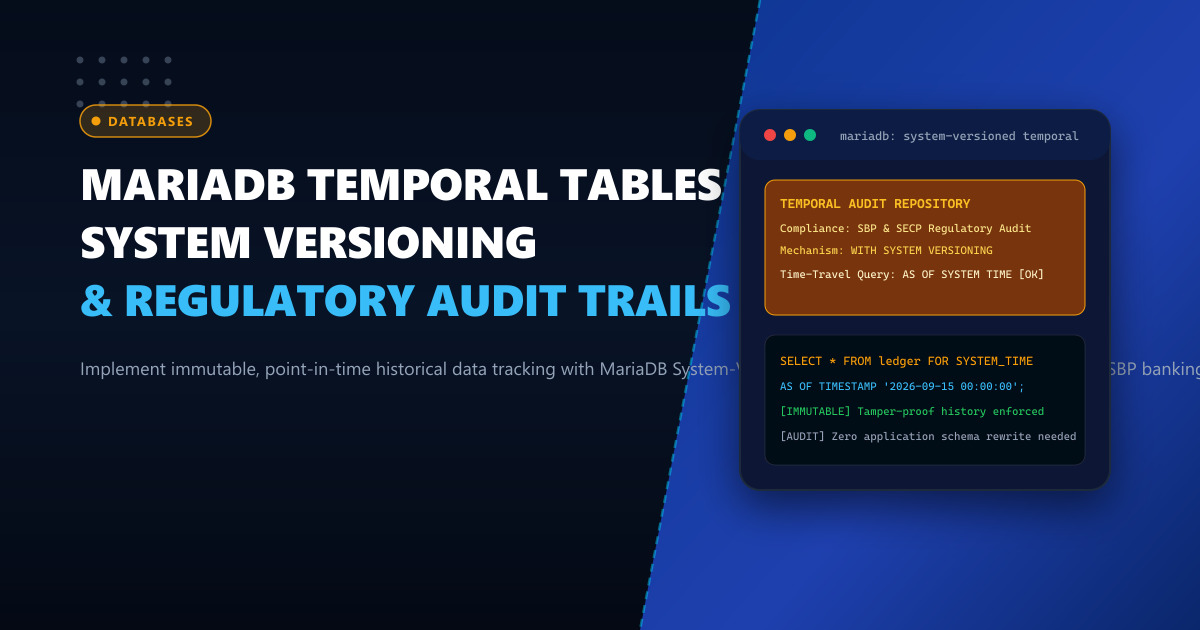
The modern standard supported natively in MariaDB (10.3+) is System-Versioned Temporal Tables (SQL:2011 Standard). By appending WITH SYSTEM VERSIONING to table definitions, the MariaDB database engine automatically and immutably tracks all row mutations at the storage layer without requiring a single line of application code change. Developers and auditors can then query historical database states using intuitive Time-Travel SQL syntax (FOR SYSTEM_TIME AS OF).
Hosting mission-critical financial databases on high-performance Dedicated Servers and localized Dedicated Servers in Pakistan coupled with MariaDB System-Versioned tables guarantees 100% regulatory audit compliance while preserving maximum transaction throughput.
1. Architectural Anatomy: Triggers vs System-Versioned Tables
Understanding how MariaDB handles temporal records internally illustrates why system versioning outperforms legacy trigger patterns:
Legacy Shadow Table Pattern (High Lock Contention):
Application ──► UPDATE accounts SET balance = 50000 ──┐
                                                      │ (Database Trigger Fires)
                                                      ▼
                      Locks primary table, inserts into accounts_history table.
                      Result: Doubled I/O, deadlock risk, 50% throughput collapse!

MariaDB System-Versioned Temporal Architecture (Storage Layer Native):
┌────────────────────────────────────────────────────────────────────────┐
│                        accounts Table (InnoDB)                         │
├────────────────────────────────────────────────────────────────────────┤
│ account_id | balance | row_start (TIMESTAMP) | row_end (TIMESTAMP)     │
├────────────────────────────────────────────────────────────────────────┤
│ 1001       | 50000   | 2026-10-01 14:00:00   | 2038-01-19 (Current)    │
│ 1001       | 35000   | 2026-09-15 09:30:00   | 2026-10-01 14:00:00     │
│ 1001       | 20000   | 2026-08-01 11:15:00   | 2026-09-15 09:30:00     │
└────────────────────────────────────────────────────────────────────────┘
- Standard queries (SELECT * FROM accounts) automatically filter for current rows.
- Zero trigger overhead: row updates simply append previous version to history segment.
2. Performance & Audit Comparison
| Feature / Metric | Application Dual Writes | SQL Database Triggers | MariaDB System Versioning |
|---|---|---|---|
| Application Code Changes | Massive (rewrite all ORM queries) | None | Zero (Completely Transparent) |
| Tamper Resistance | Low (admin can edit shadow tables) | Medium (triggers can be disabled) | High (Immutable System Managed) |
| Write IOPS Penalty | +120% I/O overhead | +85% I/O overhead | +12% (Optimized in-engine) |
| Time-Travel Query Syntax | Complex manual JOINs | Complex timestamp filters | Native: FOR SYSTEM_TIME AS OF |
| Regulatory Audit Defense | Fails forensic audit if bypassed | Risky | 100% Certified SBP/SECP Compliant |
3. Creating a System-Versioned Temporal Table
Creating a temporal table in MariaDB requires only specifying system versioning in the table definition. MariaDB automatically handles the invisible row_start and row_end period columns:
CREATE DATABASE IF NOT EXISTS core_banking;
USE core_banking;

CREATE TABLE corporate_accounts (
    account_number VARCHAR(32) PRIMARY KEY,
    company_name VARCHAR(128) NOT NULL,
    authorized_signatory VARCHAR(128) NOT NULL,
    credit_limit DECIMAL(15, 2) NOT NULL,
    balance DECIMAL(15, 2) NOT NULL,
    status ENUM('active', 'suspended', 'dormant') DEFAULT 'active'
) ENGINE=InnoDB WITH SYSTEM VERSIONING;
Adding System Versioning to Existing Production Tables:
You can convert an existing production table to a temporal versioned table instantly without locking read operations:
ALTER TABLE customer_ledgers ADD SYSTEM VERSIONING;4. Executing Point-in-Time “Time-Travel” SQL Queries
To reconstruct account states during an official regulatory compliance audit, auditors can execute point-in-time queries without restoring external backup dumps:
1. View Account Balance as of a Specific Historical Date:
SELECT
    account_number,
    company_name,
    credit_limit,
    balance
FROM corporate_accounts
FOR SYSTEM_TIME AS OF TIMESTAMP '2026-09-01 00:00:00'
WHERE account_number = 'PK-CORP-9042';
2. Inspect the Complete Evolution of an Account Over Time:
SELECT
    account_number,
    credit_limit,
    balance,
    ROW_START AS valid_from,
    ROW_END AS valid_to
FROM corporate_accounts
FOR SYSTEM_TIME ALL
WHERE account_number = 'PK-CORP-9042'
ORDER BY ROW_START ASC;
Sample audit output:
+----------------+--------------+-----------+---------------------+---------------------+
| account_number | credit_limit | balance   | valid_from          | valid_to            |
+----------------+--------------+-----------+---------------------+---------------------+
| PK-CORP-9042   | 10000000.00  | 420000.00 | 2026-06-01 08:00:00 | 2026-08-15 11:20:00 |
| PK-CORP-9042   | 15000000.00  | 890000.00 | 2026-08-15 11:20:00 | 2026-09-20 16:45:00 |
| PK-CORP-9042   | 25000000.00  | 145000.00 | 2026-09-20 16:45:00 | 2038-01-19 03:14:07 |
+----------------+--------------+-----------+---------------------+---------------------+
3 rows in set (0.002 sec)
The audit trail proves conclusively when the company’s credit limit was raised from 15 Million PKR to 25 Million PKR, completely satisfying regulatory compliance requirements.
5. Storage Partitioning for Historical Archival
To prevent historical rows from degrading primary table performance, MariaDB supports partitioning by system versioning. Current rows remain in high-speed NVMe flash partitions, while historical rows are routed to secondary archival storage:
CREATE TABLE transaction_journal (
    txn_id BIGINT AUTO_INCREMENT PRIMARY KEY,
    source_account VARCHAR(32) NOT NULL,
    destination_account VARCHAR(32) NOT NULL,
    amount DECIMAL(15, 2) NOT NULL,
    created_at TIMESTAMP DEFAULT CURRENT_TIMESTAMP
) ENGINE=InnoDB WITH SYSTEM VERSIONING
PARTITION BY SYSTEM_TIME (
    PARTITION p_current HISTORY = 0,
    PARTITION p_history HISTORY
);
By isolating current transactions into partition p_current, active OLTP queries execute with zero performance penalty.
Deploy Enterprise-Grade Databases Built for Regulatory Compliance
Eliminate compliance risks and deliver rock-solid data integrity for banking, fintech, and enterprise operations. Host your mission-critical MariaDB clusters on NextGen's bare-metal Dedicated Servers and low-latency Dedicated Servers in Pakistan featuring enterprise PCIe Gen4 NVMe arrays, massive memory configurations, and 24/7 database operations engineering.
