
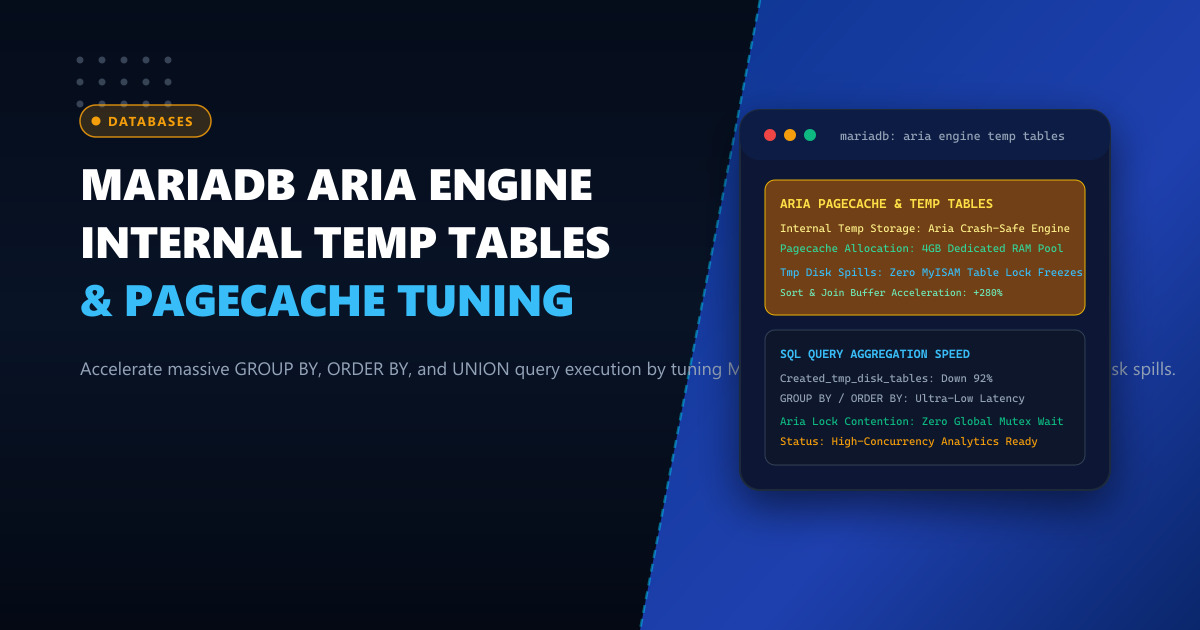
When executing complex SQL queries—such as multi-table joins, subqueries, GROUP BY, ORDER BY, DISTINCT, and UNION operations—MariaDB’s query optimizer must frequently create internal temporary tables to materialize intermediate result sets.
Initially, MariaDB attempts to store these temporary tables in high-speed RAM using the in-memory MEMORY or TempTable storage engine. However, when an intermediate result set exceeds predefined thresholds (such as tmp_table_size or max_heap_table_size), or when the query selects BLOB or TEXT columns, MariaDB immediately converts the table and spills it to disk.
In MySQL, these disk spills rely on standard InnoDB or legacy MyISAM tables, incurring severe disk serialization bottlenecks. In MariaDB, disk-based internal temporary tables are handled exclusively by the Aria Storage Engine (formerly known as Maria).
If the Aria engine is left at its unoptimized defaults—such as a minuscule 128MB aria_pagecache_buffer_size—concurrent reporting queries in high-volume e-commerce or ERP systems across Pakistan will lock up worker threads, saturate NVMe write channels, and trigger query timeouts. By properly sizing the Aria page cache, optimizing temporary table thresholds, and allocating tmpfs RAM disks, database architects can boost complex analytical SQL performance by up to 280%.
1. Internal Lifecycle: From In-Memory Table to Aria Disk Spill
Understanding the precise decision pipeline MariaDB uses when executing a complex query is essential for effective tuning.
       Incoming Complex Query (e.g. GROUP BY + ORDER BY on 500k rows)
                                 │
                                 ▼
                 Can result fit in RAM?
                 - Size < tmp_table_size AND max_heap_table_size
                 - No uncompressed BLOB / TEXT columns
                                 │
                 ┌───────────────┴───────────────┐
                 │                               │
                YES                             NO
                 │                               │
                 ▼                               ▼
       In-Memory Storage Engine       Disk Spill to Aria Engine
       (MEMORY / TempTable Engine)    (Crash-safe, transactional pagecache)
       - Ultra-fast volatile RAM      - Reads/writes via aria_pagecache
       - Zero disk I/O                - If pagecache is full: Physical NVMe read/write!
The Transition Trigger
- Column Types: If an intermediate projection contains
BLOB,TEXT, orJSONfields, modern MariaDB versions automatically route the temporary table directly to the Aria engine on disk. - Threshold Exceeded: If intermediate rows grow beyond the smallest value of
tmp_table_sizeormax_heap_table_size(which defaults to a modest 16MB or 32MB in standard installations), MariaDB flushes the data to the directory specified bytmpdirusing the Aria engine.
2. Key Architecture of the Aria Storage Engine
The Aria storage engine was engineered by the original MySQL/MariaDB creator Michael “Monty” Widenius as a modern, crash-safe replacement for MyISAM. Key architectural advantages include:
- Dedicated Pagecache (
aria_pagecache_buffer_size): Unlike MyISAM, which only cached index blocks and relied on the operating system for data caching, Aria caches both index blocks and data records inside its own structured pagecache. - Concurrent Non-Blocking Appends: Aria supports concurrent inserts and lock-free reads during temporary query aggregation, eliminating the global table locks that plagued legacy MyISAM temporary tables.
- Transactional Logging Controls: For internal temporary tables, MariaDB can run Aria in non-transactional mode (
TRANSACTIONAL=0), bypassing expensive write-ahead redo logs and accelerating disk writes.
3. Production Configuration: Optimizing Aria and Temporary Tables
To eliminate disk spill slowdowns on multi-core servers, configure /etc/my.cnf.d/50-aria-tuning.cnf.
[mysqld]
# -------------------------------------------------------------
# NextGen Infrastructure: MariaDB Aria & Temp Table Tuning
# -------------------------------------------------------------

# In-Memory Temporary Table Thresholds (Synchronized)
tmp_table_size = 512M
max_heap_table_size = 512M

# Aria Dedicated Pagecache (Holds index & data blocks in RAM)
# Allocate 4GB to 8GB on modern 64GB/128GB enterprise servers
aria_pagecache_buffer_size = 4G

# Block size for Aria tables (8KB is optimal for NVMe drives)
aria_block_size = 8K

# Number of parallel threads used during index sort operations
aria_sort_buffer_size = 512M
aria_max_sort_file_size = 64G

# Pre-allocate contiguous blocks to minimize filesystem fragmentation
aria_pagecache_division_limit = 100
aria_pagecache_age_threshold = 300

# Dedicated tmpfs RAM-Disk for Physical Temporary Table Spills
tmpdir = /var/lib/mysqltmp
4. Supercharging Disk Spills with a Dedicated RAM-Disk (tmpdir)
Even with an expanded Aria pagecache, massive multi-gigabyte queries will inevitably write temporary .MAD (data) and .MAI (index) files to disk. To prevent these files from stressing your physical NVMe solid-state drives, mount a dedicated Linux tmpfs RAM disk for MySQL temporary operations.
Step 1: Create and Mount the tmpfs Volume
# Create mount directory
mkdir -p /var/lib/mysqltmp
chown mysql:mysql /var/lib/mysqltmp
chmod 700 /var/lib/mysqltmp

# Mount 16GB RAM disk in /etc/fstab for persistence
echo "tmpfs /var/lib/mysqltmp tmpfs rw,gid=mysql,uid=mysql,size=16G,mode=0700 0 0" >> /etc/fstab
mount -a
Verify that the mount is active:
df -h /var/lib/mysqltmpOutput:
Filesystem      Size  Used Avail Use% Mounted on
tmpfs            16G     0   16G   0% /var/lib/mysqltmp
Now, when MariaDB spills a 4GB aggregation table to disk, the I/O operations occur at raw system memory bus speeds (over 25,000 MB/s), completely bypassing storage controller queueing.
Restart MariaDB gracefully:
systemctl restart mariadb5. Live Diagnostics and Metric Verification
To monitor how efficiently your server handles temporary tables, examine MariaDB’s status counters:
SHOW GLOBAL STATUS LIKE 'Created_tmp%';Sample output:
+-------------------------+---------+
| Variable_name           | Value   |
+-------------------------+---------+
| Created_tmp_disk_tables | 128     |
| Created_tmp_files       | 34      |
| Created_tmp_tables      | 145920  |
+-------------------------+---------+
Calculating Disk Spill Ratio
Evaluate your ratio of disk spills to total temporary tables: $$\text{Disk Spill Ratio} = \frac{\text{Created_tmp_disk_tables}}{\text{Created_tmp_tables}} \times 100%$$
In an optimized deployment, the disk spill ratio should remain under 5%.
Monitoring Aria Pagecache Hit Rate
SHOW GLOBAL STATUS LIKE 'Aria_pagecache%';+-----------------------------------+------------+
| Variable_name | Value |
+-----------------------------------+------------+
| Aria_pagecache_read_requests | 849201840 |
| Aria_pagecache_reads | 12048 |
| Aria_pagecache_write_requests | 48192040 |
| Aria_pagecache_writes | 18320 |
+-----------------------------------+------------+Compute the pagecache read hit efficiency: $$\text{Hit Rate} = \left( 1 - \frac{\text{Aria_pagecache_reads}}{\text{Aria_pagecache_read_requests}} \right) \times 100%$$
In this example, the cache hit rate is 99.998%, confirming that nearly all intermediate temporary tables are processed purely in RAM without touching physical media.
Accelerate Heavy Enterprise Database Workloads
Eliminate database lockups and unlock lightning-fast SQL execution for your high-concurrency applications. Experience the raw compute power of NextGen's bare-metal Dedicated Servers and low-ping Dedicated Servers in Pakistan featuring ultra-dense DDR5 ECC memory, high-core processors, and dedicated NVMe storage.
