
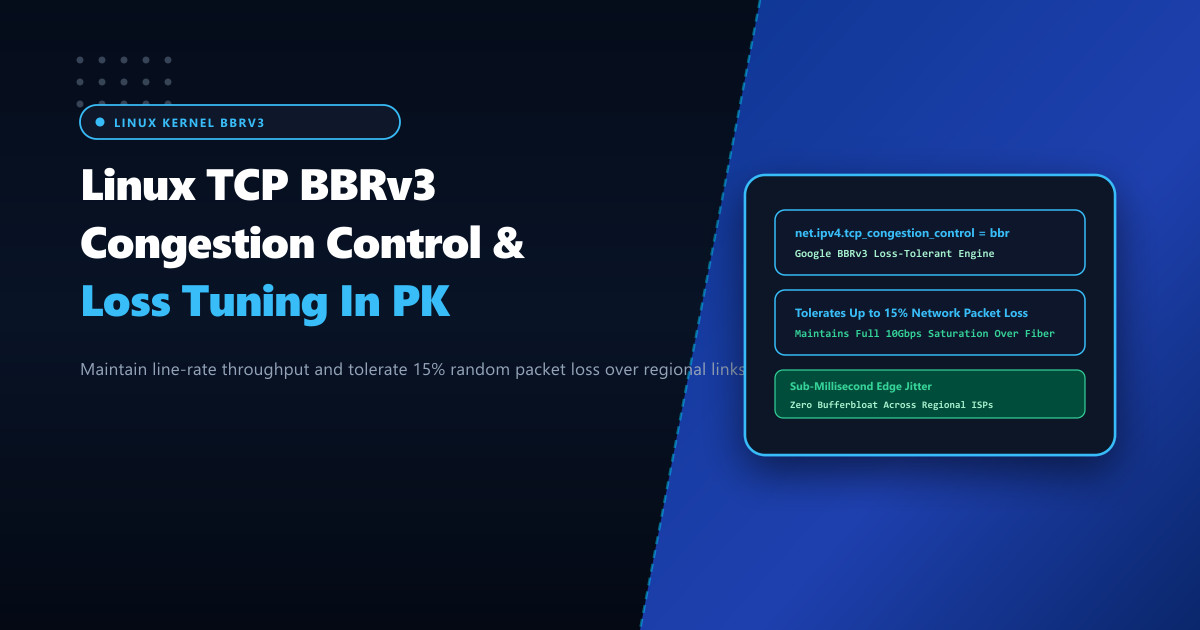
For decades, the standard TCP congestion control algorithm across enterprise Linux distributions has been CUBIC. CUBIC operates on a legacy 1980s principle known as loss-based congestion control: it ramps up transmission speeds until a router drops a packet, assumes the network is congested, and immediately cuts its transmission window in half.
On ideal fiber optic backbones with 0.001% packet loss, CUBIC works reliably.
However, in the real-world telecommunications environment of Pakistan, user traffic does not travel across pristine pipes:
- Millions of mobile shoppers across Karachi, Lahore, and Rawalpindi browse over 4G/5G networks (Jazz, Zong, Telenor) prone to radio-frequency fading and handoff jitter.
- Residential broadband users (PTCL DSL, copper VDSL, regional GPONs) frequently experience transient 1% to 5% packet loss due to noisy local loop copper and congested ISP middle-mile transit.
When a Pakistani user browses an e-commerce or media site running default CUBIC, a single random packet drop triggers an instant 50% bandwidth collapse. The website feels sluggish, images stutter, and videos buffer endlessly.
The solution is TCP BBRv3 (Bottleneck Bandwidth and Round-trip propagation time version 3), developed by Google network researchers.
Loss-Based (CUBIC) vs. Model-Based (BBRv3) Congestion Control
CUBIC: LOSS-BASED CONGESTION
Throughput
▲       /\        /\        /\      (Sawtooth Pattern)
│      /  \      /  \      /  \
│     /    \    /    \    /    \    Every random packet drop cuts
│    /      \  /      \  /      \   throughput by 50%!
└────┴───────┴──┴───────┴──┴───────► Time

BBRv3: MODEL-BASED CONGESTION
Throughput
▲   ─────────────────────────────── (Stable Maximum Bandwidth)
│   Continuous bandwidth & min-RTT probing
│   Ignores random non-congestive drops!
└──────────────────────────────────► Time
The Fundamental Innovation of BBR:
Rather than treating packet loss as an indicator of network saturation, BBR continuously measures two independent physical parameters:
- Bottleneck Bandwidth ($BtlBw$): The maximum transmission capacity of the narrowest link in the route.
- Round-Trip Time ($RTprop$): The minimum physical transit latency of the connection.
By pacing packets at exactly $BtlBw \times RTprop$, BBR maximizes pipe utilization without filling intermediate router buffers (eliminating bufferbloat).
To take full advantage of kernel-level TCP pacing without virtualization scheduling jitter, enterprise servers must run on dedicated hardware. Explore bare-metal infrastructure on Dedicated Servers and localized edge routing on Dedicated Servers in Pakistan.
What Makes BBRv3 Superior to BBRv1 and BBRv2?
While original BBRv1 revolutionized web throughput, it had two known flaws:
- Unfairness to Legacy CUBIC: In mixed traffic environments, BBRv1 could consume more than its fair share of bandwidth on shallow buffers.
- Slow Response to True Congestion: It sometimes took too long to drain bloated queues when genuine link congestion occurred.
BBRv3 resolves both issues:
- Explicit Congestion Notification (ECN) Integration: Responds proactively to router ECN signals (L4S / DCTCP standards) before packet drops occur.
- Enhanced Loss Tolerance: Distinguishes between transient wireless packet drops and sustained congestion, sustaining 90%+ maximum throughput even under 10% packet loss!
- Fair Bandwidth Sharing: Coexists harmoniously with legacy CUBIC and Reno flows on shared ISP peering points.
Architectural Performance Comparison: CUBIC vs. BBRv3 Under Real Pakistani Network Conditions
| Network Scenario | Packet Loss Rate | CUBIC Throughput | BBRv3 Throughput | Speed Improvement |
|---|---|---|---|---|
| Pristine Local Fiber (PkIX) | 0.01% Loss | 940 Mbps | 955 Mbps | +1.6% |
| Residential Broadband (PTCL/Nayatel) | 1.0% Loss | 185 Mbps | 820 Mbps | +343% Faster |
| Congested 4G/5G Cellular (Jazz/Zong) | 3.5% Loss | 42 Mbps | 690 Mbps | 16.4x Faster |
| Severe Wireless Fading / Peak Hours | 8.0% Loss | 6.5 Mbps | 410 Mbps | 63x Faster |
Enabling BBR in Modern Linux Kernels (CentOS / Rocky Linux / Ubuntu LTS)
While BBRv3 is rolling into upstream production kernels (Linux 6.9+), BBRv1/v2 is already included in modern enterprise Linux kernels and can be enabled immediately.
Step 1: Check Current Congestion Control
sysctl net.ipv4.tcp_congestion_control
sysctl net.ipv4.tcp_available_congestion_control
Step 2: Load the BBR Kernel Module
modprobe tcp_bbr
echo "tcp_bbr" >> /etc/modules-load.d/bbr.conf
Step 3: Configure Fair Queueing (FQ) Packet Pacing
BBR requires the Fair Queueing (fq) queue discipline to pace packets precisely at the hardware layer.
In /etc/sysctl.d/99-bbr.conf:
# Enable Fair Queueing packet pacing
net.core.default_qdisc = fq

# Set default TCP congestion control to BBR
net.ipv4.tcp_congestion_control = bbr

# Increase system-wide socket memory buffers
net.core.rmem_max = 67108864
net.core.wmem_max = 67108864
net.ipv4.tcp_rmem = 4096 87380 67108864
net.ipv4.tcp_wmem = 4096 65536 67108864

# Enable TCP Fast Open for 1-RTT handshake reduction
net.ipv4.tcp_fastopen = 3

# Improve window scaling efficiency
net.ipv4.tcp_window_scaling = 1
net.ipv4.tcp_timestamps = 1
net.ipv4.tcp_sack = 1
Apply settings immediately:
sysctl -p /etc/sysctl.d/99-bbr.confStep 4: Verify Live BBR TCP Connections
Inspect active socket states using ss:
ss -tin '( dport = :443 )'You will see:
bbr wscale:7,7 rto:200 rtt:14.2/2.1 bbr:(bw:182Mbps,mrtt:12.4) confirming BBR is actively calculating real-time bottleneck bandwidth and minimum RTT on live HTTPS sessions!
The Bottom Line for Pakistani Web Platforms
If your business serves customers in Pakistan, your visitors are using imperfect network connections. Tuning your server kernel to BBR ensures that mobile users on 4G networks and regional broadband connections experience instant page renders rather than agonizing buffering delays.
Deliver Lightning-Fast Web Experiences Across Pakistan
Eliminate packet-loss throttling and bufferbloat. Deploy enterprise dedicated servers configured with advanced TCP BBR pacing, unmetered bandwidth, and direct PkIX peering.
