
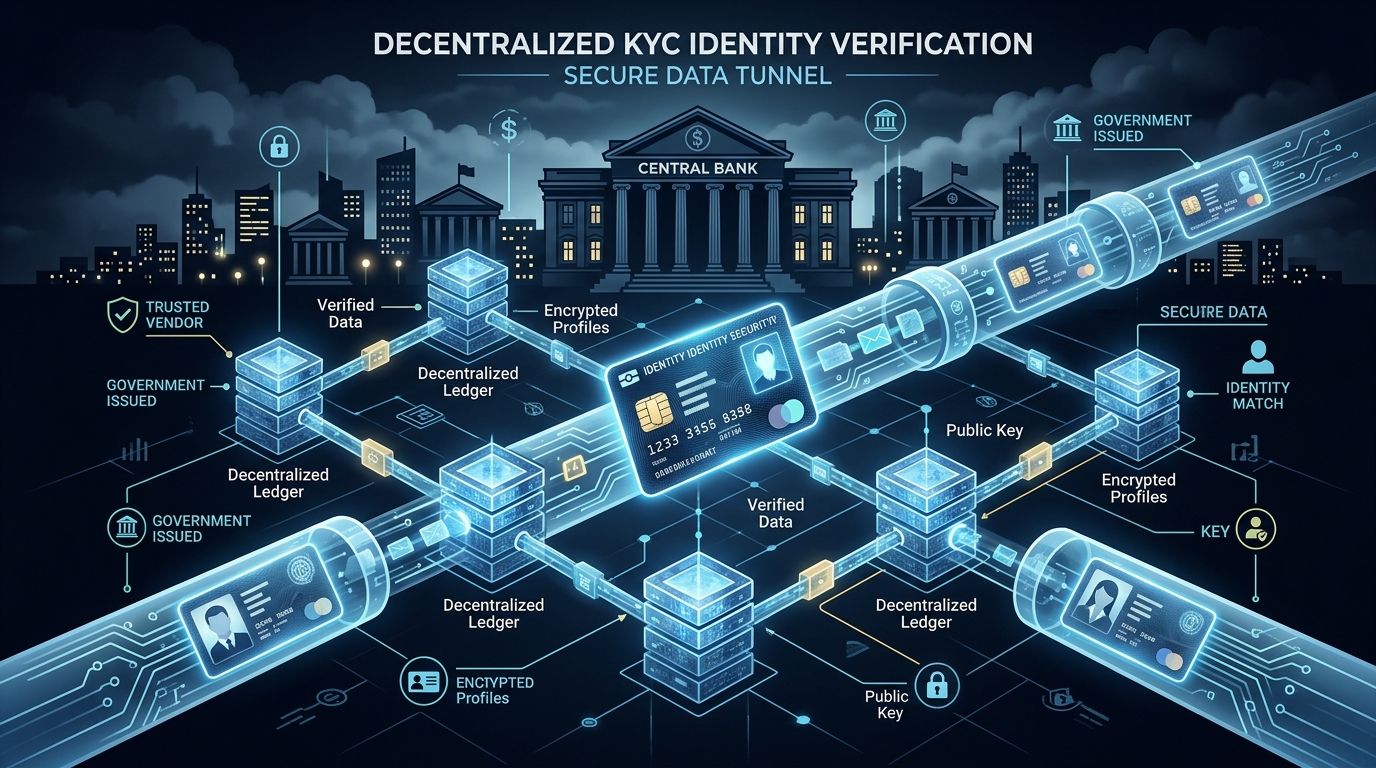
The Pakistani financial sector is undergoing a massive digital transformation. With the State Bank of Pakistan (SBP) expanding the Raast instant payment infrastructure and the Securities and Exchange Commission of Pakistan (SECP) advancing Regulatory Sandbox frameworks for tokenized assets and digital banks, consumer onboarding efficiency has become a critical competitive differentiator.
Traditionally, customer onboarding required redundant, paper-heavy verification across multiple financial institutions. A customer opening a bank account, setting up a brokerage account, and creating a digital wallet had to undergo three identical NADRA biometric checks, submitting the same identity documents each time.
Blockchain-based electronic Know Your Customer (eKYC) solves this challenge. By leveraging permissioned distributed ledgers, Zero-Knowledge Proofs (ZKPs), and cryptographic identity attestations, financial institutions can securely share customer identity verification records in real time—without exposing personally identifiable information (PII) on a public ledger.
In this architecture guide, we break down how Pakistani fintechs and financial institutions build compliant, high-throughput eKYC infrastructure on Dedicated Servers in Pakistan.
The Regulatory Landscape: SBP and SECP Data Residency Mandates
Before writing a single smart contract or deploying a validator node, compliance with Pakistani regulatory frameworks is mandatory:
- SBP Cloud Data Residency Framework: All sensitive banking customer records, transaction histories, and identity documents must reside physically within the geographical borders of Pakistan. Hosting production database shards or master validator nodes on overseas public clouds (AWS US-East, Google Cloud Europe) is a direct compliance violation!
- NADRA Biometric Verification Integration: Any eKYC protocol must anchor identity against NADRA’s Verisys or Biometric API endpoints.
- Decentralized Identifiers (DIDs) & Privacy: Under SECP Sandbox guidelines, PII cannot be written to blockchain state trees in plaintext. Only cryptographic hashes, Merkle roots, and Zero-Knowledge Proofs may be recorded on-chain.
High-Level System Architecture: Permissioned eKYC Consortium
Customer Mobile App (Biometric Capture)
                │
                ▼ (TLS 1.3 / mTLS)
   [Fintech Core API Gateway (Karachi DC)]
                │
        ┌───────┴───────┐
        ▼               ▼
 [NADRA Verisys API]  [Local Document Storage (S3/MinIO)]
 (Biometric Match)    (Encrypted AES-256 with Local HSM)
        │
        ▼
 [Zero-Knowledge Proof Generator]
 (Calculates SHA-256 Hash + ZK Attestation)
        │
        ▼ (JSON-RPC)
 [Enterprise Hyperledger Fabric / Polygon Supernet]
 (Consortium Validator Nodes hosted on NextGen Bare Metal in Pakistan)
        │
        ▼
 Other Consortium Banks / Brokerages verify identity in sub-second latency!
Layer 1: Cryptographic Identity Attestation Smart Contract
Consortium members interact with an identity attestation contract deployed on a private, permissioned EVM chain (such as Hyperledger Besu or Avalanche Subnet). The contract stores zero PII, recording only cryptographic hashes and validity timestamps:
// SPDX-License-Identifier: MIT
pragma solidity ^0.8.20;

/**
 * @title PakistanConsortiumKYC
 * @dev SBP-Compliant Identity Attestation Registry
 */
contract PakistanConsortiumKYC {

    struct IdentityRecord {
        bytes32 identityHash;       // SHA-256 hash of NADRA CNIC + Biometric Token
        address issuingEntity;      // Ethereum address of licensed Bank/Fintech
        uint64 timestamp;           // Issuance UNIX epoch
        uint64 expiryTimestamp;     // 1-Year renewal mandate
        bool isValid;               // Revocation flag
    }

    // Mapping from Citizen Pseudonymous DID Hash => Identity Record
    mapping(bytes32 => IdentityRecord) private registry;

    // Approved financial institutions authorized by SBP/SECP
    mapping(address => bool) public authorizedIssuers;

    address public consortiumAdmin;

    event IdentityRegistered(bytes32 indexed didHash, address indexed issuer, uint64 expiry);
    event IdentityRevoked(bytes32 indexed didHash, address indexed issuer);

    modifier onlyIssuer() {
        require(authorizedIssuers[msg.sender], "Caller is not an authorized SBP/SECP financial institution");
        _;
    }

    constructor() {
        consortiumAdmin = msg.sender;
    }

    function addIssuer(address _issuer) external {
        require(msg.sender == consortiumAdmin, "Only consortium admin can whitelist institutions");
        authorizedIssuers[_issuer] = true;
    }

    function registerIdentity(
        bytes32 _didHash,
        bytes32 _identityHash,
        uint64 _validityDuration
    ) external onlyIssuer {
        require(_didHash != bytes32(0), "Invalid DID hash");

        registry[_didHash] = IdentityRecord({
            identityHash: _identityHash,
            issuingEntity: msg.sender,
            timestamp: uint64(block.timestamp),
            expiryTimestamp: uint64(block.timestamp + _validityDuration),
            isValid: true
        });

        emit IdentityRegistered(_didHash, msg.sender, uint64(block.timestamp + _validityDuration));
    }

    function verifyIdentity(bytes32 _didHash) external view returns (bool, address, uint64) {
        IdentityRecord memory record = registry[_didHash];
        if (record.isValid && block.timestamp < record.expiryTimestamp) {
            return (true, record.issuingEntity, record.expiryTimestamp);
        }
        return (false, address(0), 0);
    }
}
Layer 2: On-Premise Encrypted Document Storage (Local S3/MinIO)
While proof of verification resides on-chain, the underlying encrypted KYC dossiers must be stored locally in Pakistan. Deploying a self-hosted MinIO cluster on bare metal provides S3-compatible, hardware-accelerated object storage:
version: '3.8'

services:
  minio:
    image: quay.io/minio/minio:RELEASE.2024-04-18T19-09-19Z
    restart: always
    environment:
      MINIO_ROOT_USER: SBP_Audit_Admin
      MINIO_ROOT_PASSWORD_FILE: /run/secrets/minio_root_password
      MINIO_KMS_SECRET_KEY: my-encryption-key:v1:g+P8r... # Hardware Security Module Integration
    volumes:
      - /mnt/nvme-pool/kyc-vault:/data
    command: server /data --console-address ":9001"
    ports:
      - "127.0.0.1:9000:9000"
      - "127.0.0.1:9001:9001"
Layer 3: Hardware Sizing for Consortium Validator Nodes
Validator nodes in a financial consortium must guarantee zero fork divergence, sub-second block finality (using IBFT 2.0 or QBFT consensus), and strict network isolation:
- Compute: Dual AMD EPYC 9354 (64 vCPU threads) to handle high-throughput cryptographic signature verifications.
- Storage: Enterprise PCIe Gen5 NVMe configured in RAID 10 to sustain high write IOPS for blockchain state storage.
- Network: Private Point-to-Point Cross-Connects or encrypted WireGuard VPN tunnels over local Pakistani internet backbones.
Deploying on dedicated infrastructure with Tier-3 redundancy guarantees compliance with SBP’s 99.99% uptime mandate for digital banking infrastructure.
Host Your Fintech & Banking Nodes Locally in Pakistan
Fulfill all SBP and SECP data residency mandates with NextGen Bare Metal Infrastructure. Enterprise hardware, local Karachi & Lahore datacenter presence, and dedicated 24/7 technical support.
