
Every website owner in Pakistan knows the dread of a sudden submarine cable fault.
When a subsea fiber cut occurs on the SEA-ME-WE 4 (SMW4), SEA-ME-WE 5 (SMW5), or AAE-1 systems off the coast of Karachi or in the Red Sea, international internet speeds across PTCL, Nayatel, and StormFiber collapse overnight. International ping times spike from 140ms to 450ms+, packet loss climbs above 15%, and domestic visitors abandon sluggish websites.
In 2026, deploying a properly tuned Content Delivery Network (CDN) is not just a speed luxury—it is an existential business resilience strategy.
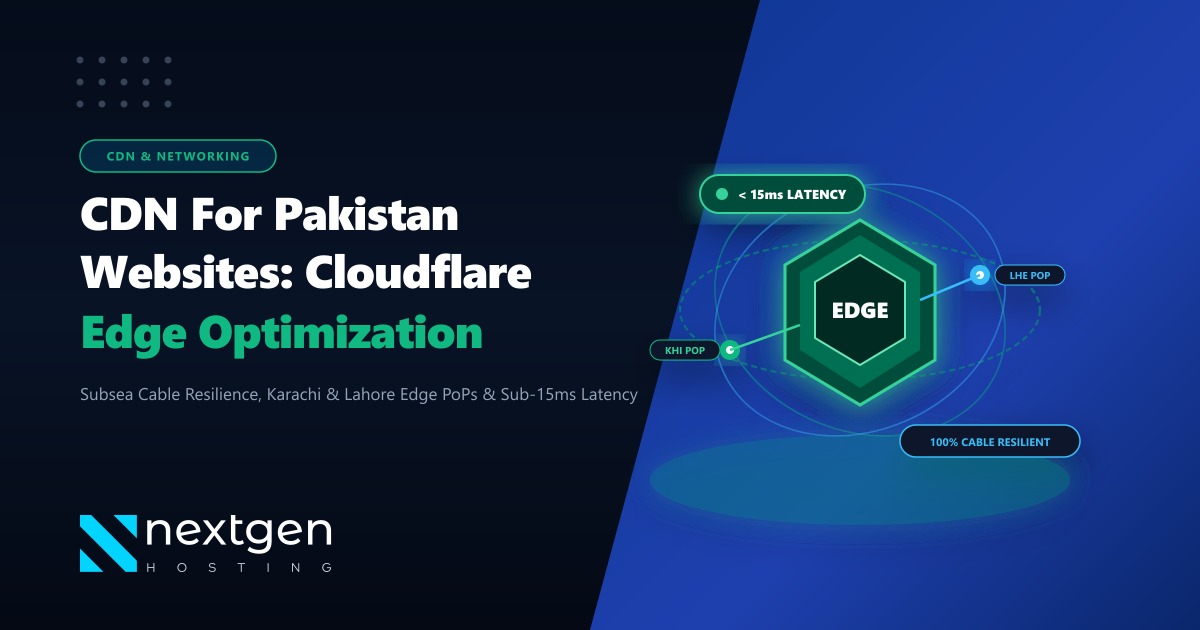
By caching static and dynamic web assets across Anycast edge points of presence (PoPs) in Karachi and Lahore, a modern CDN delivers up to 85% of your web traffic locally, completely immune to international subsea cable disruptions.
Here is how to calibrate Cloudflare and modern Anycast CDNs for maximum performance and fault tolerance in Pakistan.
Core CDN Best Practices for Pakistan
- Leverage Domestic Anycast PoPs: Cloudflare operates edge data centers in Karachi (KHI) and Lahore (LHE). Domestic requests served from these PoPs resolve in under
15 millisecondsover local ISP peering exchanges. - Subsea Cable Isolation: Edge-caching HTML, CSS, JavaScript, and WebP media ensures that when international submarine cables are severed, your Pakistani visitors experience zero degradation in website loading speeds.
- Activate Automatic Platform Optimization (APO): Bypasses origin server round-trips for WordPress sites by serving complete HTML pages directly from the edge cache using Cloudflare Workers.
- Tiered Caching & Origin Shields: Direct all regional cache misses to a single consolidated regional data center, slashing origin server bandwidth load by up to
90%.
1. How Pakistan’s Subsea Cable Architecture Impacts Website Latency
Pakistan connects to the global internet via seven primary submarine cable systems landing in Karachi and Gwadar:
[ Pakistani Domestic User (Karachi / Lahore / Islamabad) ]
                         |
           (PTCL / Nayatel / StormFiber)
                         |
        +----------------+----------------+
        |                                 |
[ Domestic Anycast PoP ]       [ Subsea Cable Transit ]
  (Karachi / Lahore Edge)        (SMW4 / SMW5 / AAE-1 / PEACE)
        |                                 |
   Latency: <15ms                  Latency: 160ms - 240ms
   Zero Packet Loss                Prone to Cable Cuts & Jitter
When your origin web server is located in Europe or the United States without a localized CDN:
- Every CSS file, JavaScript bundle, and image must cross 7,000+ kilometers of fiber optic cables.
- A single page requesting 65 assets requires dozens of TCP handshakes, causing total load times to exceed 4.5 seconds.
- During cable maintenance or cuts, your website becomes completely unreachable for domestic users.
By contrast, when your assets are cached at the edge, domestic requests never leave Pakistani territory.
2. Cloudflare Configuration Rules for Pakistan
To ensure domestic Pakistani traffic is routed through local edge nodes with maximum cache hit ratios, implement these production Page Rules and Cache Rules:
Rule 1: Edge Cache Dynamic HTML (WordPress & E-Commerce)
Under Caching > Cache Rules, create an edge rule for public content:
- Field:
URI Pathdoes not contain/wp-admin/,/cart/,/checkout/, or/my-account/ - Cache Eligibility: Cache Everything
- Edge Cache TTL: 1 month (Respect Origin Headers)
- Browser Cache TTL: 4 hours
Rule 2: Tiered Caching & Argo Smart Routing
Enable Tiered Cache in your Cloudflare dashboard. Instead of hundreds of global edge PoPs querying your origin server on cache misses, edge nodes fetch from Cloudflare’s regional hub, shielding your server from resource spikes.
# Verify whether your website is serving from Pakistani PoPs via curl
curl -I -s https://yourbrand.pk | grep -E "cf-cache-status|cf-ray"

# Expected Output:
# cf-cache-status: HIT
# cf-ray: 8df23a5b891e4a10-KHI  <-- KHI confirms serving from Karachi Edge!
3. Optimizing Core Web Vitals for Low-Bandwidth 4G Networks
While metropolitan broadband in Pakistan offers 50Mbps–100Mbps connections, a massive portion of mobile traffic relies on congested 4G LTE connections in tier-2 and tier-3 cities (Faisalabad, Multan, Gujranwala, Peshawar).
Implement these CDN transformations to accelerate mobile user experiences:
| Optimization Technique | Implementation | Impact on Mobile Performance |
|---|---|---|
| Polish / WebP Compression | Cloudflare Speed > Optimization | Reduces image payload sizes by 65% to 80% without visible loss in quality. |
| Early Hints (103) | Cloudflare Speed > Optimization | Preloads critical CSS and font files before the main HTML response finishes generating. |
| Brotli Compression | Cloudflare Speed > Optimization | Up to 20% better compression ratio compared to legacy Gzip. |
| HTTP/3 (QUIC) | Cloudflare Network Settings | Eliminates head-of-line blocking on unstable mobile connections with packet loss. |
4. Origin Infrastructure: Why CDNs Still Require High-Performance Hardware
A common misconception among web developers is that using a CDN allows you to run on cheap, sluggish origin hosting.
In reality, dynamic transactions—such as WooCommerce cart updates, database searches, user logins, and API webhooks—cannot be cached at the edge. When dynamic requests pass through the CDN, origin server processing speed dictates total latency.
If your origin server takes 1.5 seconds to compute a database query, your user still waits 1.5 seconds, completely negating the benefit of the CDN.
For platforms requiring enterprise computing power to process dynamic database loads, deploying on global bare-metal Dedicated Servers provides high-clock AMD EPYC processors and unmetered network uplinks.
Furthermore, for Pakistani enterprises subject to domestic data localization policies or handling domestic financial transactions, pairing Cloudflare with Dedicated Servers in Pakistan guarantees sub-10ms origin round-trips over direct PKIX fiber interconnections and local PKR billing.
5. Security at the Edge: Mitigating Layer 7 Attacks
In addition to caching, your CDN serves as your primary perimeter defense. Automated scraping bots, brute-force login attempts, and Layer 7 HTTP floods can overwhelm your server before you even notice.
- Enable Bot Fight Mode: Instantly drops automated headless browser scrapers and credential stuffing scripts.
- Block Malicious Country Subnets: If your business operates strictly within Pakistan, challenge or block high-risk international ASNs associated with bulletproof hosting botnets.
- WAF Rate Limiting: Enforce strict thresholds on
wp-login.php(e.g., maximum 5 requests per minute per IP) to neutralize dictionary attacks.
Accelerate Your Pakistan Website with Ultra-Fast Hosting
Combine high-speed Anycast CDN edge routing with pure NVMe server infrastructure. Nextgen Hosting delivers 99.9% uptime SLAs, free Cloudflare integration, and 24/7 technical support in Pakistan.
