
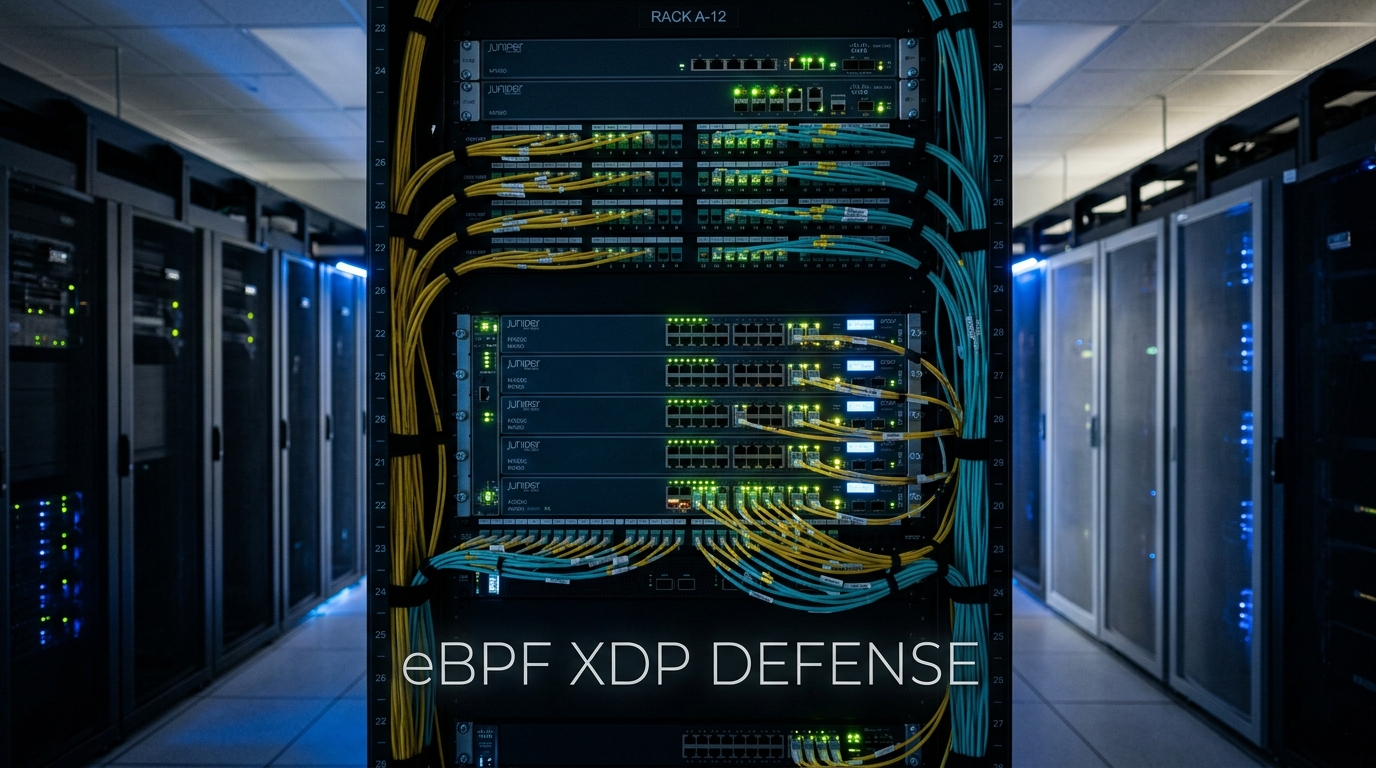
When volumetric Distributed Denial-of-Service (DDoS) attacks strike hosting providers, fintech gateways, or game servers in Pakistan, standard Linux firewall tools like iptables, nftables, and UFW quickly collapse. The fundamental bottleneck is architectural: traditional firewalls process packets inside the kernel network stack after the Operating System allocates an sk_buff (socket buffer) data structure and issues an interrupt (softirq). Under a flood of 5 to 10 million packets per second (Mpps), CPU cores become 100% saturated with kernel memory allocations, resulting in packet drop and complete server unresponsiveness.
eXpress Data Path (XDP) powered by extended Berkeley Packet Filter (eBPF) solves this fundamentally. XDP programs execute directly inside the Network Interface Card (NIC) driver layer before the kernel allocates any socket buffers. Malicious packets are inspected and dropped (XDP_DROP) at line rate, allowing a single dedicated server core to filter over 14 million packets per second without touching user space or degrading legitimate traffic.
In this masterclass, we explore the internal architecture of XDP, author a custom C-based eBPF DDoS mitigation filter, compile it via LLVM/Clang, and attach it to production NIC drivers on Dedicated Servers and Dedicated Servers in Pakistan.
1. Network Stack Architecture: iptables vs. eBPF / XDP
To understand why XDP achieves line-rate throughput, consider how an incoming Ethernet frame traverses the Linux kernel:
+--------------------------------------------------------------------------+
|                     LINUX PACKET PROCESSING PIPELINE                     |
+--------------------------------------------------------------------------+
| Incoming Network Frame: 10Gbps Fiber NIC (Mellanox ConnectX / Intel E810) |
|        │                                                                 |
|        ▼ (DMA Transfer to Ring Buffer)                                   |
| [ XDP Hook (NIC Driver Layer) ] ──► eBPF Program Execution               |
|        │                                                                 |
|        ├──► Verdict: XDP_DROP ──► Packet Dropped at Wire Speed (Zero RAM)|
|        │                                                                 |
|        ▼ (Verdict: XDP_PASS - Legitimate Client Traffic)                 |
| [ Kernel Allocates sk_buff ]                                             |
|        │                                                                 |
|        ▼ (Traditional Linux Network Stack)                               |
| [ Netfilter / iptables / nftables ]                                      |
|        │                                                                 |
|        ▼                                                                 |
| [ TCP/IP Stack & Sockets ] ──► User Space Application (Nginx / Database) |
+--------------------------------------------------------------------------+
Performance Matrix: Filtering Under Volumetric SYN / UDP Floods
| Metric / Mechanism | iptables / Netfilter | nftables | eBPF / XDP Driver Mode |
|---|---|---|---|
| Max Filtering Rate (1 Core) | ~1.2 Mpps | ~2.1 Mpps | 14.8+ Mpps (Line Rate) |
| Memory Allocation | Yes (sk_buff per packet) |
Yes (sk_buff per packet) |
None (Zero allocation) |
| CPU Saturation Point | ~800k pps | ~1.5M pps | 10M+ pps |
| Hardware Offload Support | No | No | Yes (SmartNICs / Netronome) |
2. Developing an eBPF DDoS Filter in C
Let us write a high-performance eBPF filter in C that inspects incoming packets, validates TCP SYN flags and UDP packet lengths, and checks an in-memory BPF Hash Map of blocked IP subnets to drop malicious traffic instantly.
Create xdp_ddos_filter.c:
// xdp_ddos_filter.c
#include <linux/bpf.h>
#include <linux/if_ether.h>
#include <linux/ip.h>
#include <linux/tcp.h>
#include <linux/udp.h>
#include <bpf/bpf_helpers.h>
#include <bpf/bpf_endian.h>

// Define a BPF map to store blocked IPv4 addresses dynamically
struct {
    __uint(type, BPF_MAP_TYPE_HASH);
    __uint(max_entries, 100000);
    __type(key, __u32);   // IPv4 Address (Network Byte Order)
    __type(value, __u64); // Packet drop counter
} blacklist_map SEC(".maps");

SEC("xdp")
int xdp_drop_ddos(struct xdp_md *ctx) {
    void *data_end = (void *)(long)ctx->data_end;
    void *data = (void *)(long)ctx->data;

    // Parse Ethernet Header
    struct ethhdr *eth = data;
    if ((void *)(eth + 1) > data_end)
        return XDP_PASS;

    // Only process IPv4 packets
    if (eth->h_proto != bpf_htons(ETH_P_IP))
        return XDP_PASS;

    // Parse IPv4 Header
    struct iphdr *ip = (void *)(eth + 1);
    if ((void *)(ip + 1) > data_end)
        return XDP_PASS;

    // Lookup Source IP in Blacklist Hash Map
    __u32 src_ip = ip->saddr;
    __u64 *drops = bpf_map_lookup_elem(&blacklist_map, &src_ip);
    if (drops) {
        // Increment drop telemetry and drop immediately at wire speed
        __sync_fetch_and_add(drops, 1);
        return XDP_DROP;
    }

    // Mitigate NTP / DNS Amplification (UDP packets to high ports with large payloads)
    if (ip->protocol == IPPROTO_UDP) {
        struct udphdr *udp = (void *)(ip + 1);
        if ((void *)(udp + 1) > data_end)
            return XDP_PASS;

        // Drop fragmented reflection attacks exceeding standard MTU thresholds
        if (bpf_ntohs(udp->len) > 1400 && (udp->source == bpf_htons(53) || udp->source == bpf_htons(123))) {
            return XDP_DROP;
        }
    }

    // Pass all legitimate traffic up to the Linux kernel network stack
    return XDP_PASS;
}

char _license[] SEC("license") = "GPL";
3. Compiling & Loading the XDP Program via Clang & bpftool
Step 1: Install Compilation Toolchain
# Ubuntu / Debian
sudo apt-get update
sudo apt-get install -y clang llvm libbpf-dev linux-tools-$(uname -r)

# AlmaLinux / Rocky Linux
sudo dnf install -y clang llvm libbpf-devel bpftool kernel-devel
Step 2: Compile to eBPF Bytecode
clang -O2 -g -target bpf -c xdp_ddos_filter.c -o xdp_ddos_filter.oStep 3: Attach the XDP Program to Network Interface
Identify your primary network interface (e.g., eth0 or enp3s0):
ip link showAttach the compiled program in native driver mode (fastest):
# Attach in native driver mode (xdpdrv)
sudo ip link set dev eth0 xdpdrv obj xdp_ddos_filter.o sec xdp

# Verify that the XDP program is active on the interface
ip link show dev eth0
Expected output:
2: eth0: <BROADCAST,MULTICAST,UP,LOWER_UP> mtu 1500 xdp/id:48 ...4. Dynamically Injecting Blocked IPs via bpftool
Because eBPF maps reside in kernel memory, an external monitoring script or DDoS detection daemon can inject abusive IP addresses in real time with zero disruption:
# Pin the map to bpffs for user-space access
sudo bpftool map pin name blacklist_map /sys/fs/bpf/blacklist_map

# Add an abusive IP (e.g. 198.51.100.25 -> 0xC6336419) to the blacklist map
sudo bpftool map update pinned /sys/fs/bpf/blacklist_map key hex 19 64 33 c6 value hex 00 00 00 00 00 00 00 00

# View drop statistics across blocked addresses
sudo bpftool map dump pinned /sys/fs/bpf/blacklist_map
The moment an IP is entered into the map, subsequent packets are discarded in sub-microsecond time directly in the NIC ring buffer.
5. Architectural Synergy: High-Bandwidth Dedicated Infrastructure
XDP and eBPF provide superhuman packet filtering capabilities, but hardware constraints remain supreme. Virtual private servers running on shared hypervisors share physical NIC ring buffers and virtual switch queues. For enterprise environments requiring true 10Gbps/40Gbps unthrottled line-rate capacity and dedicated NIC PCIe lanes, bare-metal hardware is mandatory.
Explore our related network and systems guides:
- Linux VPS Swap Tuning & zRAM Optimization
- Nginx Reverse Proxy Caching & Microcaching
- ModSecurity OWASP CRS Tuning on cPanel
For enterprise fintech, gaming platforms, and mission-critical networks demanding line-rate hardware filtering, deploy on high-throughput Dedicated Servers in Pakistan.
Deploy Wire-Speed Dedicated Servers in Pakistan
Protect your digital infrastructure against volumetric floods. High-bandwidth 10Gbps uplinks, dedicated hardware PCIe lanes, and zero hypervisor virtualization overhead.
