
Many digital marketers, content creators, and SEO professionals spend thousands of hours conducting keyword research, writing exhaustive 3,000-word guides, and acquiring authoritative editorial backlinks.
Yet, despite flawless on-page optimization, their search rankings remain inexplicably stuck on page two or three of Google search results.
In a majority of these cases, the root culprit is not content quality or backlink volume—it is underlying server infrastructure.
Google’s search ranking algorithms are fundamentally engineered to deliver fast, seamless, and secure user experiences. If your web hosting provider introduces server-side latency, frequent intermittent downtime, or unoptimized database response times, search algorithms will systematically suppress your organic rankings.
Here is the definitive technical breakdown of how your web hosting environment directly dictates your SEO performance in 2026.
1. Time to First Byte (TTFB) and Core Web Vitals (LCP)
Time to First Byte (TTFB) measures the duration from the moment a browser or search engine crawler requests a URL to the moment the first byte of data arrives from your web server:
- Google considers a TTFB under 200 milliseconds good, while a TTFB exceeding 600ms is classified as “Poor.”
- TTFB is the bedrock of Largest Contentful Paint (LCP): if your server takes 800ms just to begin delivering HTML, achieving an LCP under the mandatory 2.5-second threshold is mathematically impossible.
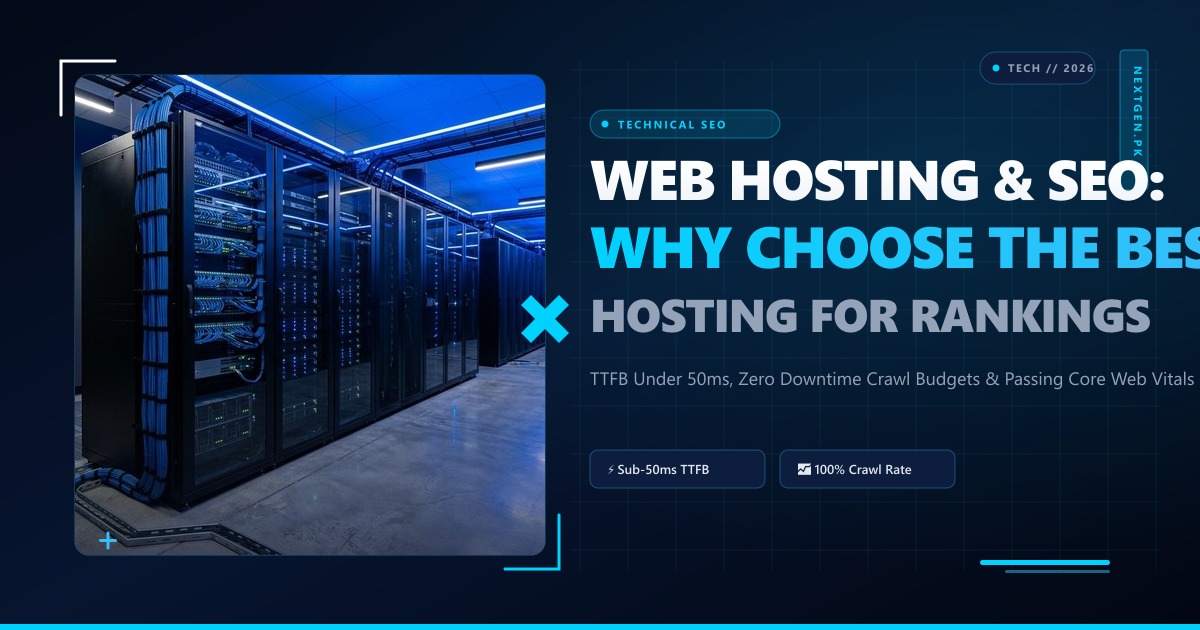
- Quality hosts utilizing enterprise PCIe Gen4/Gen5 NVMe SSDs and LiteSpeed Web Server compress dynamic TTFB to under 50 milliseconds, instantly lifting Core Web Vitals scores across your entire domain.
┌────────────────────────────────────────────────────────┐
│             THE TTFB CASCADE TO LCP & RANKINGS         │
├────────────────────┬───────────────────────────────────┤
│ BUDGET HOST (HDD)  │ 850ms TTFB ➔ 4.2s LCP ➔ SEO PENALTY│
├────────────────────┼───────────────────────────────────┤
│ NEXTGEN NVME HOST  │ 45ms TTFB  ➔ 1.1s LCP ➔ GREEN PASS│
└────────────────────┴───────────────────────────────────┘
2. Crawl Budget Efficiency and Indexation Velocity
Search engines allocate a finite crawl budget to every website based on domain authority and server responsiveness:
- When Googlebot crawls your site, it monitors how quickly your web server responds.
- If your server exhibits slow response times, high CPU loads, or returns sporadic
503 Service Unavailableerrors, Googlebot intentionally reduces its crawl frequency to avoid crashing your site. - High-performance hosting allows search engine spiders to crawl and index hundreds of newly published pages in seconds, accelerating topical authority acquisition.
3. Uptime Reliability and 5xx Server Drop-Offs
Uptime is not just a customer convenience; it is a critical ranking factor:
- If Googlebot attempts to crawl your website during an unexpected outage and encounters a
500 Internal Server Erroror connection timeout, it schedules a re-crawl. - If the server remains inaccessible over multiple consecutive crawl passes, Google removes your URLs from search indexes to prevent sending searchers to dead links.
- Demanding a legitimate 99.9% or 99.99% Service Level Agreement (SLA) backed by redundant hardware and automatic failover is vital to protect organic traffic equity.
4. Geographic Server Proximity and Local Peering
The physical distance between your web server and your prospective visitors introduces physical fiber-optic transit latency:
- If your core audience is in Pakistan, but your hosting server is located in Dallas or Frankfurt, every web request must travel thousands of kilometers, incurring an unavoidable 180ms to 280ms ping penalty.
- Hosting locally on Tier-3 datacenters directly connected to the Pakistan Internet Exchange (PkIX) slashes domestic network latency to under 10ms, signaling supreme geographic relevance to localized search algorithms.
5. Scaling to Dedicated Hardware for Enterprise SEO Dominance
For high-volume e-commerce catalogs, news agencies, and corporate platforms containing tens of thousands of indexed URLs, shared hosting will inevitably constrain search performance.
- Eliminate Resource Throttling: Scale your platform onto high-performance bare-metal Dedicated Servers, ensuring 100% dedicated hardware silicon, hardware RAID arrays, and unmetered gigabit ports for lightning-fast crawler processing.
- Dominate Local Search in Pakistan: For organizations targeting the Pakistani market, deploying on Dedicated Servers in Pakistan guarantees sub-10ms domestic ping times, total compliance with State Bank of Pakistan (SBP) data residency mandates, and permanent immunity to international submarine cable cuts.
Turbocharge Your Google Rankings Today
Achieve sub-50ms TTFB and perfect Core Web Vitals. Power your SEO strategy with pure NVMe storage, LiteSpeed caching, and 99.9% uptime from Nextgen Hosting.
