
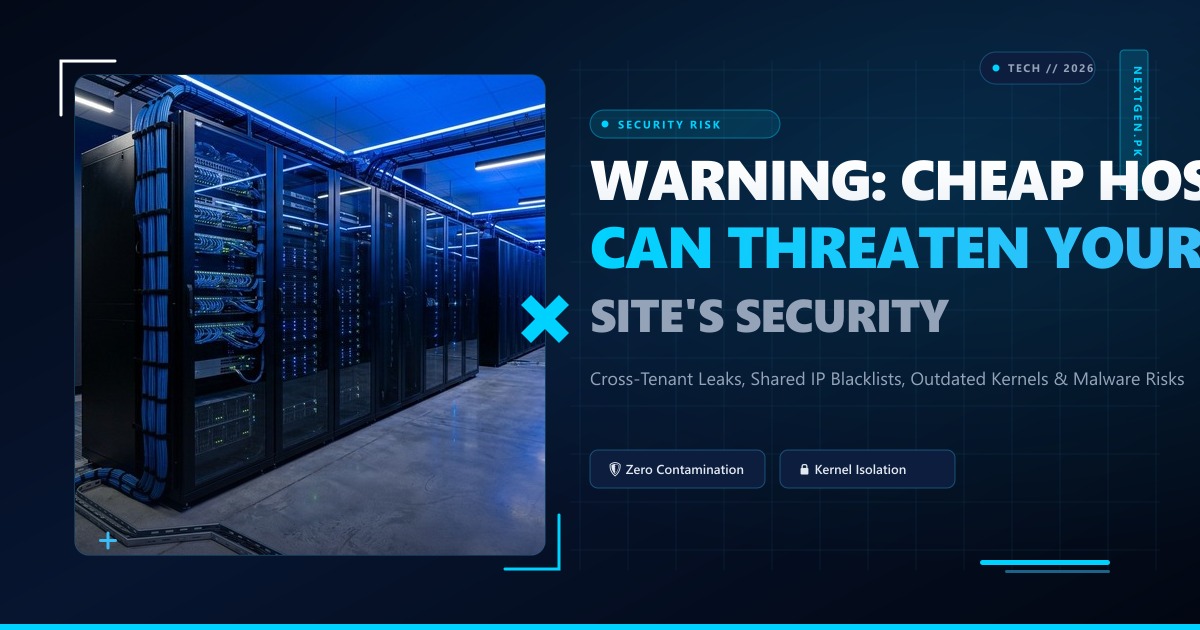
When launching a new business or web project, selecting a hosting plan based purely on the lowest price tag is an alluring temptation. Commercials promising “unlimited hosting for $1.50 per month” dominate search ads.
However, in modern enterprise architecture, there is no free lunch in physical compute infrastructure.
When hosting companies offer servers at commodity prices, they balance their profit margins through hyper-density overselling—packing thousands of disparate customer sites onto a single, overburdened physical bare-metal chassis with outdated Linux kernels and stripped-down security isolation.
Here is the technical reality of how cheap budget hosting threatens your website’s security, reputation, and revenue in 2026.
1. Cross-Tenant Contamination and Inadequate Chroot Isolation
In a quality hosting environment, each user account runs inside an isolated virtualized kernel container (such as CloudLinux CageFS or dedicated hypervisor cgroups), strictly preventing users from viewing or interacting with other directories on the filesystem.
On budget shared hosts, multi-tenancy is frequently poorly isolated:
- Symlink Exploits: If an attacker compromises a vulnerable WordPress plugin on a neighboring tenant’s website on the same server, they can execute symlink bypasses to traverse the root file tree (
/home/), inspecting thewp-config.phpdatabase credentials of hundreds of adjacent websites. - Shared Temp Directories: Shared
/tmpand/var/tmpdirectories without strict execution restrictions (noexec, nosuid) allow malicious cron scripts to execute arbitrary rootkit payloads across accounts.
┌────────────────────────────────────────────────────────┐
│             BUDGET MULTI-TENANCY THREAT MODEL          │
├────────────────────────────────────────────────────────┤
│ Compromised Neighbor Site (Vulnerable Plugin)          │
│                       │                                │
│                       ▼ (Traverses Filesystem)         │
│ Unrestricted /tmp or /home Root Boundary               │
│                       │                                │
│                       ▼ (Reads Configurations)         │
│ YOUR Website Database Credentials Compromised          │
└────────────────────────────────────────────────────────┘
2. Dirty Shared IP Addresses and Domain Reputation Poisoning
When you purchase budget shared hosting, your website shares a single outward-facing public IPv4 address with 500 to 2,000 other websites.
If just one of those neighboring accounts gets infected by automated botnets sending outbound phishing campaigns, crypto scams, or spam emails:
- Major reputation networks (Spamhaus, SURBL, Barracuda) blacklist the entire IP address.
- Your critical transactional emails (order confirmations, password resets, client invoices) get rejected by Gmail, Outlook, and corporate mail exchange servers.
- Search engines may flag the shared IP as associated with malicious networks, triggering security interstitial warnings in Google Chrome.
3. Outdated Kernels and Neglected Software Stacks
Enterprise hosting companies invest heavily in live kernel patching (KernelCare), proactive zero-day vulnerability scanning, and real-time Web Application Firewalls (ModSecurity with OWASP CRS).
Budget hosts cut operating costs by:
- Delaying operating system and hypervisor security patches to avoid service restart overhead.
- Running outdated PHP runtimes that have reached official End-of-Life (EOL), leaving your code vulnerable to remote code execution (RCE) flaws.
- Omitting real-time behavioral malware scanners, allowing persistent backdoors to incubate undetected for months.
4. Noisy Neighbor Denial of Service (DoS)
Budget hosts rarely enforce strict per-tenant CloudLinux Lightweight Virtual Environment (LVE) limits on CPU, physical memory, and I/O operations per second (IOPS).
When an adjacent website undergoes a massive viral traffic surge or suffers an incoming Layer-7 HTTP flood:
- Apache/Nginx worker pools exhaust server sockets.
- The Linux kernel OOM (Out-of-Memory) killer arbitrarily terminates MySQL/MariaDB database daemons.
- Your site collapses with persistent
503 Service Unavailableor500 Internal Server Errorscreens, destroying user trust and Google organic crawl budgets.
5. Non-Existent or Ransom-Gated Backup Systems
Cheap web hosts routinely advertise “automated backups” in their marketing blurbs, but burial in their Terms of Service reveals catastrophic caveats:
- Backups are often stored on the exact same physical drive array as the live site, meaning a drive failure annihilates both production data and snapshots simultaneously.
- Accounts that exceed arbitrary inode thresholds (e.g., 50,000 files) are silently dropped from backup schedules without email notification.
- Restoring an existing snapshot incurs punitive “manual administrative recovery fees” of $50 to $100.
6. How to Build an Unshakeable Security Posture
To safeguard your digital business, customer data, and brand integrity, transition to infrastructure engineered with strict hardware isolation:
- Isolate Mission-Critical Workloads: Move beyond shared tenancy into containerized cloud instances or bare-metal Dedicated Servers, where physical CPU cores, RAM modules, and pure PCIe NVMe disk arrays belong exclusively to your application with zero shared tenant risk.
- Ensure Domestic Compliance & Low Latency: For Pakistani enterprises, banks, and growing online stores, deploying on Dedicated Servers in Pakistan guarantees strict SBP and PTA data residency compliance, isolated IP blocks, and ultra-fast sub-10ms domestic routing that shields your network from international transit disruptions.
Deploy Isolated, Hardened Infrastructure
Protect your enterprise from noisy neighbors and shared tenant risks. Experience pure NVMe performance, hardware DDoS mitigation, and 24/7 engineering monitoring with Nextgen Hosting.
