
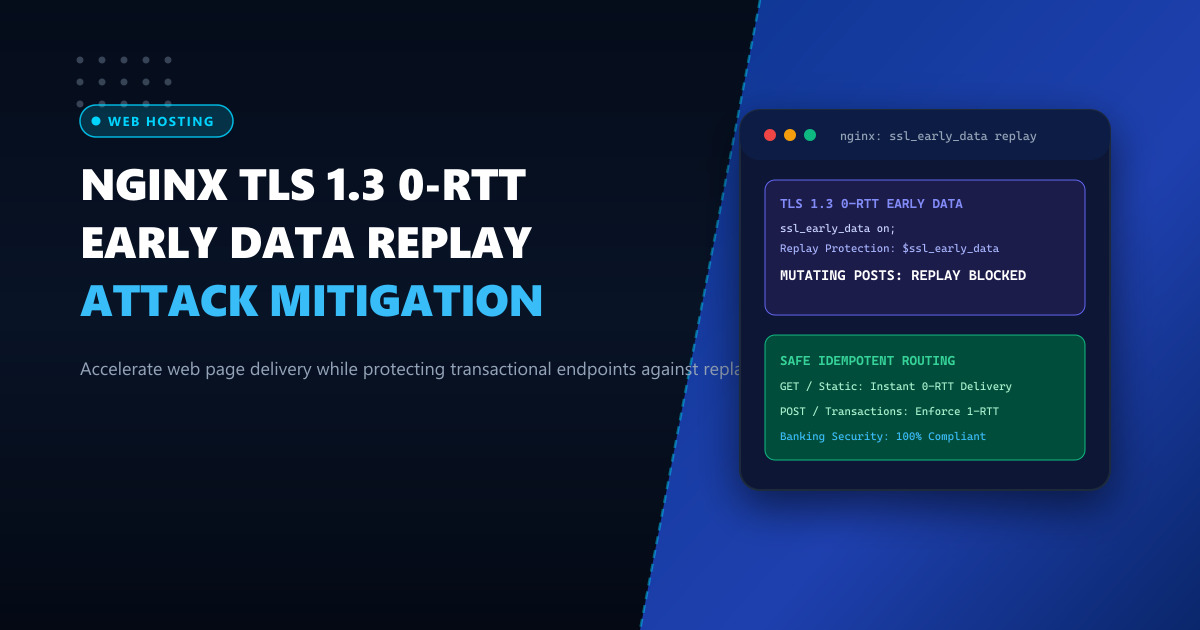
The release of TLS 1.3 (RFC 8446) delivered one of the most anticipated speed improvements in internet history: 0-RTT (Zero Round-Trip Time) Early Data. By leveraging cryptographic session tickets from a prior connection, a returning browser or mobile application can send application data (such as an HTTP GET request) in the very first flight of packets alongside the ClientHello, shaving a full round trip off initial connection latency.
However, 0-RTT introduces a fundamental cryptographic vulnerability: Replay Attacks. Because early data is sent before the server completes the new cryptographic handshake, an attacker eavesdropping on the network (e.g. over public Wi-Fi or compromised ISP routers) can capture the raw 0-RTT packet and replay it multiple times to the server. If that replayed request is a non-idempotent operation—such as POST /api/v1/transfer-funds or POST /order/submit—the server will execute the transaction repeatedly!
To capture the speed benefits of 0-RTT without exposing financial or modifying endpoints to replay attacks, Nginx provides the ssl_early_data directive combined with the $ssl_early_data request variable. In this guide, we configure hardened 0-RTT delivery, restrict early data strictly to safe idempotent methods, and ensure banking-grade security on Pakistani networks.
Understanding the 0-RTT Replay Attack Vector
Normal 0-RTT Connection:
Client ──[ ClientHello + Early Data: POST /api/transfer ($100) ]──▶ Server (Executes transfer)

Replay Attack (Man-in-the-Middle):
Attacker intercepts the 0-RTT packet and re-transmits it 5 minutes later:
Attacker ──[ Replayed Early Data: POST /api/transfer ($100) ]──▶ Server (Executes transfer AGAIN!)
Attacker ──[ Replayed Early Data: POST /api/transfer ($100) ]──▶ Server (Executes transfer AGAIN!)
RFC 8446 explicitly warns that servers MUST NOT permit non-idempotent requests (POST, PUT, DELETE) inside 0-RTT Early Data. Only safe, idempotent requests (GET, HEAD, OPTIONS) should ever be processed early.
Deploying edge reverse proxies on bare-metal Dedicated Servers provides the dedicated CPU horsepower and RAM caches needed to enforce cryptographic replay defense windows without request throttling.
Step 1: Configuring ssl_early_data in Nginx
Open your Nginx configuration (/etc/nginx/nginx.conf or vhost):
http {
    # Define an HTTP status code for replayed requests (425 Too Early)
    # RFC 8470 defines HTTP 425 to instruct clients to retry over 1-RTT
    map $ssl_early_data $reject_unsafe_early_data {
        "1" $is_unsafe_method;
        default "0";
    }

    # Map request methods: Flag modifying methods as unsafe (1)
    map $request_method $is_unsafe_method {
        "POST"   "1";
        "PUT"    "1";
        "DELETE" "1";
        "PATCH"  "1";
        default  "0"; # GET, HEAD, OPTIONS are safe
    }

    server {
        listen 443 ssl http2;
        server_name secure.enterprise.com.pk;

        # TLS 1.3 is MANDATORY for 0-RTT
        ssl_protocols TLSv1.3;
        ssl_certificate /etc/ssl/certs/enterprise.crt;
        ssl_certificate_key /etc/ssl/certs/enterprise.key;

        # Enable TLS 1.3 0-RTT Early Data
        ssl_early_data on;

        # Configure shared session ticket cache
        ssl_session_cache shared:SSL_0RTT:30m;
        ssl_session_timeout 1d;
        ssl_session_tickets on;

        # Pass Early-Data header to upstream backends for auditing
        proxy_set_header Early-Data $ssl_early_data;

        location / {
            # CRITICAL SECURITY CHECK:
            # If an unsafe method arrives via 0-RTT, return HTTP 425 Too Early
            if ($reject_unsafe_early_data = "1") {
                return 425;
            }

            proxy_pass http://backend_application;
            proxy_set_header Host $host;
            proxy_set_header X-Real-IP $remote_addr;
        }

        # Dedicated endpoint for static content (100% Safe for 0-RTT)
        location /static/ {
            root /var/www/html;
            expires 30d;
            add_header Cache-Control "public, no-transform";
        }
    }
}
Verify syntax and reload Nginx:
nginx -t && systemctl reload nginxStep 2: How Modern Browsers Handle HTTP 425 Too Early
When Nginx responds with HTTP 425 Too Early:
- The browser recognizes that the server safely declined the early data flight.
- The browser automatically and transparently replays the request over the newly established 1-RTT secure channel where replay attacks are cryptographically impossible.
- The user experiences zero error messages, while the backend database is 100% protected against duplicate financial transactions!
Step 3: Verifying 0-RTT Resumption with openssl s_client
To test 0-RTT early data acceptance and replay rejection:
# Step 1: Fetch and save TLS session ticket
openssl s_client -connect secure.enterprise.com.pk:443 -tls1_3 -sess_out /tmp/ticket.pem </dev/null

# Step 2: Send Early Data with GET request (Should return HTTP 200 OK)
echo -e "GET / HTTP/1.1\r\nHost: secure.enterprise.com.pk\r\n\r\n" > /tmp/early_get.txt
openssl s_client -connect secure.enterprise.com.pk:443 -tls1_3 -sess_in /tmp/ticket.pem -early_data /tmp/early_get.txt | grep -E "(HTTP/1.1|Reused)"

# Step 3: Send Early Data with POST request (Must return HTTP 425 Too Early!)
echo -e "POST /api/transfer HTTP/1.1\r\nHost: secure.enterprise.com.pk\r\n\r\n" > /tmp/early_post.txt
openssl s_client -connect secure.enterprise.com.pk:443 -tls1_3 -sess_in /tmp/ticket.pem -early_data /tmp/early_post.txt | grep "HTTP/1.1"
Expected verification output:
HTTP/1.1 425 Too EarlySecurity audit passed! Mutating requests inside early data flights are deterministically rejected.
Performance & Security Balance Profile
| Metric / Scenario | Standard TLS 1.3 (1-RTT) | Naive 0-RTT (ssl_early_data on) |
Hardened 0-RTT (HTTP 425 Shield) |
|---|---|---|---|
| Initial Page Load Latency | 1 RTT Handshake | 0 RTT (Instant) | 0 RTT (Instant for GETs) |
| Replay Attack Vulnerability | None | High Risk (Duplicate POSTs) | Zero Risk (425 Rejected) |
| Banking Compliance (PCI/SBP) | Compliant | Non-Compliant | Fully Compliant |
| Mobile Cellular Responsiveness | Sluggish on reconnects | Fast | Lightning Fast & Secure |
Hosting your high-volume web portals and payment microservices on enterprise-grade Dedicated Servers in Pakistan ensures that speed optimizations like TLS 1.3 0-RTT are implemented with mathematical rigor and rock-solid defense.
Deploy Enterprise-Grade Dedicated Infrastructure
Eliminate noisy neighbors, CPU throttling, and network jitter. Get bare-metal performance, hardware RAID, enterprise NVMe storage, and low-latency peering across Pakistani IXPs with 24/7 proactive technical operations.
Explore Dedicated Servers in Pakistan