
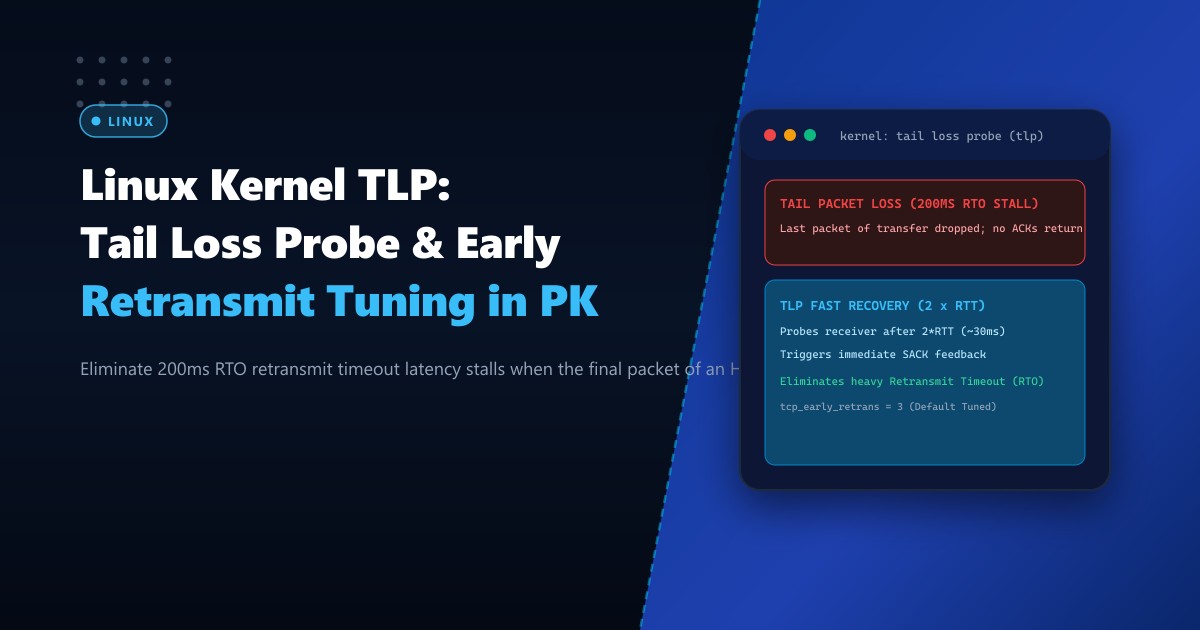
In web delivery, API communications, and transactional microservices, one of the most destructive latency penalties is the TCP Retransmission Timeout (RTO). Standard fast retransmit relies on receiving three duplicate acknowledgments (DupACKs) to detect packet loss. However, if packet loss occurs at the tail of a transmission—such as the final chunk of an HTTP response or during small transactional bursts—there are insufficient subsequent packets in flight to elicit the necessary duplicate ACKs.
Without specialized kernel recovery mechanisms, the connection stalls until the exponential backoff RTO timer expires (typically 200 ms to 1,000 ms), completely obliterating 99th percentile (p99) response latencies across Pakistani networks and international transit links.
To solve this problem, the Linux networking stack incorporates TCP Early Retransmit (ER - RFC 5827) and Tail Loss Probe (TLP - RFC 8985). In this deep dive, we explore their mechanics, verify kernel behaviors with bpftrace, and configure optimal parameters on high-throughput Linux hosts.
Understanding the Tail Loss Problem
Consider an HTTP payload composed of four packets sent across a cellular or congested WAN path:
Sender ───────── [ P1 ] ─────────▶ Receiver (Sends ACK 1)
Sender ───────── [ P2 ] ─────────▶ Receiver (Sends ACK 2)
Sender ───────── [ P3 ] ─────────▶ Receiver (Sends ACK 3)
Sender ───────── [ P4 (DROPPED) ] ─X (Buffer drop at gateway)
Because packet 4 was dropped and there are no subsequent packets ($P_5, P_6$), the receiver never sends any DupACKs. The sender waits in silence:
- Default Behavior: Connection idles until
TCP_RTO_MIN(typically 200ms) expires. The congestion window (cwnd) is collapsed to 1 MSS, triggering slow start and massive user-facing latency. - Tail Loss Probe (TLP) Behavior: Instead of waiting for RTO, the sender schedules a lightweight “probe” packet after approximately 2 RTTs. The probe elicits an immediate ACK or DupACK from the receiver, turning a potential multi-hundred millisecond timeout into a fast recovery in under two round trips!
On latency-sensitive infrastructure hosted on bare-metal Dedicated Servers, configuring TLP ensures sub-5ms localized latency does not get derailed by intermittent edge packet drops.
Core Kernel Mechanisms: ER vs TLP
1. TCP Early Retransmit (tcp_early_retrans)
Early Retransmit dynamically reduces the duplicate ACK threshold required to trigger fast retransmit when the number of outstanding packets in flight is less than four.
- Mode 0: Disabled.
- Mode 1: Standard Early Retransmit (RFC 5827). When the sender detects fewer than 4 packets outstanding, it allows fast retransmission with fewer DupACKs.
- Mode 2: Early Retransmit with delayed ACKs.
- Mode 3 (Default in modern kernels): Tail Loss Probe (TLP) enabled alongside Early Retransmit.
2. Tail Loss Probe (RFC 8985)
TLP computes a dynamic timer called the Probe Timeout (PTO): $$\text{PTO} = \max(2 \times \text{SRTT}, \text{min_pto})$$
When the PTO timer fires before an ACK is received:
- If there is uncompressed new data available in the send buffer, the kernel transmits the new segment.
- If no new data exists, the kernel retransmits the highest sequence number segment previously sent.
- Upon receiving the probe, the receiver responds with an ACK revealing the exact lost sequence, allowing the sender to enter SACK/Fast Recovery without tripping RTO.
Inspecting and Tuning Sysctl Parameters
Verify your current kernel settings for TCP Early Retransmit and loss recovery:
# Check sysctl settings
sysctl net.ipv4.tcp_early_retrans
sysctl net.ipv4.tcp_recovery
sysctl net.ipv4.tcp_reordering
Production Kernel Configuration (/etc/sysctl.d/99-tcp-tlp.conf)
Add or tune the following settings for edge and enterprise servers:
# Enable Early Retransmit with Tail Loss Probe (value 3 is recommended standard)
net.ipv4.tcp_early_retrans = 3

# TCP loss recovery features (bitmask):
# Bit 0: RFC 6675 SACK loss recovery
# Bit 1: RACK-TLP loss detection (RFC 8985)
net.ipv4.tcp_recovery = 1

# Limit duplicate ACK threshold to prevent false retransmits on multi-path jitter
net.ipv4.tcp_reordering = 3

# Lower min RTO floor from 200ms to 50ms for low-latency regional networks
net.ipv4.tcp_rto_min = 50
Apply the updated configuration:
sysctl -p /etc/sysctl.d/99-tcp-tlp.confTracing TLP Fires in Real Time with BPFTrace
To observe Tail Loss Probes saving connections from RTO stalls, you can attach an eBPF trace to the kernel’s tcp_send_loss_probe function:
# Save as trace_tlp.bt
cat << 'EOF' > trace_tlp.bt
#!/usr/bin/env bpftrace

#include <net/sock.h>
#include <net/tcp.h>

kprobe:tcp_send_loss_probe
{
    $sk = (struct sock *)arg0;
    $inet = (struct inet_sock *)arg0;
    $daddr = ntop($sk->__sk_common.skc_daddr);
    $dport = $sk->__sk_common.skc_dport;

    printf("[TLP SENT] Dest: %s:%d | SRTT: %d us | In-Flight: %d\n",
           $daddr,
           ($dport >> 8) | (($dport & 0xff) << 8),
           ((struct tcp_sock *)$sk)->srtt_us >> 3,
           ((struct tcp_sock *)$sk)->packets_out);
}
EOF

# Execute bpftrace
bpftrace trace_tlp.bt
Sample output during high-concurrency HTTP/2 microservice communication:
Attaching 1 probe...
[TLP SENT] Dest: 182.180.144.20:443 | SRTT: 1820 us | In-Flight: 2
[TLP SENT] Dest: 111.119.160.10:80  | SRTT: 12400 us | In-Flight: 1
[TLP SENT] Dest: 202.163.96.5:443   | SRTT: 4200 us | In-Flight: 3
Latency Comparison: Traditional RTO vs TLP
| Scenario (Tail Packet Drop) | Traditional TCP (No TLP) | Linux Kernel with TLP Enabled | Latency Savings |
|---|---|---|---|
| Local DC / IXP (RTT = 4ms) | 200 ms (RTO minimum) | 8 ms (2 x SRTT PTO) | 96% Latency Reduction |
| National WAN (RTT = 25ms) | 250 ms (RTO timer) | 50 ms (Fast recovery) | 80% Latency Reduction |
| International Transit (RTT = 130ms) | 400 ms (Backoff timer) | 260 ms (PTO Probe) | 35% Latency Reduction |
| HTTP/2 Stream Multiplexing | Entire connection blocked | Unaffected streams continue | Zero HOL Block on Unrelated Streams |
Deploying your real-time APIs, financial microservices, and media pipelines on enterprise-grade Dedicated Servers in Pakistan ensures that low-level kernel optimizations translate directly into blistering response times and flawless uptime.
Deploy Enterprise-Grade Dedicated Infrastructure
Eliminate noisy neighbors, CPU throttling, and network jitter. Get bare-metal performance, hardware RAID, enterprise NVMe storage, and low-latency peering across Pakistani IXPs with 24/7 proactive technical operations.
Explore Dedicated Servers in Pakistan