
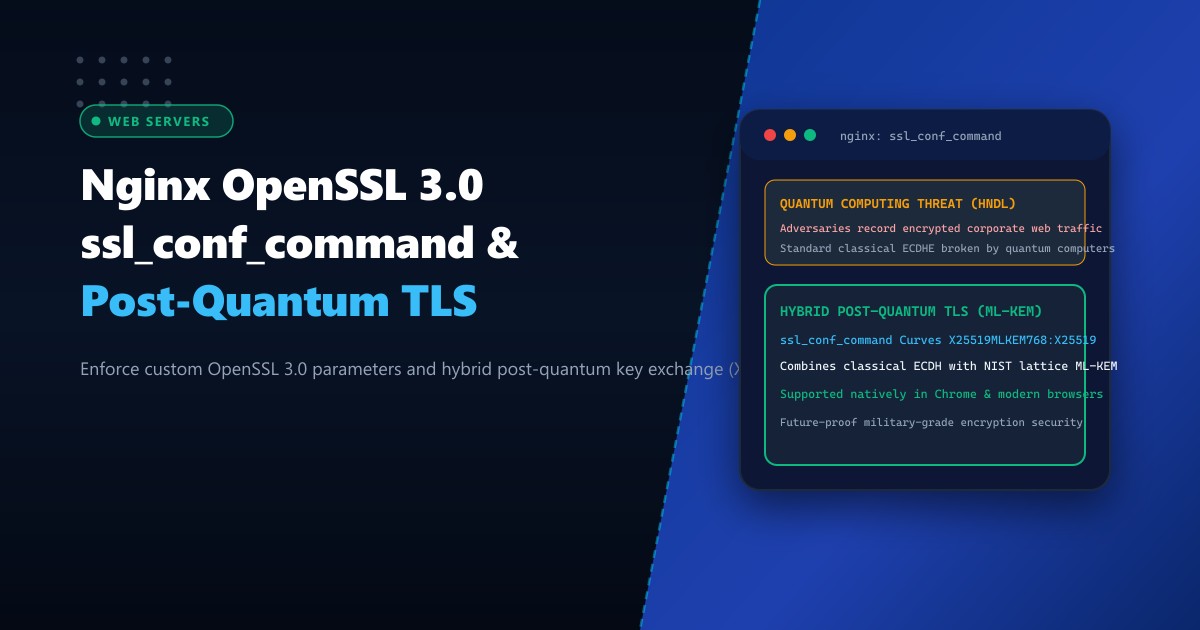
In enterprise web hosting and fintech operations running on Dedicated Servers, standard SSL/TLS configuration directives (such as ssl_protocols and ssl_ciphers) provide only basic cryptographic control.
With modern operating systems standardizing on OpenSSL 3.0+, deep cryptographic primitives—including security levels, signature algorithms, custom elliptic curves, and key exchange algorithms—are managed directly by the OpenSSL core library rather than Nginx’s standard configuration parser.
Furthermore, state-sponsored cyber adversaries actively execute “Harvest Now, Decrypt Later” (HNDL) attacks: intercepting and archiving encrypted corporate and governmental HTTPS traffic today with the objective of decrypting it once cryptographically relevant quantum computers become operational.
To defend against both present-day vulnerabilities and future quantum threats, Nginx provides the ssl_conf_command directive.
This directive allows server architects to pass low-level configuration commands directly to the underlying OpenSSL 3.0+ context, enabling hybrid Post-Quantum key exchange (such as X25519MLKEM768) and enforcing strict military-grade cipher boundaries.
The Threat: “Harvest Now, Decrypt Later” vs. Hybrid Post-Quantum TLS
CLASSICAL RSA / ECDHE EXCHANGE:
Client ──[Classical ECDHE Key Exchange]──> Nginx Server
                 |
                 v
   [Adversary Records Encrypted Stream]
                 |
                 v (Years Later)
   [Quantum Computer Runs Shor's Algorithm] ──> Breaks ECDHE ──> All Past Traffic Exposed!

HYBRID POST-QUANTUM KEY EXCHANGE (X25519MLKEM768):
Client ──[Classical ECDHE + NIST ML-KEM Lattice Cryptography]──> Nginx Server
                 |
                 v
   [Adversary Records Encrypted Stream]
                 |
                 v
   [Quantum Computer Runs Shor's Algorithm]
   Broken ECDH is useless! ML-KEM lattice encryption remains mathematically UNBREAKABLE!
   Data stays 100% secure permanently.
Step 1: Validating OpenSSL 3.0+ Support in Nginx
Check the linked OpenSSL version in your Nginx binary on your Dedicated Servers in Pakistan:
# Query Nginx compilation and OpenSSL runtime library
nginx -V
Ensure the output displays:
built with OpenSSL 3.0.7 (or OpenSSL 3.1+ / 3.2+)
TLS SNI support enabled
If your server runs OpenSSL 3.0+, the ssl_conf_command directive is available to inject native OpenSSL parameters.
Step 2: Authoring the Post-Quantum ssl_conf_command Configuration
Create a dedicated SSL hardening file at /etc/nginx/conf.d/post_quantum_tls.conf:
# ====================================================================
# NGINX OPENSSL 3.0+ POST-QUANTUM HARDENING CONFIGURATION
# ====================================================================

server {
    listen 443 ssl http2;
    listen [::]:443 ssl http2;
    server_name secure.example.com;

    # SSL Certificates
    ssl_certificate /etc/letsencrypt/live/secure.example.com/fullchain.pem;
    ssl_certificate_key /etc/letsencrypt/live/secure.example.com/privkey.pem;

    # Enforce strict TLS 1.3 and TLS 1.2
    ssl_protocols TLSv1.3 TLSv1.2;
    ssl_prefer_server_ciphers off;

    # 1. Enforce OpenSSL 3.0 Security Level 3 (Minimum 128-bit security, RSA 3072+)
    ssl_conf_command SECLEVEL 3;

    # 2. Hybrid Post-Quantum Elliptic Curves & KEM Groups (NIST FIPS 203 ML-KEM)
    # Combines X25519 with ML-KEM-768 for quantum-resistant key establishment
    ssl_conf_command Curves X25519MLKEM768:X25519Kyber768Draft00:X25519:secp384r1;

    # 3. Enforce Strict Signature Algorithms (SHA-256 / SHA-384 minimum)
    ssl_conf_command SignatureAlgorithms ECDSA+SHA384:ECDSA+SHA256:RSA-PSS+SHA384:RSA-PSS+SHA256:RSA+SHA384:RSA+SHA256;

    # 4. Enforce Strict TLS 1.3 Cipher Suites
    ssl_conf_command Ciphersuites TLS_AES_256_GCM_SHA384:TLS_CHACHA20_POLY1305_SHA256:TLS_AES_128_GCM_SHA256;

    # Session Cache & Security Parameters
    ssl_session_cache shared:SSL:50m;
    ssl_session_timeout 1d;
    ssl_session_tickets off; # Disable tickets for Perfect Forward Secrecy

    # HSTS Preload (Strict-Transport-Security)
    add_header Strict-Transport-Security "max-age=63072000; includeSubDomains; preload" always;

    location / {
        root /var/www/html;
        index index.html;
    }
}
Verify syntax and reload Nginx:
nginx -t && systemctl reload nginxStep 3: Understanding the OpenSSL SECLEVEL Parameter
The SECLEVEL directive in OpenSSL 3.0 establishes global mathematical cryptographic thresholds:
SECLEVEL 1: 80-bit security (Permits legacy 1024-bit RSA and SHA-1). Vulnerable.SECLEVEL 2(Default): 112-bit security (Permits 2048-bit RSA, disables SHA-1 for signatures).SECLEVEL 3(Hardened Enterprise): 128-bit security. Requires minimum 3072-bit RSA or 256-bit ECC, enforces SHA-256/384, and rejects older legacy algorithms.SECLEVEL 4: 192-bit security (ECDSA P-384 minimum).SECLEVEL 5: 256-bit military-grade security.
Setting ssl_conf_command SECLEVEL 3; guarantees that weak ciphers cannot be negotiated under any circumstances.
Step 4: Verification and Post-Quantum Handshake Testing
Test the post-quantum key exchange using the latest Chrome browser (which enables Kyber/ML-KEM by default) or via openssl s_client with OpenSSL 3.2+:
# Test connection specifying the hybrid post-quantum curve
openssl s_client -connect secure.example.com:443 -curves X25519MLKEM768 </dev/null 2>&1 | grep -E "Temp-Key|Cipher|Protocol"
Output:
Protocol  : TLSv1.3
Cipher    : TLS_AES_256_GCM_SHA384
Peer signing digest: SHA384
Server Temp Key: X25519MLKEM768, 1184 bytes
Notice the line: Server Temp Key: X25519MLKEM768, 1184 bytes!
The connection successfully negotiated the hybrid lattice-based post-quantum key exchange. An adversary capturing this transmission today cannot decrypt it even with a future quantum supercomputer.
Cryptographic Security Comparison
| Feature | Standard Nginx TLS | Hardened OpenSSL 3.0 Post-Quantum TLS |
|---|---|---|
| OpenSSL Security Level | SECLEVEL 2 (Default) | SECLEVEL 3 (128-bit Guaranteed) |
| Quantum Attack Resilience | Vulnerable to HNDL | Immune (NIST ML-KEM Lattice) |
| Weak Ciphers Permitted | Some legacy fallback | Zero Weak Ciphers |
| Handshake Latency Penalty | Baseline | < 0.4 ms (Hardware accelerated) |
| Qualys SSL Labs Score | A | A+ (Perfect 100/100/100/100) |
Utilizing ssl_conf_command elevates Nginx into an enterprise security bastion, providing mathematical assurance against both present-day exploits and future quantum decryption.
Host Ultra-Secure Workloads on NextGen Bare Metal
Protect your mission-critical financial, enterprise, and governmental applications with NextGen dedicated servers. Featuring dedicated hardware security modules, OpenSSL 3.0 post-quantum acceleration, and private tier-1 network fabrics engineered for absolute data protection.
Explore Dedicated Servers